Places
Piódão
Piódão, a historic schist village nestled in the Serra do Açor, in Arganil, Coimbra district: an amphitheater-like cluster of houses with a blue parish church.
- Location
- Piódão, Coimbra
- Style
- Arquitetura tradicional de xisto
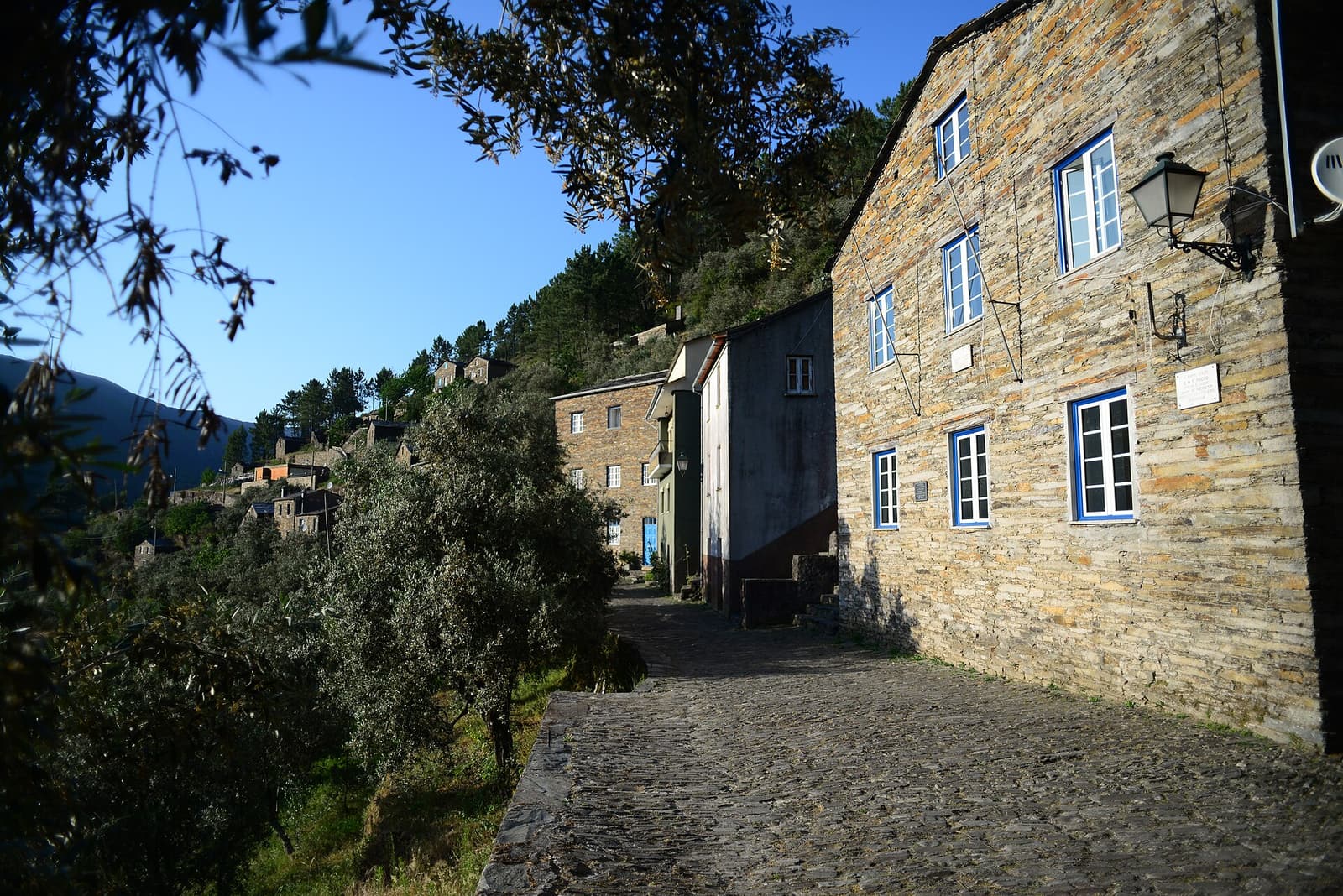
Perched on a steep slope of Serra do Açor, in the municipality of Arganil, Coimbra district, Piódão is one of Portugal’s most distinctive inland schist villages. The houses are arranged in overlapping terraces facing the Piódão stream valley, in a layout often compared to an amphitheater or a nativity scene. Against the uniformity of dark grey schist walls and slate roofs, the blue doors and windows stand out—a chromatic signature that makes this village one of the most photographed places in inland Beira.
A schist village shaped by isolation
Piódão’s construction is inseparable from the mountain’s geology. Schist, abundant in the region, was locally quarried and stacked in dry stone or bound with poor mortar, creating compact two- or three-story dwellings pressed together along narrow, winding alleys that follow the slope. Roofs covered with slate slabs and blue-painted wooden lintels complete a remarkably cohesive ensemble. This building method shares the same logic as other schist villages in Beira, where schist houses translate the subsistence economy of mountain communities into stone.
Isolation shaped the village’s history. First mentioned in 1527 in the Joanine census as a small homestead with few households, Piódão became an autonomous parish in 1676 and was incorporated into Arganil municipality in 1855. For centuries, difficult access—only recently served by a road—preserved the village from transformations that erased vernacular architecture elsewhere in the country.
What elsewhere was poverty and backwardness became heritage in Piódão: precisely this isolation kept intact a built ensemble of rare unity.
The parish church and the village heart
At the highest point stands the Church of Nossa Senhora da Conceição, dating from the early 19th century. Unlike the houses, it is whitewashed, with blue-painted stonework and pinnacles, standing out against the surrounding dark schist. Its silhouette, with a late Baroque-style façade and four pinnacles, dominates the landscape and serves as the village’s visual anchor. Around it unfolds the small square, center of community life and local pilgrimages.
Piodão was classified as a Property of Public Interest in 1978 and now belongs to the Historic Villages of Portugal network, which gathers inland Central Region settlements valued for their built heritage and community identity. This dual membership—in both the Schist Villages and Historic Villages networks—reflects simultaneous recognition of its architectural value and living memory.
Visiting and understanding
Exploring is done on foot, wandering alleys that climb and descend the stone amphitheater to viewpoints over the mountains. The village retains a small resident population, around a hundred inhabitants, and its preservation now relies on cultural tourism and careful building restoration. Visitors to the Central Region will find Piódão a natural complement to other mountain and Beira heritage sites near Coimbra and the cluster of villages dotting the Central Region.
More than a picturesque setting, Piódão is a built document: the distilled expression of inhabiting the mountains in schist stone, where landscape, materials, and architecture merge into a single gesture.
Frequently asked questions
- Where is Piódão located?
- Piódão is situated in the municipality of Arganil, Coimbra district, nestled on the southeastern slopes of Serra do Açor in Portugal's Central Region.
- Why do Piódão's houses have blue doors and windows?
- The buildings are constructed in dark grey schist, and the blue of the doors and windows reportedly resulted, according to local tradition, from being the only color available in the village's small shop; the contrast became the village's trademark image.
- Is Piódão part of Portugal's Historic Villages network?
- Yes. Piódão is part of the Historic Villages of Portugal network and has been classified as a Property of Public Interest since 1978.
Sources
Keep exploring
Heritage nearby
More places to discover from here. Approximate straight-line distances, within 50 km.