Resources
Dão Wine Route
The Dão Wine Route traverses the demarcated region of Beira Alta, land of Touriga Nacional and Encruzado, among estates and wineries, with its headquarters in Viseu.
- Location
- Viseu, Viseu
- Built
- 1995 (protocolo); 1998 (inauguração)
The Dão Wine Route is a wine tourism itinerary that organizes the cultural and viticultural offerings of one of Portugal’s most prestigious regions, often nicknamed the “Portuguese Burgundy.” Located in the heart of Beira Alta, the Demarcated Region of Dão stretches across a natural amphitheater protected by the Caramulo, Buçaco, Nave, and Estrela mountain ranges, on a plateau of granitic soils and significant thermal amplitude that lends the wines elegance, freshness, and remarkable aging potential. The Route was formalized by protocol on September 20, 1995, and inaugurated in 1998, with seventeen initial members.
Territory and Wine Identity
The Demarcated Region of Dão was established by a royal charter on September 18, 1908, becoming the first Portuguese region of non-fortified wines to be demarcated and regulated—after the pioneering demarcation of the Douro. The territory spans sixteen municipalities in the districts of Viseu, Guarda, and Coimbra, including Viseu, Mangualde, Nelas, Carregal do Sal, Tondela, Penalva do Castelo, and Santa Comba Dão.
The red grape Touriga Nacional, considered native to this region, is its great emblem: it produces full-bodied wines with intense aromas and noble tannins, suitable for long aging. It is accompanied by Jaen, Alfrocheiro, Rufete, and Tinta Roriz. Among whites, Encruzado stands out, a grape with rare aging potential, alongside Bical (Borrado das Moscas), Cercial, and Malvasia-Fina. The Route is part of the Wine Routes of Portugal and engages in dialogue, to the west, with the neighboring Bairrada Wine Route.
A Journey Among Estates and Wineries
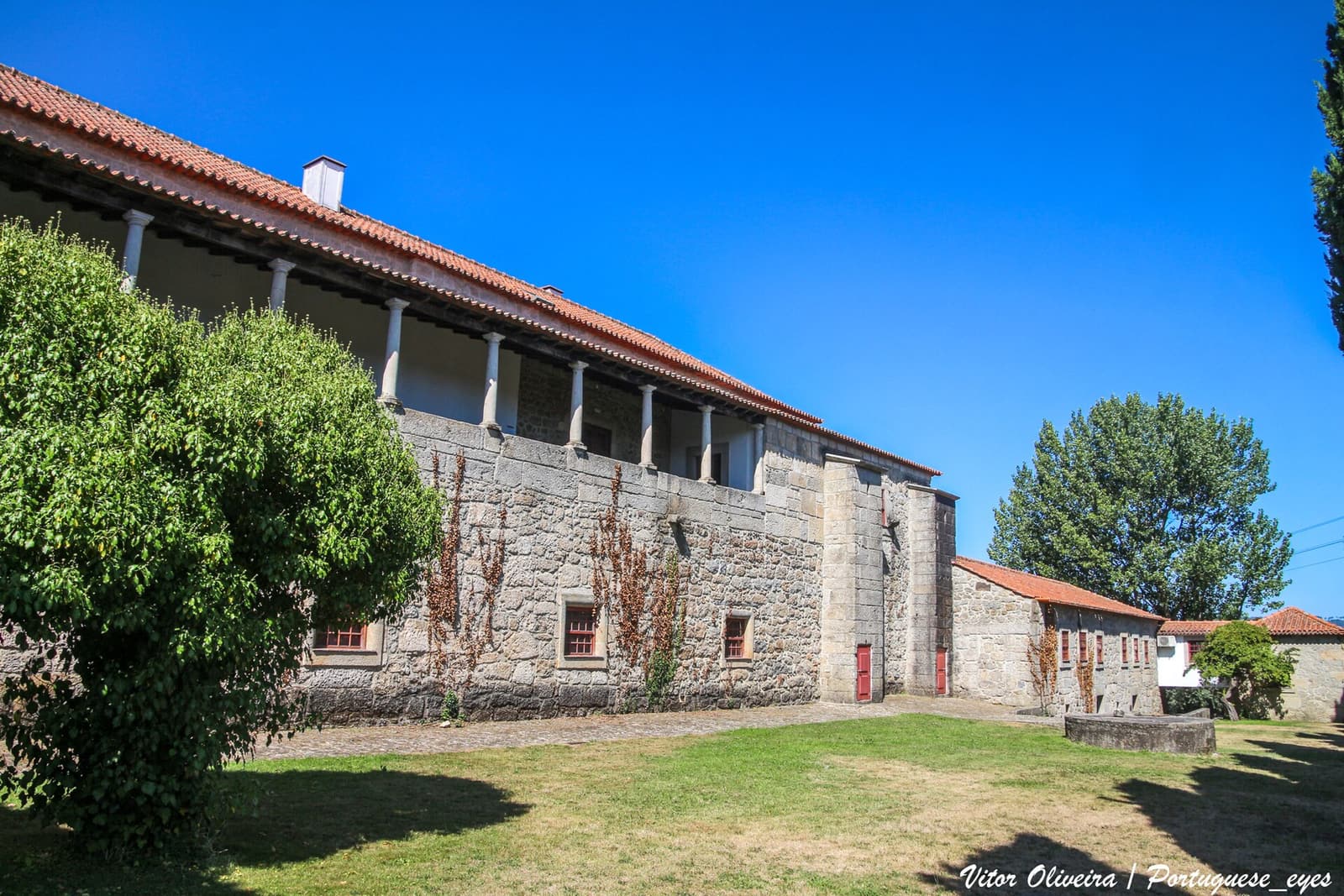
The headquarters and welcome center of the Route operate at the Solar do Vinho do Dão, housed in the former Episcopal Palace of Fontelo in Viseu—a summer residence for the bishops of the diocese since the Middle Ages—restored and inaugurated in 2004 as a Welcome Center and headquarters of the Regional Wine Commission of Dão. The building, with tasting rooms, a media library, and exhibition space, is a short distance from the city’s monumental core, dominated by the Viseu Cathedral and the Adro da Sé complex.
The Route is organized into five thematic itineraries—Terras de Viseu, Terras de Azurara e Castendo, Terras de Besteiros, Terras de Alva, and Terras da Serra da Estrela—linking estates, cooperative wineries, and historic houses.
Traveling these routes, visitors traverse a landscape of small vineyards nestled among granite outcrops, villages, and centuries-old estates, many of which are manor houses of agricultural origin that now combine wine production, guided tastings, and lodging. The experience naturally intersects with regional gastronomy—Beira veal and sausages, Serra da Estrela cheeses—and participation in the September grape harvests.
Culture, Territory, and Wine Tourism
More than a tourist circuit, the Dão Wine Route serves as a tool for territorial valorization, bringing together producers, municipalities, and tourism structures around a product of origin with DOC designation. As in the Alto Douro Vinhateiro, the vineyard landscape here is inseparable from built heritage and cultural identity, linking the know-how of Touriga Nacional and Encruzado to the history of one of Europe’s oldest demarcated regions.
Frequently asked questions
- Where is the headquarters of the Dão Wine Route located?
- The headquarters and welcome center operate at the Solar do Vinho do Dão, housed in the former Episcopal Palace of Fontelo in Viseu, which is also the seat of the Regional Wine Commission of Dão.
- Which grape varieties characterize Dão wines?
- For reds, Touriga Nacional stands out, accompanied by Jaen, Alfrocheiro, Rufete, and Tinta Roriz (Aragonez). Among whites, Encruzado shines, alongside Bical, Cercial, and Malvasia-Fina.
- When was the Dão region demarcated?
- The Demarcated Region of Dão was established by a royal charter on September 18, 1908, becoming the first non-fortified wine region demarcated in Portugal and the second demarcated region in the country.
Sources
Resources for research
Find the sources. Follow the story.
Guides to researching buildings, exploring museum collections and understanding heritage protection.
SIPA
Get to know the architectural inventory, building records and documentary archive.
Read the guideMuseum collectionsMatrizNet
Explore the museum catalogue and records of works, materials, authorship and provenance.
Read the guideHeritage protectionHeritage classification
Understand cultural property categories and the levels of national, public and municipal interest.
Read the guide