Archaeology
Sanctuary of Panóias
The Sanctuary of Panóias in Vila Real is a Roman rock-cut sanctuary featuring tanks carved into the rock and Latin and Greek inscriptions dedicated to chthonic…
- Location
- Vila Real, Vila Real
- Built
- Finais do séc. II / inícios do séc. III d.C.
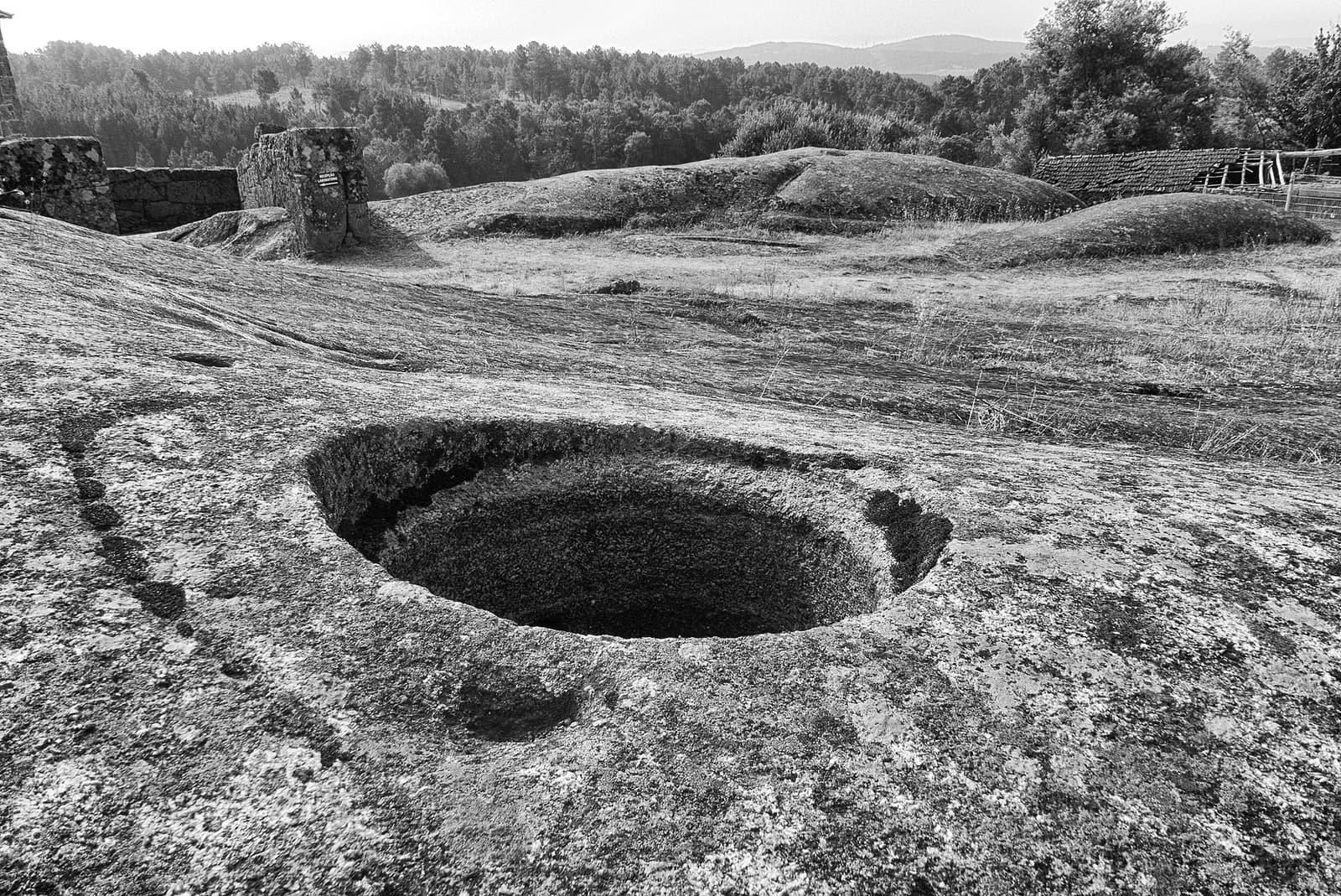
The Sanctuary of Panóias is one of the most unique monuments of the Roman world in the Iberian Peninsula: an open-air worship space, carved directly into three large granite outcrops in Vale de Nogueiras, a few kilometers from Vila Real. It stands apart from most Roman temples by not relying on constructed architecture but on the living rock itself, shaped to accommodate tanks, staircases, and platforms where sacrificial and initiation rituals took place.
A Cult to the Deities of the Dead
The dating of the sanctuary, placed in the late 2nd or early 3rd century AD, and its ritual organization are known thanks to an exceptional set of rock inscriptions. These attribute the foundation of the site to Gaius Calpurnius Rufinus, a Roman senator (vir clarissimus), a figure linked to provincial elites and, according to several interpretations, originally from Asia Minor. It was he who consecrated the site to the Severe Gods and to Serapis, an Egyptian-rooted deity associated with the underworld and the passage to death.
The inscriptions, carved in Latin and one also in Greek, are rare precisely because they describe the ritual in detail. They explain that the victims were beheaded on-site, their blood poured into small basins, their entrails burned in rectangular cavities, and their flesh consumed by the participants. This documentary clarity makes Panóias an almost unique case in the religious epigraphy of the Empire, offering direct testimony of practices that at other sites can only be inferred.
Few places in the Roman world allow one to read, carved into the very stone of the altar, the exact instructions for how to perform the sacrifice.
The Three Rocks and the Ritual Landscape
The sanctuary is organized around three large granite outcrops, tiered in height. Carved into them are tanks (lacus and laciculi), purification basins (lavacra), a circular cavity for roasting meat (gastra), access steps, and sockets for now-vanished wooden structures. It is believed that small temples once stood atop the outcrops and that progression between the three rocks corresponded to stages of initiation, culminating in a symbolic ritual of death and rebirth.
This ascending interpretation lends the sanctuary a dramatic dimension: the initiate would advance from platform to platform, in a journey that combined natural topography with religious meaning. The choice of pre-existing outcrops, some with signs of use predating Roman presence, further suggests that Panóias was a sacred site of long duration, later integrated into the forms of worship brought by the Empire.
Significance and Classification
Panóias fits into the broader framework of Roman Portugal’s archaeology, in a territory where Romanization left deep marks, from rural villae to the mining exploitation of Tresminas, in the same district. As a sanctuary, however, it occupies a unique place, closer to Eastern mystery cults than to official civic religion.
The monument has been classified as a National Monument since 1910 and now features an interpretive center to support visits and understanding. It continues to be studied within the field of Roman archaeology, both for the rarity of its inscriptions and for how it articulates religion, landscape, and power on one of the peripheries of the Roman world.
Frequently asked questions
- Where is the Sanctuary of Panóias located?
- It is situated in Vale de Nogueiras, in the parish of Constantim e Vale de Nogueiras, approximately six kilometers southeast of the city of Vila Real, in northern Portugal.
- To which deities was the sanctuary dedicated?
- The inscriptions mention Serapis and the Severe Gods, deities associated with the underworld, in a cult promoted by Gaius Calpurnius Rufinus in the late 2nd or early 3rd century AD.
- What are the tanks carved into the rocks?
- They are cavities hewn into the granite for ritual purposes: victims were beheaded, their blood collected in smaller basins, and their entrails burned in rectangular tanks, as described in the inscriptions themselves.
Sources
Keep exploring
Heritage nearby
More places to discover from here. Approximate straight-line distances, within 50 km.