Periods & Styles
Art Nouveau in Portugal
Art Nouveau (Arte Nova) in Portugal: chronology, characteristics and the great centres of Aveiro, Lisbon, Porto, Leiria and Caldas da Rainha.
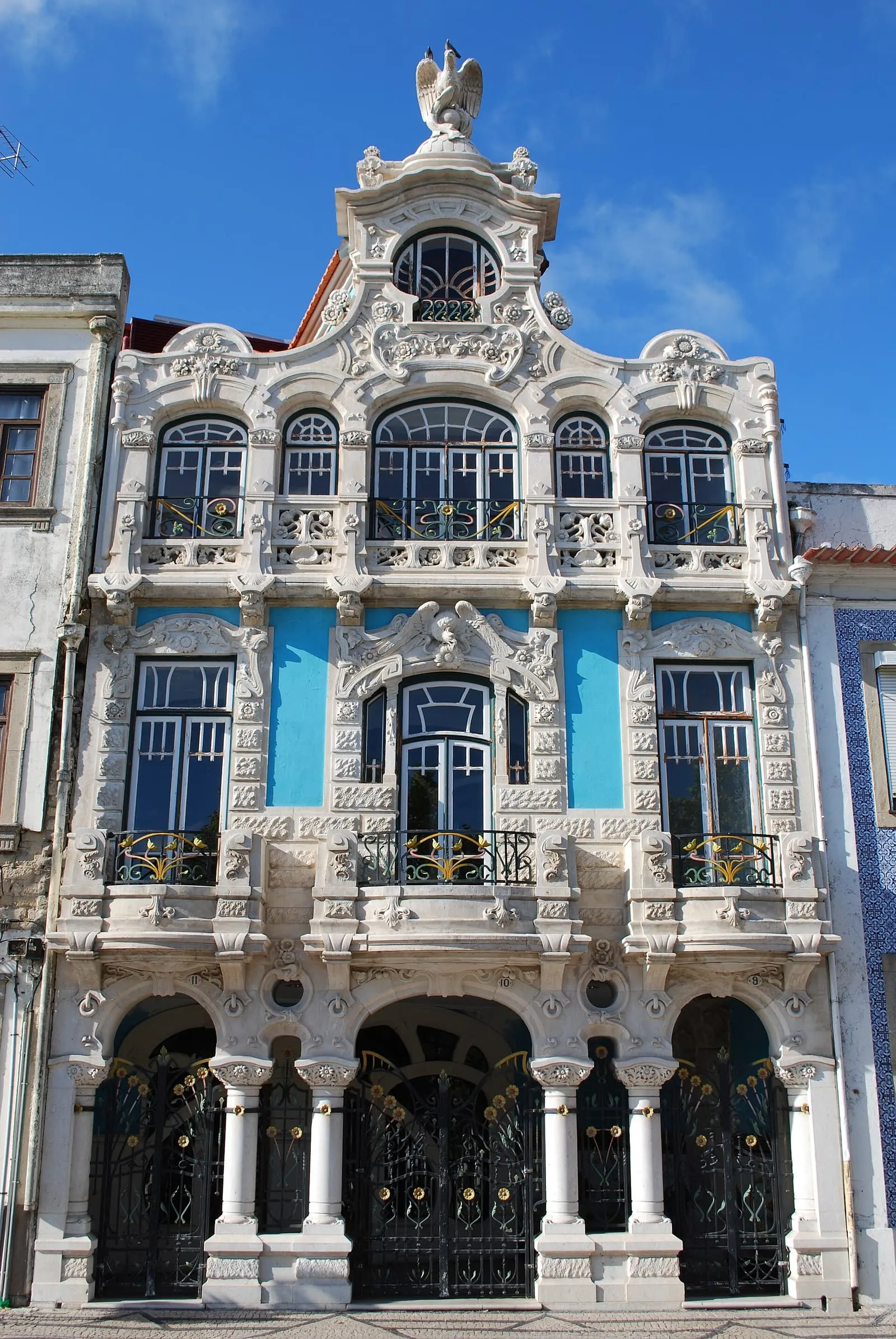
- Location
- Aveiro, Aveiro
- Built
- 1905–1920
- Style
- Arte Nova (Art Nouveau)
Arte Nova — the Portuguese name for the international movement known as Art Nouveau — was the decorative language that sought to break with the academicism and historicist revivals of the second half of the nineteenth century. Rather than copying the styles of the past, it proposed an ornamentation drawn directly from nature: the sinuous curve, the coiling stem, the stylised flower, the dragonfly and the peacock. In Portugal, the movement arrived late and had a short life, concentrated above all between around 1905 and 1920, at a moment when Europe was already moving towards other idioms.
An aesthetic of the façade
The most distinctive trait of Portuguese Art Nouveau was its expression as an art of the façade. The urban bourgeoisie of the growing cities adopted the style as a means of asserting status, investing in the front of the building — in worked stonework, wrought-iron railings and tile panels — while the interiors often remained conventional. This dissociation between the ostentatious exterior and the restrained interior sets the Portuguese case apart from European examples such as that of Victor Horta in Brussels, where Art Nouveau was a total system that also organised the inner space.
Industrial materials were natural allies of the movement. Iron made possible railings and canopies of free design, and its combination with glass opened up façades and galleries previously unthinkable — an affinity that links Art Nouveau to the broader architecture of iron of the industrial age. The tile was likewise reinvented: the production of façade tiles in the Art Nouveau and modern taste covered surfaces with floral motifs and broad tonal compositions, prolonging the Portuguese ceramic tradition in a new grammar.
Aveiro, capital of Art Nouveau
No Portuguese city identifies so closely with the movement as Aveiro. The prosperity tied to trade, salt extraction and industry produced a bourgeoisie willing to translate its wealth into carved stone. The central figure was Francisco Augusto da Silva Rocha, a teacher and designer who, without formal training as an architect, designed dozens of buildings in the city and the region.
In Aveiro, Art Nouveau was not merely an imported style: it became a collective signature of the city, read today along an urban route that runs past the façades as if they were pages of a single book.
The greatest example is the Casa do Major Pessoa, raised from 1907 at the initiative of Mário Belmonte Pessoa, with a design by Silva Rocha and the participation of the Swiss architect Ernesto Korrodi. It is one of the rare cases in which Art Nouveau extends to the interior. Listed as a Property of Public Interest since 1997, it was transformed in 2008 into the Museu Arte Nova, the starting point of the local route and part of the European network of cities of the movement. A visit to the Aveiro centre is today indispensable for understanding the phenomenon.
Beyond Aveiro
The movement left its mark elsewhere in the country. In Lisbon, the Casa-Museu Dr. Anastácio Gonçalves — the former Casa Malhoa, awarded the Valmor Prize of 1905 — is a benchmark testimony. In Porto, spaces such as the Café Majestic and the Livraria Lello incorporated the language in settings of great scenographic effect. In Leiria decorated façades multiplied, and Caldas da Rainha stood out above all for its naturalistic ceramics, with cabbage-shaped plates and pumpkin-shaped tureens that brought the Art Nouveau vocabulary to the table.
Short but intense, the movement was rapidly supplanted by the geometric lines of Art Déco in Portugal, which in the 1920s and 1930s expressed a new taste for rationality and the machine. Even so, Art Nouveau holds a place of its own among the periods and styles of Portuguese art: it was the moment when the façade became a garden, and when the curve — vegetal, free, decorative — affirmed that modernity, too, could be ornament.
Frequently asked questions
- What is Art Nouveau?
- Art Nouveau, known in Portugal as Arte Nova, was an artistic movement at the turn of the nineteenth to the twentieth century that favoured the curved line, plant motifs and the integration of the decorative arts into architecture. In Portugal it flourished above all between 1905 and 1920.
- Where are the best examples of Art Nouveau in Portugal?
- Aveiro is the most celebrated case, with dozens of decorated façades, but there are important centres in Lisbon, Porto, Leiria and Caldas da Rainha, the last also notable for its naturalistic ceramics.
- Who was the leading architect of Aveiro's Art Nouveau?
- Francisco Augusto da Silva Rocha was the most influential figure of Art Nouveau in Aveiro, responsible for numerous façades, including the Casa do Major Pessoa, today the Museu Arte Nova.