Monuments
Arouce Castle (Lousã)
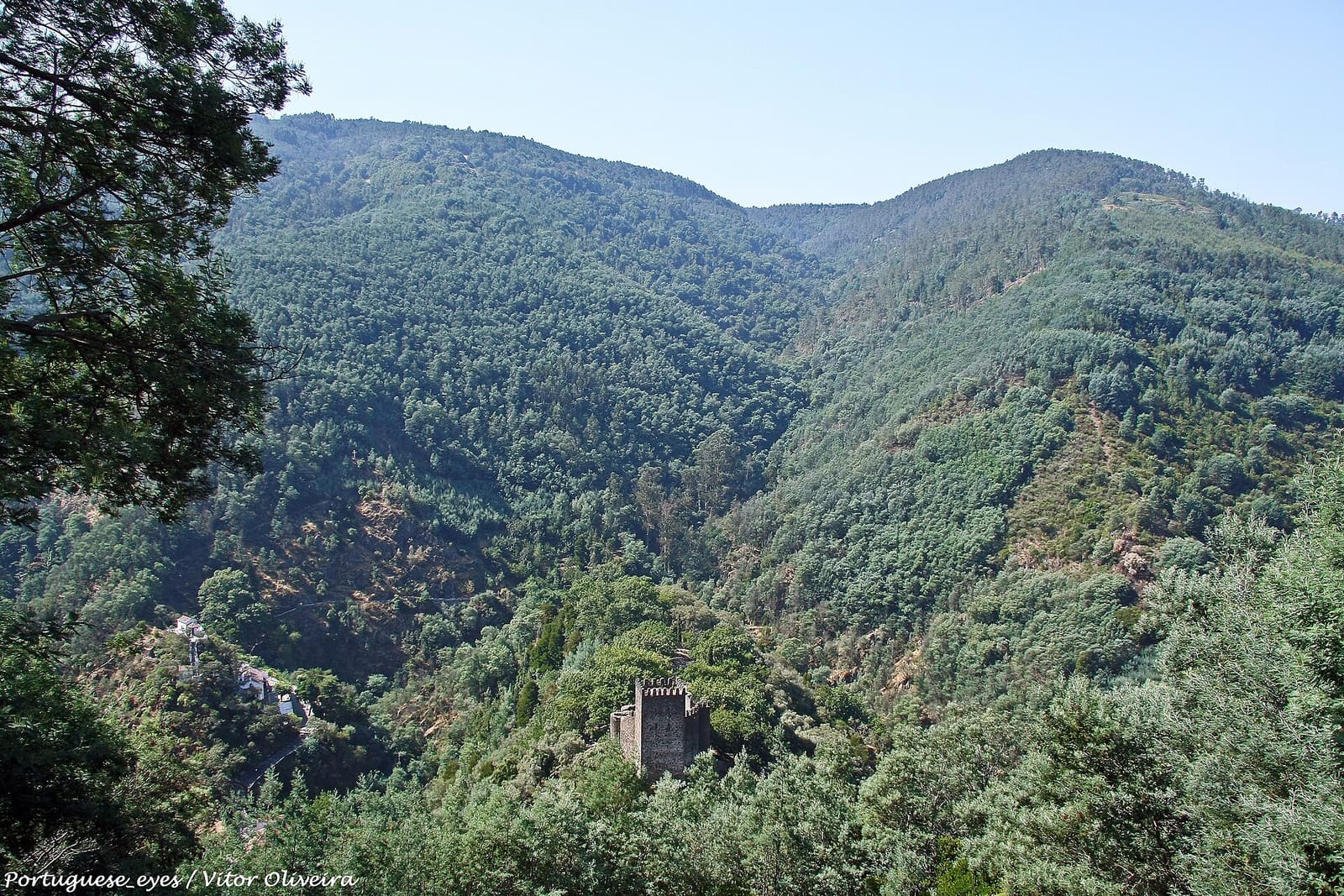
Arouce Castle, in Lousã: a small schist rock castle set into the mountains, at the gateway to the schist villages, and a National Monument of the Coimbra district.
- Location
- Lousã, Coimbra
- Built
- séc. XI (torre de menagem séc. XIV)
- Style
- Românico e Gótico
Arouce Castle, later known as Lousã Castle, is a small rock castle set into the Serra da Lousã, above the right bank of the River Arouce, a short distance from the town. Built almost entirely of schist masonry — the stone that gives its name to the whole region — it is distinguished less by its modest scale than by its dramatic siting: it rises on a rocky spur at the foot of a mountain gorge, a natural crossing point between the Coimbra plain and the highlands of the range.
Origins and the Reconquista
The place name Arouce appears in records very early: it features as Arauz in a tenth-century deed concerning the Monastery of Lorvão. The building or rebuilding of the castle is dated to the second half of the eleventh century, in the context of the reorganisation of the territory of Coimbra led by the Mozarabic count Sesnando Davides, following the Christian reconquest of the city in 1064.
In the following decades, the fortress shared in the instability of the frontier. It was taken in the Muslim offensive of 1124 and reoccupied and repaired by Teresa of León. With the Christian expansion southwards, it lost military importance as the frontier line moved from the Mondego towards the Tagus, especially after 1147. Lousã received a charter in 1151 and a new Manueline charter in 1513, the point from which the name of the place came to override that of the former settlement of Arouce.
Architecture and visiting
The enclosure has an irregular, roughly hexagonal plan, adapted to the rock on which it stands. The most imposing element is the keep, raised in the fourteenth century and dominating the whole to the north; access to it was at the level of the wall-walks, through a pointed-arch doorway, a defensive solution common in rock castles. The schist fabric, in irregular slabs, blends from a distance with the slope itself, giving the monument an austere appearance, deeply integrated into the landscape.
In the mid-twentieth century, between 1942 and 1945, the castle was consolidated and restored, an intervention that returned much of its present silhouette. A small centre of devotion and leisure grew up around the fortress, with chapels and a landscaped area by the river, today a popular starting point for walking trails.
Significance and context
Although modest beside the great strongholds of the Mondego valley, such as the vast Montemor-o-Velho Castle, Arouce Castle is an exemplary illustration of the mountain rock-castle type, built from local materials and dependent above all on position and slope for its defence. It belongs to the vast network of castles that structured the medieval Portuguese territory and serves today as the symbolic gateway to the schist villages of the Serra da Lousã, a few kilometres from Coimbra.
Classified as a National Monument since 1910, the complex retains its value as a testament to the Reconquista frontier and to military architecture built in schist, in one of the most scenic natural settings in central Portugal.
Frequently asked questions
- Where is Arouce Castle?
- It rises in the Serra da Lousã, on the right bank of the River Arouce, about two kilometres from the town of Lousã, in the district of Coimbra, at the entrance to the valley that leads to the schist villages.
- Why does it have two names, Arouce and Lousã?
- The older name is Arouce, attested in the place name Arauz as early as the tenth century. After Lousã received a new charter from King Manuel I in 1513, the fortification came to be known above all as Lousã Castle.
- Is the castle listed?
- Yes. Arouce Castle was classified as a National Monument by decree of 23 June 1910 and underwent restoration works in the 1940s.
Sources
Keep exploring
Heritage nearby
More places to discover from here. Approximate straight-line distances, within 50 km.