Typologies
Medieval castles of Portugal
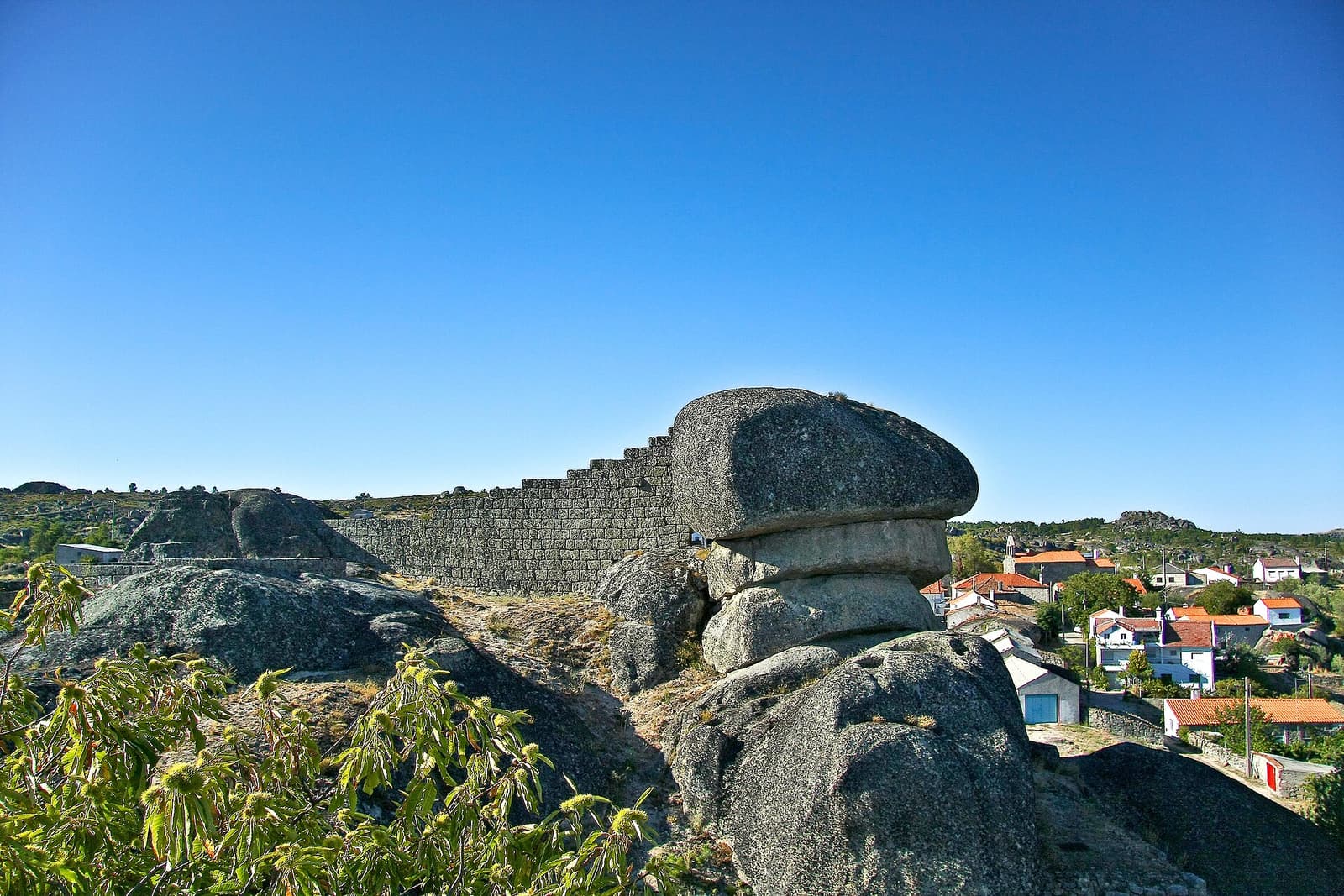
The medieval castles of Portugal: keep, walls and enclosures born of the Reconquista, which shaped the frontier and royal power across the land.
- Style
- Arquitetura militar medieval (românica e gótica)
Few elements mark the Portuguese landscape as profoundly as the medieval castle. Set upon a hilltop, dominating the valley and the roads, it is above all a machine of defence — but also a seat of power, a refuge for the population and, in time, a memory in stone of the very formation of the kingdom. This typology brings together the rock-built fortifications raised chiefly between the 9th and 14th centuries, born of military architecture and the long labour of fortifying the land.
Anatomy of the castle
The medieval castle is organised in concentric defensive layers. The outer perimeter is the enclosure or curtain wall, run along the top by a wall-walk — the patrol path — and punctuated by crenellations that protect the defenders. Vulnerable points such as gates and angles were reinforced by towers and, at times, by a barbican, a lower forward wall that forced the attacker to expose himself twice.
Within rises the most recognisable feature: the keep. Taller and more massive than the rest, it was the last redoubt of the defence and the place where the castellan paid homage to the king — the oath of fealty that gives the tower its Portuguese name. In Portugal, square-plan towers predominate, with thick walls and few loopholes, their floors linked by wooden stairs easily removed in the event of an assault.
To read a castle is to read a chronology: the base may be Roman or Muslim, the wall Romanesque, the keep Gothic and the finishes already modern. Few monuments condense so many centuries into a single silhouette.
Castles and the Reconquista
The overwhelming majority of Portuguese castles arose in the context of the Reconquista, the long struggle between Christians and Muslims for the Iberian Peninsula. Many reused earlier structures — hillforts, Roman fortifications, Islamic citadels — adapted and reinforced over generations. Once a stronghold was taken, it was urgent to settle people and secure the defence, and the castle became the skeleton around which the town grew.
Unlike other regions of Europe, where seigneurial castles proliferated, in Portugal the fortification remained tied above all to royal power. The scarcity of a great territorial nobility and the military urgency of the Reconquista led the Crown to concentrate the network of castles in its own hands, entrusted to appointed castellans. Hence the close relationship between castle, charter and the founding of municipalities.
A line on the frontier
Once the frontier with Castile was stabilised in the 13th century, the castles of the raia (the borderland) were organised into a true defensive line still legible on the map today. Marvão, perched on the Serra de São Mamede, or the walls of Óbidos, which embrace the whole town, illustrate how castle and settlement merged into a single organism. Further south, Silves preserves in its reddish rammed-earth castle the memory of Almohad rule in the Algarve.
At the centre of the kingdom, São Jorge crowns Lisbon from its highest hill, while Guimarães, a comital foundation of the 10th century, was forever linked to the origin of the nation.
Castelo de Guimarães
Comital foundation of the 10th century, cradle of the nation.
CASTLECastelo de São Jorge
The citadel that dominates Lisbon from its highest hill.
CASTLECastelo de Óbidos
Walls that completely encircle the medieval town.
CASTLECastelo de Marvão
An eagle's nest on the Alentejo frontier with Spain.
CASTLECastelo de Silves
The reddish rammed earth that recalls the Islamic Algarve.
CASTLECastelo de Almourol
A Templar fortress on an islet in the middle of the Tagus.
CASTLECastelo de Bragança
Trás-os-Montes citadel with a remarkable medieval enclosure.
CASTLECastelo de Leiria
Gothic royal palace upon the ancient walls.
Frequently asked questions
- What is the keep?
- It is the tallest and most solid tower of the castle, the last redoubt of the defence and a symbol of its lord's power. Its Portuguese name, torre de menagem, derives from the ritual of homage, the oath of fealty sworn by the castellan to the king. In Portugal, square-plan towers predominate.
- When were the Portuguese castles built?
- Most were raised between the 9th and 14th centuries, in the context of the Christian Reconquista, many over earlier Roman or Muslim fortifications. The line of castles along the frontier with Castile was consolidated above all in the 13th and 14th centuries.
- Which is the oldest castle in Portugal?
- There is no single answer, but the Castle of Guimarães, a comital foundation of the second half of the 10th century, is traditionally associated with the origin of the nation and ranks among the most emblematic.