Monuments
Estremoz Castle
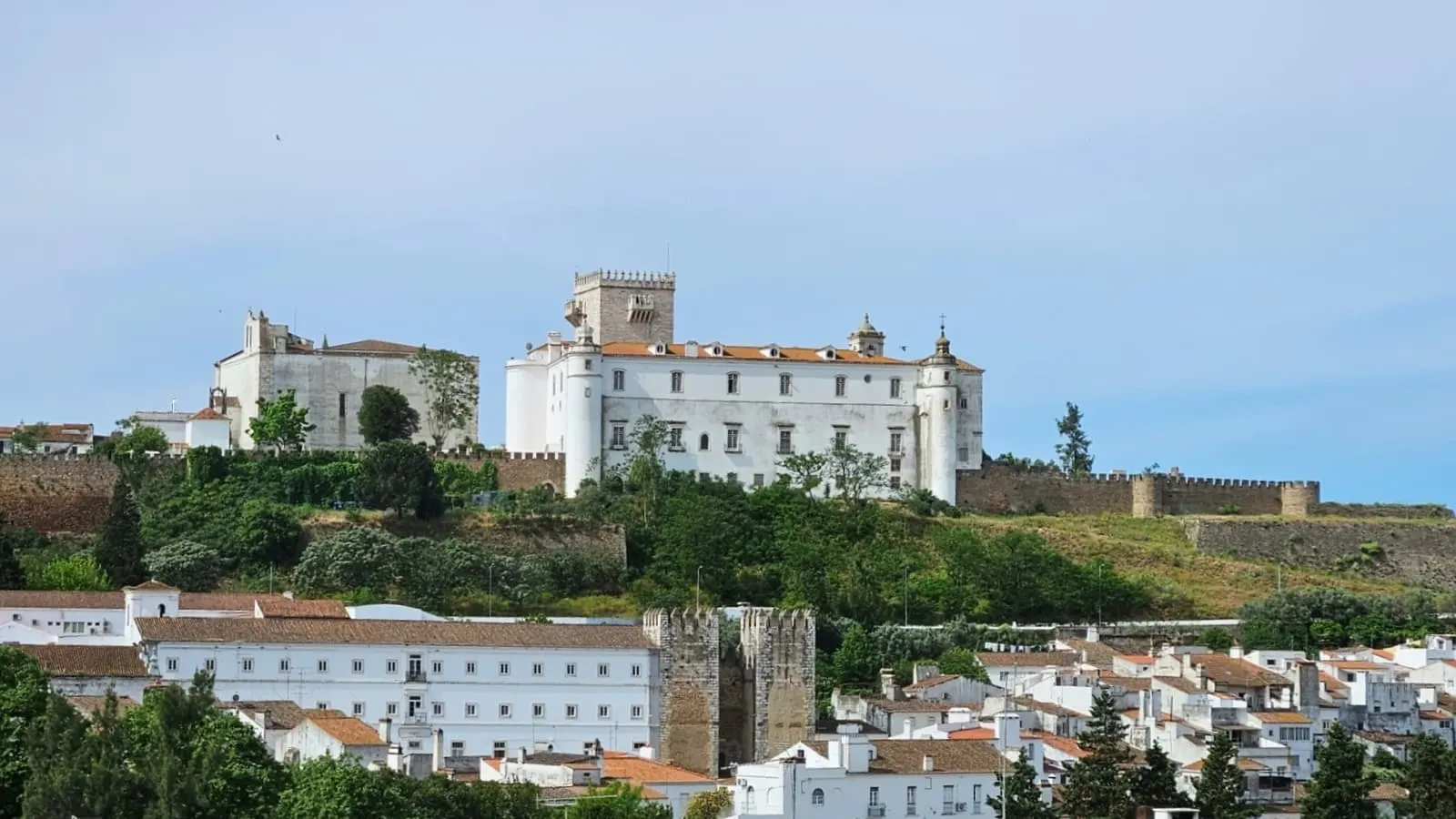
Estremoz Castle, a Dionisian palace-castle of the Alentejo crowned by the Tower of the Three Crowns in white marble, bound to the memory of the Holy Queen Isabel.
- Location
- Estremoz, Évora
- Built
- século XIII
- Style
- Gótico
Atop the hill that commands the plain of the Alto Alentejo, Estremoz Castle rises as one of the most remarkable medieval palace-castles in Portugal. Its silhouette is defined by the slender keep of white marble from the region — the celebrated Tower of the Three Crowns — which towers over the houses of the town and marks the landscape for many kilometres around. More than a fortress, the complex is a royal citadel where frontier defence, Dionisian power and the devotion surrounding the figure of the Holy Queen Isabel all converge.
From the reconquest to the Dionisian citadel
Estremoz was definitively incorporated into the Portuguese domains in the mid-thirteenth century, and it was under Sancho II and, above all, Afonso III that the reconstruction of the castle began. The granting of a charter in 1258 was intended to attract settlers and reinforce a crucial defensive line in a territory bordering Castile. It then fell to Dinis (1279–1325), the Farmer King, to give the complex its palatial dimension, ordering the construction beside the fortification of the Royal Palace that turned the citadel into a royal residence of the first importance. This frontier vocation brings Estremoz close to other Alentejo strongholds such as the neighbouring Evoramonte Castle, which watched over the same border.
The Tower of the Three Crowns
The castle’s most emblematic element is the keep, around 27 metres high, built entirely of white marble quarried in the region. The name “Tower of the Three Crowns” evokes the three reigns over which it is said to have been raised and completed. Inside it is laid out over several floors, the most notable being an octagonal hall covered by a ribbed vault, a rare example of Portuguese civil Gothic architecture. Crowned with prismatic merlons and fitted with machicolated balconies, the tower combines its military function with a monumentality that proclaimed the royal status of the complex.
The choice of local marble was not merely aesthetic: it turned the defence into a statement of prestige, making Estremoz one of the few Portuguese castles in white stone.
The Holy Queen Isabel and the memory of the place
The citadel of Estremoz is inseparably linked to Isabel of Aragon, wife of Dinis. The queen often lingered at this residence and it was here that she died, on 4 July 1336; her body was later moved to the Monastery of Santa Clara-a-Velha in Coimbra. During the Restoration period, the queen regent Luísa de Gusmão had the former royal chambers converted into a chapel dedicated to the Holy Queen, fixing in the space the memory of one of the most venerated figures in Portuguese history. This devotion remains alive in the town and is part of the heritage richness of Estremoz and of the Alentejo cluster of cities marked by royal presence, of which the Ducal Palace of Vila Viçosa is the foremost example.
Classification and current uses
Listed as a National Monument since 1910, the monumental complex of the citadel preserves, in addition to the tower, the Royal Palace and the chapel, today integrated into a historic pousada that reuses the royal structures. Alongside the Tower of the Three Crowns, the castle forms part of a heritage circuit that makes Estremoz one of the richest centres in the network of castles of the Alentejo, where white stone, dynastic memory and local tradition intertwine in a singular way.
Frequently asked questions
- Why is it called the Tower of the Three Crowns?
- The keep of Estremoz is so named because it was raised and completed over the reigns of three monarchs — Afonso III, Dinis and Afonso IV — all associated with its construction in marble.
- What is the castle's connection to the Holy Queen Isabel?
- Isabel of Aragon, wife of Dinis, stayed for long periods at the Royal Palace of Estremoz and died there on 4 July 1336. Her chambers were later transformed into a chapel.
- Can Estremoz Castle be visited?
- Yes. The citadel today houses a historic pousada, and the Tower of the Three Crowns and the monumental complex are open to the public; it has been a National Monument since 1910.
Sources
Keep exploring
Heritage nearby
More places to discover from here. Approximate straight-line distances, within 50 km.