Monuments
Evoramonte Castle
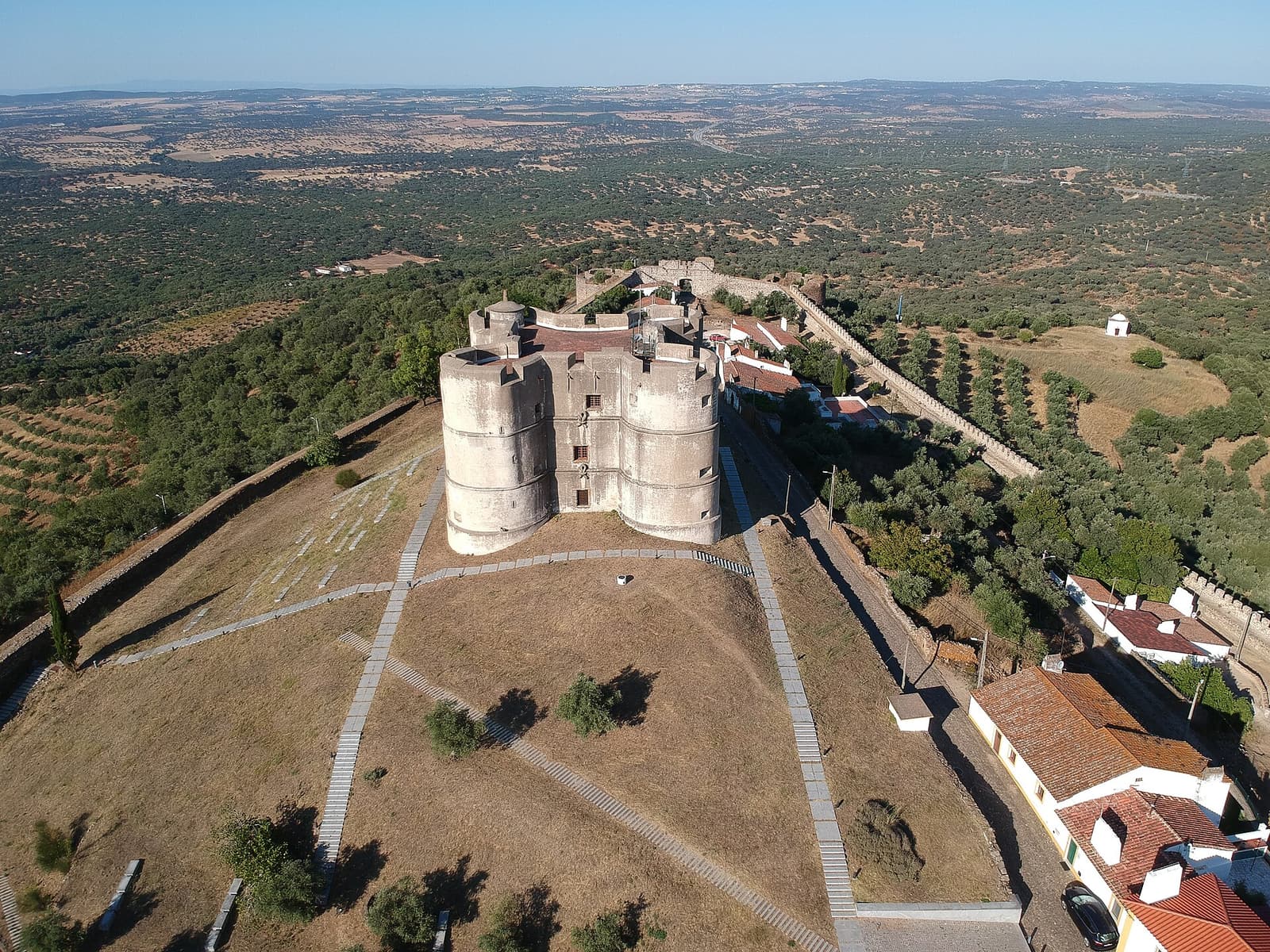
Evoramonte Castle, a singular Renaissance keep near Estremoz, in the Alentejo, stage of the Convention that ended the Liberal Wars in 1834.
- Location
- Evoramonte (Estremoz), Évora
- Built
- 1306; reedificado 1532
- Style
- Renascentista (de inspiração italiana) com elementos góticos e manuelinos
Atop a hill that commands the Alentejo plain, between Estremoz and Évora, rises one of the most unclassifiable buildings in Portuguese military heritage. In its present form, Evoramonte Castle is not a typical medieval fortress: it is a Renaissance keep of square plan, robust and geometric, that looks more like a die of stone set upon the hill than a conventional defensive structure. This singularity has made it a landmark visible from a great distance and one of the most photographed monuments of the Alentejo interior.
From medieval walls to the Renaissance keep
Occupation of the site is ancient, dating back to prehistory, but the documented history of the castle begins with the Reconquest. The settlement is thought to have been taken from the Moors around 1160, and its defences were later consolidated by the Crown: Dom Afonso III granted it a charter in 1248 and, in 1306, Dom Dinis ordered the medieval wall to be built, of which stretches of curtain wall and pointed-arch gates still survive.
The building that impresses the visitor today, however, is later. An earthquake around 1531 ruined the old keep. Under the direction of the alcaide-mor (chief warden), the castle was rebuilt around 1532 in the form of an Italian-inspired keep-palace, with a design often attributed to the circle of the royal architects Diogo and Francisco de Arruda. The result is a structure of three vaulted storeys, with four thick cylindrical towers at the corners, more a fortified palace than a castle of war.
The great novelty of the keep is its Renaissance idiom in a region where the Gothic still prevailed: the interior vaults and the geometric clarity of the plan anticipate, deep in the Alentejo, an architectural sensibility that would only become widespread much later.
Across the façade runs a carved knotted cord — the emblem of the House of Braganza, to which the lordship of the place was tied. This motif, Manueline in origin, is one of the monument’s most celebrated decorative details and reinforces its character as a seigneurial residence rather than a stronghold.
The stage for the end of the Liberal Wars
Evoramonte’s national fame is owed above all to a decisive episode in contemporary Portuguese history. It was here that, on 26 May 1834, the Convention of Evoramonte was signed, bringing the Liberal Wars to a close — the civil war that for six years pitted the supporters of Dom Miguel’s absolutism against the defenders of the constitutional monarchy of Dom Pedro and Dona Maria II. The agreement sealed the Miguelist defeat and the consequent exile of Dom Miguel, consolidating the liberal regime in Portugal.
That event transformed an inland frontier castle into a place of political memory, today recalled in the very walled village that spreads at the foot of the keep.
Visiting and context
The complex was classified as a National Monument in 1910 and forms part of the network of fortifications that dots the Alentejo, close to the Castle of Estremoz, in the same region as other military and palatial jewels such as the Ducal Palace of Vila Viçosa and the imposing Castle of Marvão. Those who tour the castles of Portugal will find in Evoramonte an atypical example, documenting the transition between the medieval fortress and the Renaissance palace.
The village of Evoramonte, with its narrow streets within the walls, and the restored keep together form one of the most coherent historic-monumental cores of the Alentejo, rewarding the climb with a sweeping view over the plain and, in the distance, the Serra de Ossa.
Frequently asked questions
- Why is Evoramonte Castle so different from other Portuguese castles?
- Because what one sees today is not an ordinary medieval fortress, but a keep-palace rebuilt around 1532 after an earthquake, with a square plan, four cylindrical towers at the corners and three vaulted storeys of Italian Renaissance inspiration.
- What was the Convention of Evoramonte?
- It was the agreement signed on 26 May 1834 that put an end to the Liberal Wars, the civil war between liberals and absolutists, sending Dom Miguel into exile and consolidating the constitutional monarchy.
- Where is Evoramonte Castle?
- It stands in the village of Evoramonte, a parish of the municipality of Estremoz, in the district of Évora, in the Alentejo, on a hilltop that commands the surrounding plain.
Sources
Keep exploring
Heritage nearby
More places to discover from here. Approximate straight-line distances, within 50 km.