Monuments
Palmela Castle
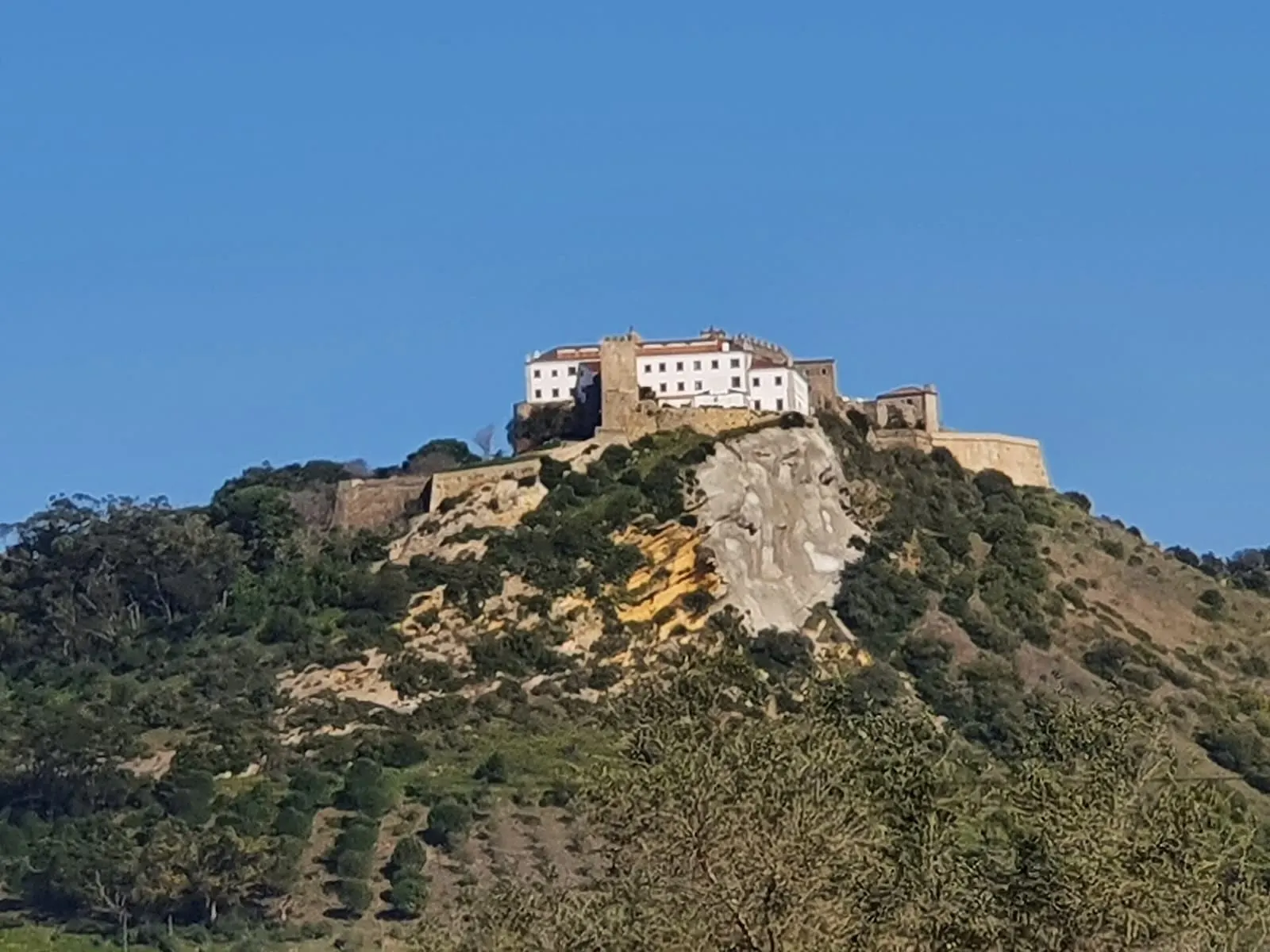
Palmela Castle, seat of the Order of Santiago atop the Arrábida hills, commands the Setúbal peninsula and the estuaries of the Tagus and the Sado.
- Location
- Palmela, Setúbal
- Built
- Séc. VIII-XVII
- Style
- Militar medieval
High on the Palmela hills, at around 240 metres in altitude, Palmela Castle rises as one of the most remarkable fortifications on the south bank of the Tagus. From its summit one looks out over a vast territory stretching from the Setúbal peninsula to the estuaries of the Tagus and the Sado, a position that explains the long military and political importance of the site. More than an isolated castle, it is a complex in which centuries of occupation are layered: from the pre-Roman settlement to the Islamic walls, from the medieval keep to the artillery bastions of the modern era.
From the Islamic walls to the Order of Santiago
The hill was fortified by the Muslims between the 8th and 12th centuries, forming part of the defensive network that protected Lisbon and the Sado valley. In 1147, Afonso Henriques took the stronghold during the conquest of Lisbon, but Christian rule was not consolidated until Sancho I, who in the mid-1180s granted Palmela to the Order of Santiago. The fortress became a central piece in the advance of the Reconquista into the Alentejo, working in concert with other strongholds of the same order, such as Alcácer do Sal.
It was in 1443 that the castle was confirmed as the head of the Order of Santiago in Portugal, a status it would retain until the suppression of the religious orders in 1834. Within the enclosure rose the church and convent of Santiago, and monastic-military life left lasting marks on the architecture, which combines defensive apparatus with conventual function.
A stage of national history
Owing to its commanding position, Palmela was repeatedly contested. During the dynastic crisis of 1383-1385 it served as a signalling point and was targeted by Castilian troops. Later, its cistern became associated with a grim episode: the imprisonment of the bishop of Évora, D. Garcia de Meneses, implicated in the conspiracy against João II, who is said to have died here in 1484.
Palmela’s strength never lay in its stones alone, but in the horizon they command: whoever controlled this hill watched over the gateways to Lisbon and to the South.
The earthquake of 1755 severely damaged the structures, above all the church of Santiago, whose ruins still bear witness today to the violence of the tremor. Military abandonment and decay continued into the 20th century.
Restoration, pousada and listing
Palmela Castle was classified as a National Monument on 23 June 1910, joining the first major set of monuments protected by the Portuguese state. From the 1960s onwards a project was developed to adapt the conventual area into a hotel, and in 1979 the pousada installed in the former convent of the Order of Santiago was inaugurated, an early example of the reuse of fortified heritage.
Today, the castle is at once a historic site, a viewpoint and an identity landmark of the town. The enclosure blends into the vine-clad, hilly landscape that extends to the Arrábida hills, and converses with other fortresses of the coast, such as Sesimbra Castle. For those exploring the town of Palmela and its municipality, the climb to the hill remains, as it has for centuries, the best starting point for understanding this territory. It belongs to the network of Portuguese castles that shaped the defence and the affirmation of the kingdom.
Frequently asked questions
- Who founded Palmela Castle?
- The fortification is of Muslim origin (8th-12th centuries). It was conquered by Afonso Henriques in 1147 and granted to the Order of Santiago in the late 12th century, which established its seat here.
- Can the interior of the castle be visited?
- Yes. The enclosure is freely accessible and lets you walk the walls, the keep and the church of Santiago. The former convent now houses a pousada.
- Why is Palmela Castle important?
- It was the seat of the Order of Santiago in Portugal between 1443 and 1834 and a strategic point controlling the estuaries of the Tagus and the Sado, playing a notable role in the 1383-1385 crisis.
Sources
Keep exploring
Heritage nearby
More places to discover from here. Approximate straight-line distances, within 50 km.