Monuments
Convento da Arrábida
Sixteenth-century Franciscan convent on the slopes of the Serra da Arrábida, in Azeitão, Setúbal, suspended between the mountain and the sea.
- Location
- Azeitão, Setúbal
- Built
- 1538–1542
- Style
- Arquitetura franciscana quinhentista
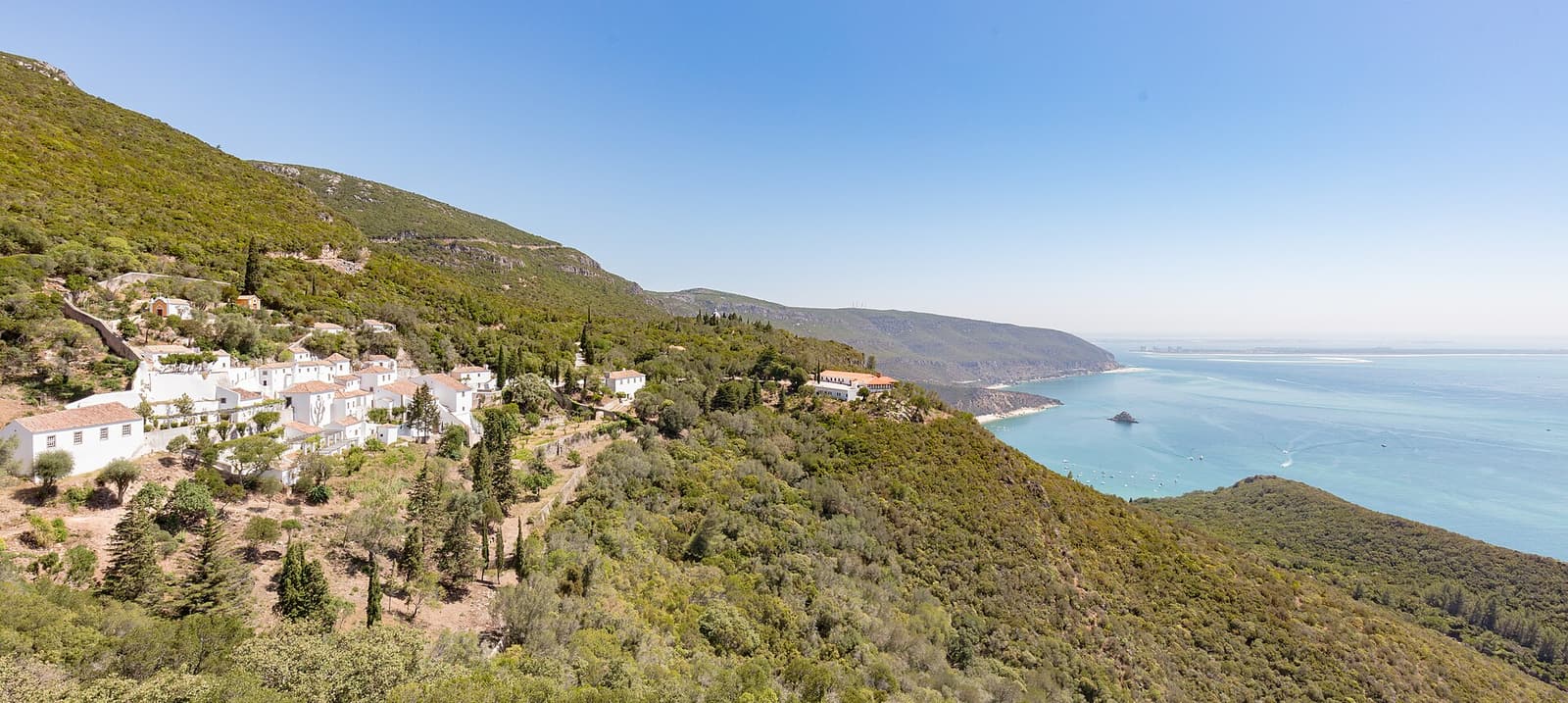
Clinging to the southern flank of the Serra da Arrábida, in an amphitheatre of limestone and Mediterranean scrub turned towards the sea, the Convento da Arrábida is one of the most singular places of Portuguese monasticism. It is not a great monastery of dressed stone like Alcobaça or Tomar, but rather a scattered ensemble of small whitewashed buildings clinging to the hillside, faithful to the ideal of poverty and contemplation from which it arose. Its strength lies not in monumentality, but in the dialogue between humble architecture and a grand landscape.
Eremitic origins
The foundation dates back to 1538-1539, when Frei Martinho de Santa Maria, a discalced friar of Andalusian origin from the Franciscan Order, sought in the mountains a retreat suited to the eremitic life dedicated to Our Lady. D. João de Lencastre, 1st Duke of Aveiro, granted him the lands of the slope, and in 1542 the community was formally constituted. Before any building, the first friars — among them Saint Peter of Alcântara — lived in cells carved into the rock, beside the Ermida da Memória, a site of ancient pilgrimages.
The convent was born not to impose a presence upon the mountains, but to hide within them: the austerity of the cells is, in itself, a theological declaration.
From this nucleus arose the Franciscan Province of Arrábida, reformed according to the rigorous constitutions of Saint Peter of Alcântara, who found here one of his most influential centres. The Arrábida reform became a benchmark of discalced Franciscanism on the Iberian Peninsula.
Convento Velho and Convento Novo
The complex spreads over some 25 hectares and is organised into two nuclei. The Convento Velho, on the higher part of the mountain, preserves its primitive character: scattered chapels, the Ermida da Memória and the small oratories that punctuate the ascent, evoking a path of meditation. The Convento Novo, halfway up the slope, was raised to house a community that had grown larger and more settled, with cloister, cisterns and conventual outbuildings, while retaining the modest scale and white walls characteristic of the Arrábida aesthetic.
Several noble families, beginning with the dukes of Aveiro, financed the expansion of the complex over the centuries, with hospices, chapels and the Sanctuary of the Bom Jesus. Despite these additions, the convent never abandoned the sobriety that distinguishes it from other Portuguese convents of aristocratic foundation.
From abandonment to the Fundação Oriente
The suppression of the religious orders in 1834 emptied the convent, which underwent decades of abandonment and decay. For its historical importance and originality, it was classified as a Property of Public Interest in 1977. Today it belongs to the Fundação Oriente, which restored it and uses it as a space for retreat, cultural gatherings and guided visits, integrated into the Arrábida Natural Park.
Its proximity to the historic centres of the Setúbal peninsula links it to a territory of remarkable heritage density, from the Convento de Jesus de Setúbal, cradle of the Manueline style, to the imposing Castelo de Palmela. This ensemble makes the region one of the richest itineraries of religious and military heritage south of the Tagus, and the Convento da Arrábida, suspended between the mountain and the ocean, is its most contemplative expression.
Frequently asked questions
- When was the Convento da Arrábida founded?
- The eremitic community formed between 1538 and 1539, and the convent was formally founded in 1542 by Frei Martinho de Santa Maria, with the support of D. João de Lencastre, 1st Duke of Aveiro.
- Can the Convento da Arrábida be visited?
- Yes. The complex belongs to the Fundação Oriente and is open for guided visits by appointment, given its location within the Arrábida Natural Park.
- Where is the Convento da Arrábida?
- It stands on the southern slope of the Serra da Arrábida, in the parish of Azeitão, municipality and district of Setúbal, overlooking the bay and the Atlantic Ocean.
Sources
Keep exploring
Heritage nearby
More places to discover from here. Approximate straight-line distances, within 50 km.