Monuments
Castle of Porto de Mós
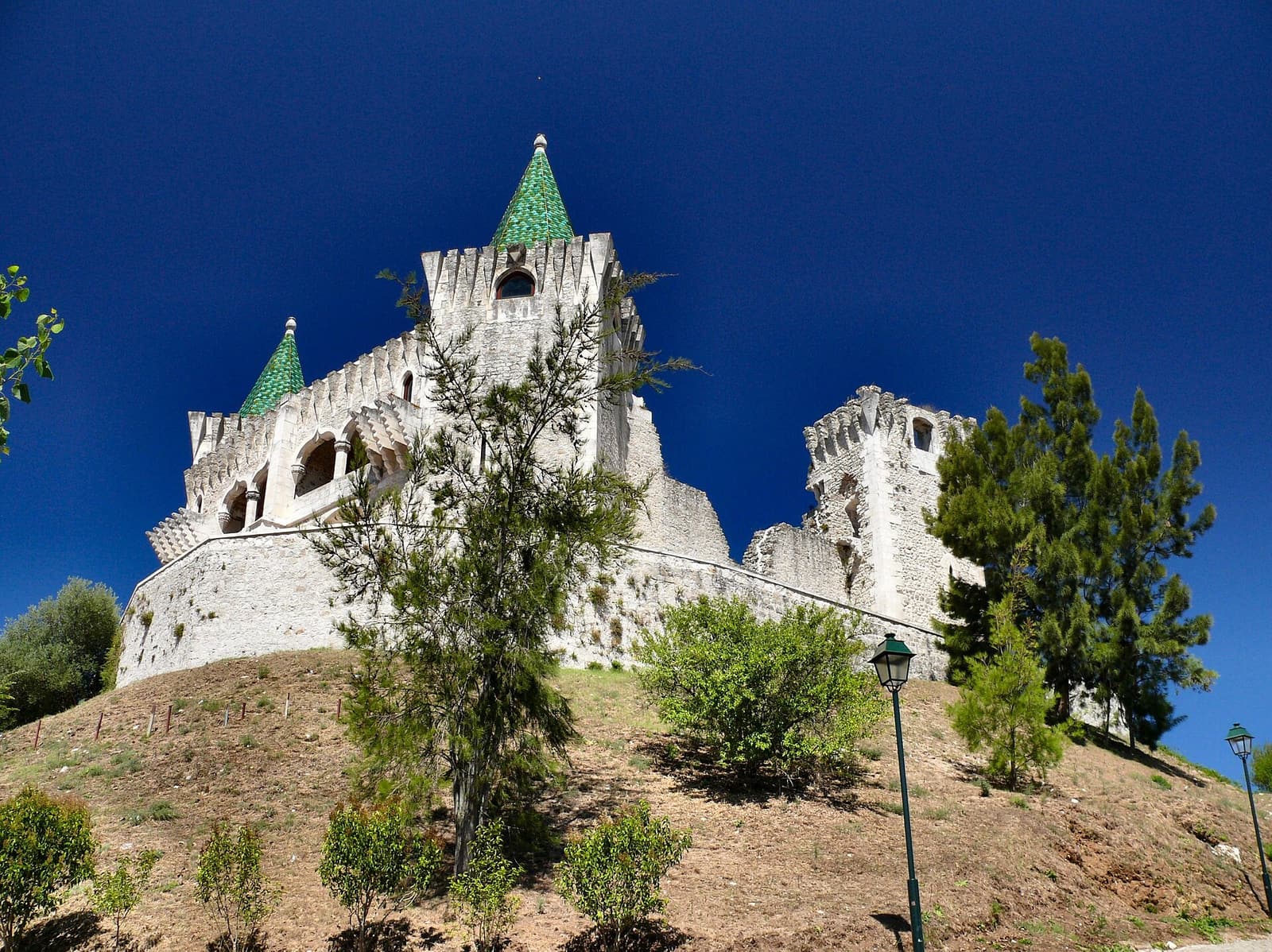
Castle of Porto de Mós: a Gothic-Renaissance palace-castle with towers crowned by green pinnacles, residence of Dom Afonso, Count of Ourém, in the district of…
- Location
- Porto de Mós, Leiria
- Built
- século XII; remodelação no século XV
- Style
- Gótico e Renascimento
Silhouetted against the sky of the basin that separates the Serra dos Candeeiros from the Serra de Aire, the Castle of Porto de Mós is one of the most original military monuments in Portugal. Its towers crowned by pyramidal pinnacles of green glazed tile, visible from a great distance, announce at once that this is no ordinary fortress, but rather a palace-castle in which medieval military memory, Gothic taste and early Renaissance experiments come together.
From the Christian conquest to the House of Ourém
The site was occupied from prehistory and saw a Roman presence, from which coins and Latin inscriptions survive. The medieval castle enters national history in 1148, when it passed into Christian hands in the context of the southward expansion begun by Dom Afonso Henriques, becoming linked to the legendary figure of the alcaide Dom Fuas Roupinho. Under Dom Sancho I the settlement prospered and, in 1305, Dom Dinis granted it a charter. After the dynastic crisis of 1383-1385, the domain was incorporated into the patrimony of Dom Nuno Álvares Pereira, the Constable, later coming to belong to the powerful House of Bragança.
Dom Afonso and the Gothic-Renaissance palace
The complex owes its phase of splendour to Dom Afonso (1403-1460), 4th Count of Ourém and grandson of King Dom João I and of the Constable. A cultured and well-travelled man, the same who reinvented the Castle of Ourém in the manner of the seigneurial residences of his time, he ordered the old castle of Porto de Mós converted into a comital palace. From that intervention come the irregular pentagonal plan, with five corner towers, and the remarkable southern façade, where a double gallery of ogee arches opens over ribbed vaults, divided at the centre by a projecting buttress. It is here that the Gothic vocabulary coexists with solutions of Renaissance inspiration, in a dialogue characteristic of Gothic architecture in Portugal as it shifted towards the manners of the Renaissance.
Within the walls survive vestiges of a courtyard that was probably flanked by a portico of columns and pilasters, with the faceted cistern at the centre — testimony to the residential ambition that presided over the work. The green pinnacles, today the monument’s hallmark, express that same desire for magnificence, proper to one of the richest houses of the Portuguese nobility at the end of the Middle Ages.
Ruin and recovery
The earthquake of 1755 struck the structure hard, aggravated by a further tremor in 1909. Its value recognised, the castle was classified as a National Monument in 1910, joining the ensemble of fortifications that punctuate the landscape of the district of Leiria. The restoration campaigns, begun in the 1960s and resumed from 2001, made it possible to consolidate the walls and restore legibility to the palace, which today welcomes visitors and cultural activities. More than a military ruin, the Castle of Porto de Mós reads as a document built upon the passage from the medieval castle to the aristocratic residence of the Portuguese Renaissance.
Frequently asked questions
- Why does the Castle of Porto de Mós have green towers?
- Two of the southern towers are crowned by pyramidal pinnacles clad in green glazed tiles, a singular decorative solution that makes the monument unmistakable from afar and brings it close to the courtly taste of the fifteenth century.
- Who transformed the castle into a seigneurial palace?
- The great remodelling is owed to Dom Afonso, 4th Count of Ourém, who in the mid-fifteenth century converted the old medieval fortress into a comital residence of Gothic-Renaissance character.
- Where is the Castle of Porto de Mós located?
- It rises above the town of Porto de Mós, in the parish of São Pedro, district of Leiria, in the Centro region of Portugal, beside the Serra dos Candeeiros.
Sources
Keep exploring
Heritage nearby
More places to discover from here. Approximate straight-line distances, within 50 km.