Monuments
Castle and Palace of the Counts of Ourém
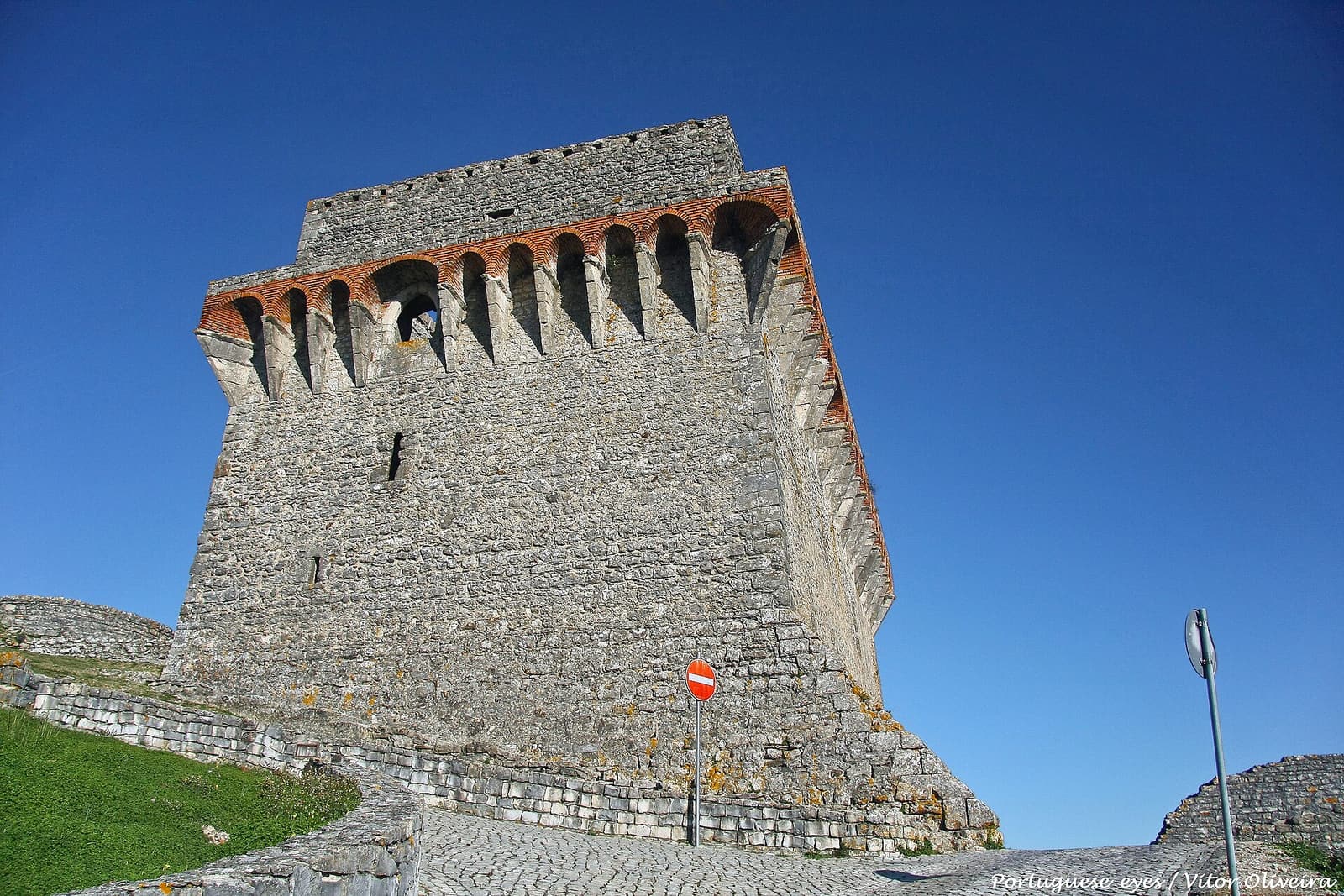
Castle and Palace of the Counts of Ourém: a remarkable late-Gothic palace-castle of the 15th century in Ourém, the work of Count Afonso, in the district of Santarém.
- Location
- Ourém, Santarém
- Built
- século XII; remodelação no século XV
- Style
- Românico e gótico tardio, com influência mudéjar e da rocca italiana
On the crest of the hill that dominates the medieval town of Ourém stands one of the most original military and residential complexes in Portuguese architecture: the castle and the Palace of the Counts of Ourém. More than a conventional fortress, it is a castle transformed into a seigneurial residence in the manner of the Italian rocche of the fifteenth century, a testimony to the taste and ambition of one of the most powerful houses of the Portuguese nobility at the close of the Middle Ages.
From medieval origins to the county
The site was taken from the Muslims during the Christian expansion of the twelfth century, becoming part of the lands that Afonso Henriques consolidated south of the Mondego. The settlement received a charter and, in the mid-fourteenth century, Pedro I raised Ourém and its territory to the rank of a county. Among the holders of that dignity was a singular figure of national history: the 3rd Count of Ourém was Nuno Álvares Pereira, the Constable who led the Portuguese forces to victory at Aljubarrota in 1385, and whose memory remained tied to the royal vow that would raise the great neighbouring Gothic monastery.
Afonso and the invention of a palace
The complex’s age of splendour belongs to the fifteenth century and to one name: Afonso (1403–1460), 4th Count of Ourém and grandson, through distinct lines, of King João I and of the Constable himself. A man of vast culture, formed at court and shaped by his travels through Europe, Afonso brought to Portugal architectural references that were then circulating in the Italian courts. Under his direction, the old medieval castle was profoundly reformed, with the construction of the Palace building and the Collegiate Church.
The Palace of Ourém is less a fortress than a declaration of power: here, the wall no longer merely defends — it stages the magnificence of those who dwell within it.
The layout adapts to the triangular terrain of the spur, with turrets at its corners. The most celebrated element is the pair of great cylindrical towers crowned by cornices of projecting brick, a solution of Italian inspiration — often compared to the Rocca of Rimini — rare in the Iberian Peninsula, which gives the complex its unmistakable silhouette. The combination of Romanesque military tradition, Gothic language and details of Mudéjar taste makes the Palace of the Counts an almost unique case of transition between the castle of war and the seigneurial palace. Afonso also sponsored a twin project, the palace of Porto de Mós, with the same will to self-affirmation.
Ruin, restoration and memory
The complex suffered severe damage in the earthquake of 1755 and, again, during the French Invasions in 1810, entering thereafter a long period of abandonment. Classified as a National Monument in 1910, it was the object of successive interventions throughout the twentieth century and, more recently, of a thorough restoration completed in 2021, which stabilised the structures and adapted the spaces for museological and cultural uses.
Today, the castle is an essential part of a heritage route that links the medieval town, the nearby sanctuary and the array of fortresses that mark the landscape of the Centro region. Those interested in Gothic architecture in Portugal and in Portuguese medieval castles will find in Ourém one of its most surprising chapters: the moment when the art of fortifying began, in its turn, to seek beauty.
Frequently asked questions
- Who ordered the construction of the Palace of the Counts of Ourém?
- The palace-castle in its present form is owed to Afonso, 4th Count of Ourém, grandson of King João I and of the Constable Nuno Álvares Pereira, who promoted major reforms in the mid-15th century.
- Where is the Castle of Ourém located?
- It rises on the highest point of the medieval town of Ourém, in the parish of Nossa Senhora das Misericórdias, district of Santarém, in the Centro region of Portugal.
- Is the Castle of Ourém a National Monument?
- Yes. It was classified as a National Monument in 1910 and is today one of the most singular examples in Portugal of a medieval castle adapted to a seigneurial residence.
Sources
Keep exploring
Heritage nearby
More places to discover from here. Approximate straight-line distances, within 50 km.