Archaeology
Castro de São Julião
Castro de São Julião, in Vila Verde (Braga): a Castro-culture settlement with a long occupation from the Late Bronze Age to the Iron Age, excavated by the…
- Location
- Vila Verde, Braga
- Built
- c. 900 a.C. (Bronze Final) a Idade do Ferro
The Castro de São Julião, also known as the Citânia de São Julião de Caldelas, is a fortified hilltop settlement set on the summit of Mount São Julião, which dominates the final stretch of the valley of the River Homem, in the municipality of Vila Verde, district of Braga. The site is divided between the parishes of Ponte and Coucieiro and occupies a strategic position with broad visual command over the valley, in a territory rich in thermal, silvo-pastoral, mineral and lithic resources. It is one of the reference sites for the study of the Castro culture in the Lower Cávado and the Minho.
Sequence of occupation
The distinctive feature of São Julião lies in its long diachrony. The earliest evidence dates back to the 4th–3rd millennium BC, with Penha-type pottery and intermittent occupations throughout the 2nd millennium, attested by huts with clay floors and post holes. The foundation of the settlement proper occurs around 900 BC, in the Late Bronze Age, around the summit and a cave known as the Cova da Moura. From then on, occupation continues uninterrupted through the transition to the Iron Age and into the full Castro period, making the hill one of the few sites in the Northwest where this passage is documented without evident breaks.
This continuity makes the castro a privileged laboratory for understanding the genesis of the great Castro-culture settlements of the region, a process equally legible at larger sites such as the Citânia de Briteiros. The archaeological work, conducted chiefly by the Archaeology Unit of the University of Minho under the direction of Manuela Martins, has revealed a dense and well-preserved stratigraphy.
Architecture and material culture
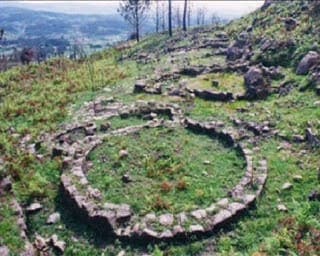
The settlement is laid out on terraces protected by several concentric lines of wall, with an acropolis at the top where the earliest huts were concentrated. The domestic buildings, circular in plan and built of stone masonry, are distributed across the lower platforms. The defences, with robust stretches of wall, demonstrate a notable military complexity for the period.
The material culture recovered is vast: tens of thousands of pottery fragments, an abundant lithic industry and numerous metal artefacts, including spearheads, cauldrons and bracelets, alongside traces of copper and bronze smelting that attest to local metallurgical activity. Among the most remarkable pieces is a statue of a warrior bearing a Latin inscription. The presence of late pottery and of a ceitil of King Afonso V indicates reoccupations extending into the Late Middle Ages.
Classification and context
The Castro de São Julião is classified as a Property of Public Interest by Decree no. 28/82 of 26 February 1982. It belongs to the vast group of sites of Portuguese archaeology in the north of the country, contributing, through its long stratigraphic sequence, to knowledge of the passage from the Bronze Age to the Iron Age in the northwest of the Peninsula.
Frequently asked questions
- Where is the Castro de São Julião located?
- It stands on the summit of Mount São Julião, overlooking the valley of the River Homem, in the parishes of Ponte and Coucieiro, municipality of Vila Verde, district of Braga.
- From what period does the settlement date?
- The main occupation begins around 900 BC, in the Late Bronze Age, continuing through the Iron Age; there are also earlier traces and later reoccupations.
- Is the site listed?
- Yes. The Citânia de São Julião has been classified as a Property of Public Interest since 1982 (Decree no. 28/82).
Sources
Keep exploring
Heritage nearby
More places to discover from here. Approximate straight-line distances, within 50 km.