Typologies
Historic Cemeteries
Portugal's historic cemeteries: family vaults, mausoleums and nineteenth-century funerary art, from the Romantic cemeteries of Lapa and Prazeres to the…
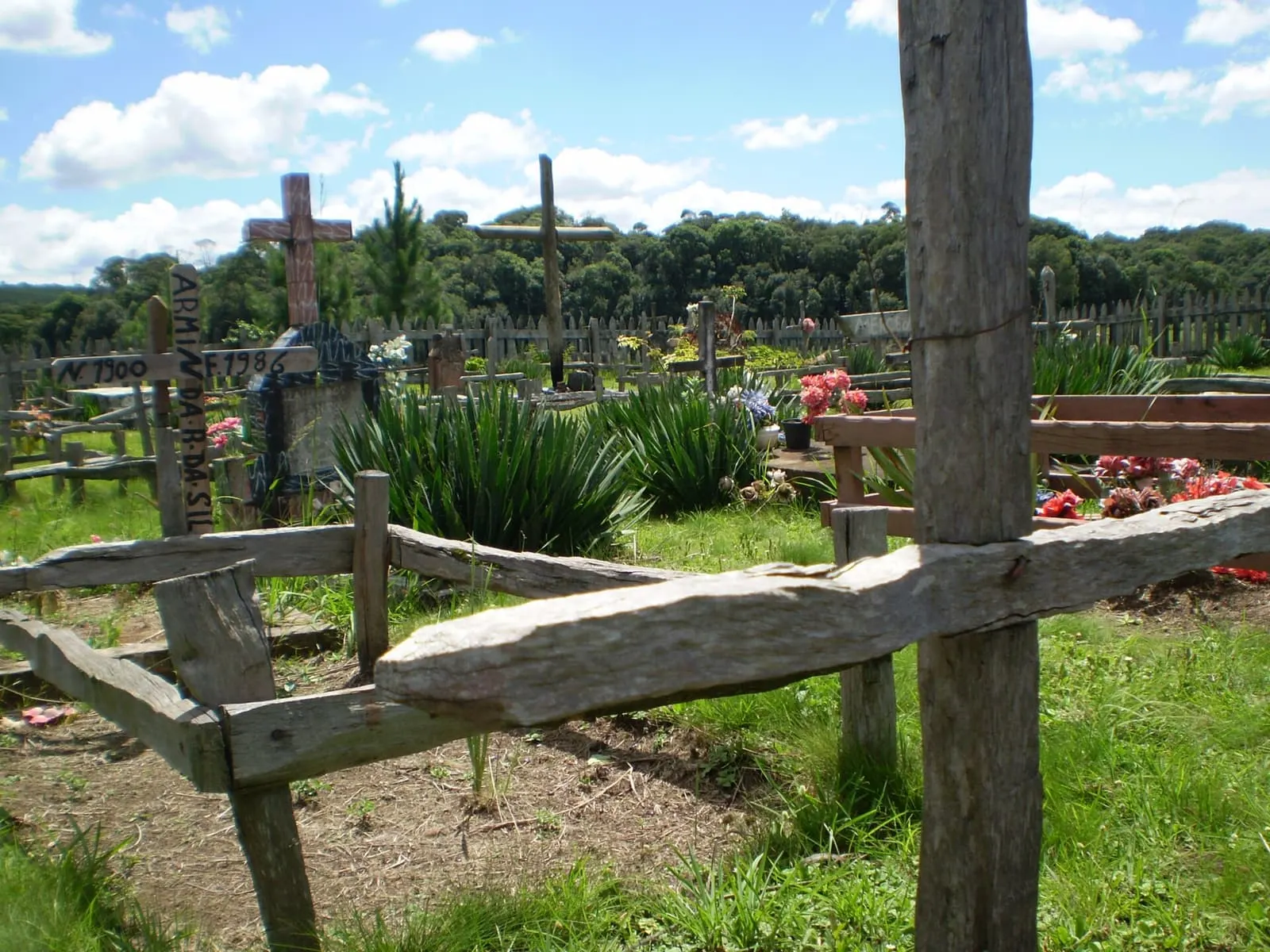
Historic cemeteries constitute one of the most singular typologies of Portuguese built heritage: cities of the dead laid out in the image of the cities of the living, where architecture, sculpture, ironwork and ceramics of great quality accumulate within a relatively small space. Born of a nineteenth-century sanitary reform, over two hundred years they became repositories of family memory, of artistic taste and of an entire culture of death.
From the church to the open field: the nineteenth-century reform
Until the first third of the nineteenth century, the dead were buried above all inside churches, chapels and conventual cloisters, or in the churchyards that surrounded them. The accumulation of corpses in the very heart of the urban fabric was a serious problem of public health, aggravated by the miasmatic theories then prevailing. The cholera-morbus epidemic that ravaged the country in 1833 made urgent the creation of large cemeteries set apart from the settlements.
The legislative response came in 1835, with the decree that officially created public cemeteries and prohibited burials inside churches and within inhabited places. The measure was reinforced by the decree of 28 September 1844, which required the deposit of mortal remains, subject to sanitary licence, in cemeteries built in the open field. The reform clashed head-on with popular religious sensibility, which saw in burial close to the altar a guarantee of salvation: the prohibition was one of the sparks of the Maria da Fonte Revolution of 1846, in the Minho, where the refusal to bury a dead woman outside the church set off the uprising that would bring down the government of Costa Cabral.
The nineteenth-century cemetery is born, paradoxically, of a law of public hygiene — but it soon becomes a stage for Romantic sentiment, a landscaped space of meditation where the bourgeoisie raises to the memory of its dead the most ambitious monuments in the city.
Funerary art and symbolic programme
The cemeteries created from this date onwards — the Cemitério da Lapa, in Porto, held to be the oldest Portuguese Romantic cemetery, that of Agramonte (reorganised in 1869), and in Lisbon the Prazeres and the Alto de São João — are organised into tree-lined avenues and streets, flanked by family vaults. These small private temples form a living catalogue of the styles of the nineteenth and twentieth centuries: from the neoclassical to the neo-Gothic, from the neo-Manueline to Art Nouveau, mobilising the historicist taste of Romanticism and the revivals.
The ornamentation obeys a recurrent iconographic programme, in which each motif has a precise meaning: the winged hourglass and the scythe evoke the passage of time and finitude; the owl, vigil; the poppy, sleep and oblivion; the urns with tears, mourning; the wreaths of flowers, ephemeral glory. To this symbolic grammar respond the finest chisels and the most skilful ironworkers of their time, in a dialogue between scholarly Portuguese sculpture and the wrought-iron work of the railings and gates.
Among the notable pieces are the mausoleum of the Dukes of Palmela, in the Cemitério dos Prazeres — frequently cited as the largest private vault in Europe — and the tomb of António Augusto Carvalho Monteiro, attributed to the scenographer-architect Luigi Manini, the same who designed the Quinta da Regaleira. The monumentality of these ensembles is not far from that which animates the commemorative statuary and monuments raised, in the same period, in the squares of the cities.
A heritage yet to be recognised
Long undervalued as merely functional spaces, historic cemeteries have gradually been rehabilitated as cultural assets. Several ensembles have already been classified — the church and cemetery of Lapa, for example, as a Monument of Public Interest — and in some cases the cemetery chapels themselves house museum collections, such as the one installed in the chapel of Prazeres from 2001 onwards. They thus fall within the broader framework of the typologies of built heritage, as material testimony to collective attitudes towards death and memory throughout the nineteenth and twentieth centuries.
Frequently asked questions
- When did public cemeteries appear in Portugal?
- The first extramural cemeteries were created in the wake of the 1833 cholera epidemic, but it was only the decree of 1835 that formally established public cemeteries, prohibiting burials inside churches. The requirement was reinforced by the decree of 28 September 1844.
- Which is the oldest Romantic cemetery in Portugal?
- The Cemitério da Lapa, in Porto, is generally regarded as the oldest Portuguese Romantic cemetery. It originated in 1833, during the Siege of Porto and the cholera epidemic, although its official consecration only took place in 1838 and the first sumptuous monuments date from 1839.
- Why are nineteenth-century cemeteries considered heritage?
- They bring together a remarkable collection of architecture, sculpture, ironwork and ceramics by scholarly masters of the nineteenth and twentieth centuries, alongside a dense symbolic programme. For this reason they are now seen as veritable open-air 'museums of death', several of them classified as Monuments of Public Interest.