Typologies
Monasteries of Portugal
The monasteries of Portugal: houses of Benedictines and Cistercians that, from Alcobaça to Tibães, shaped the landscape, economy, and art of Portuguese territory.
- Style
- Românico, gótico, manuelino e barroco
For nearly eight centuries, the monastery was one of the most powerful institutions in Portugal. Behind its walls lived a community of monks devoted to prayer and work, but the monastery was also a landlord of lands, an agricultural center, a library, a hospital, and a workshop of art. This typology encompasses the great houses of contemplative monastic orders— primarily Benedictines and Cistercians—which differ from mendicant order convents by their enclosure, self-sufficiency, and the vow of stability that bound a monk to a single place for life.
Benedictines and Cistercians
Monastic life in Portugal was organized around the Rule of Saint Benedict, written in the 6th century and summarized by the motto ora et labora—pray and work. The Benedictines settled early in the North; the Monastery of São Martinho de Tibães, with its charter confirmed in 1110 by the parents of D. Afonso Henriques, was chosen after the Council of Trent as the mother house of the Congregation of Saint Benedict of the Kingdoms of Portugal, reaching its Baroque peak in the 17th and 18th centuries.
The Cistercian Order, a rigorous reform born in France, arrived in the kingdom around 1144, establishing itself first in São João de Tarouca. In 1153, Santa Maria de Alcobaça was founded from scratch, becoming the largest and wealthiest Cistercian house in Portugal, with domains covering a vast chartered region. The Cistercians sought the isolation of fertile valleys and transformed them with advanced agricultural techniques, drainage, and milling.
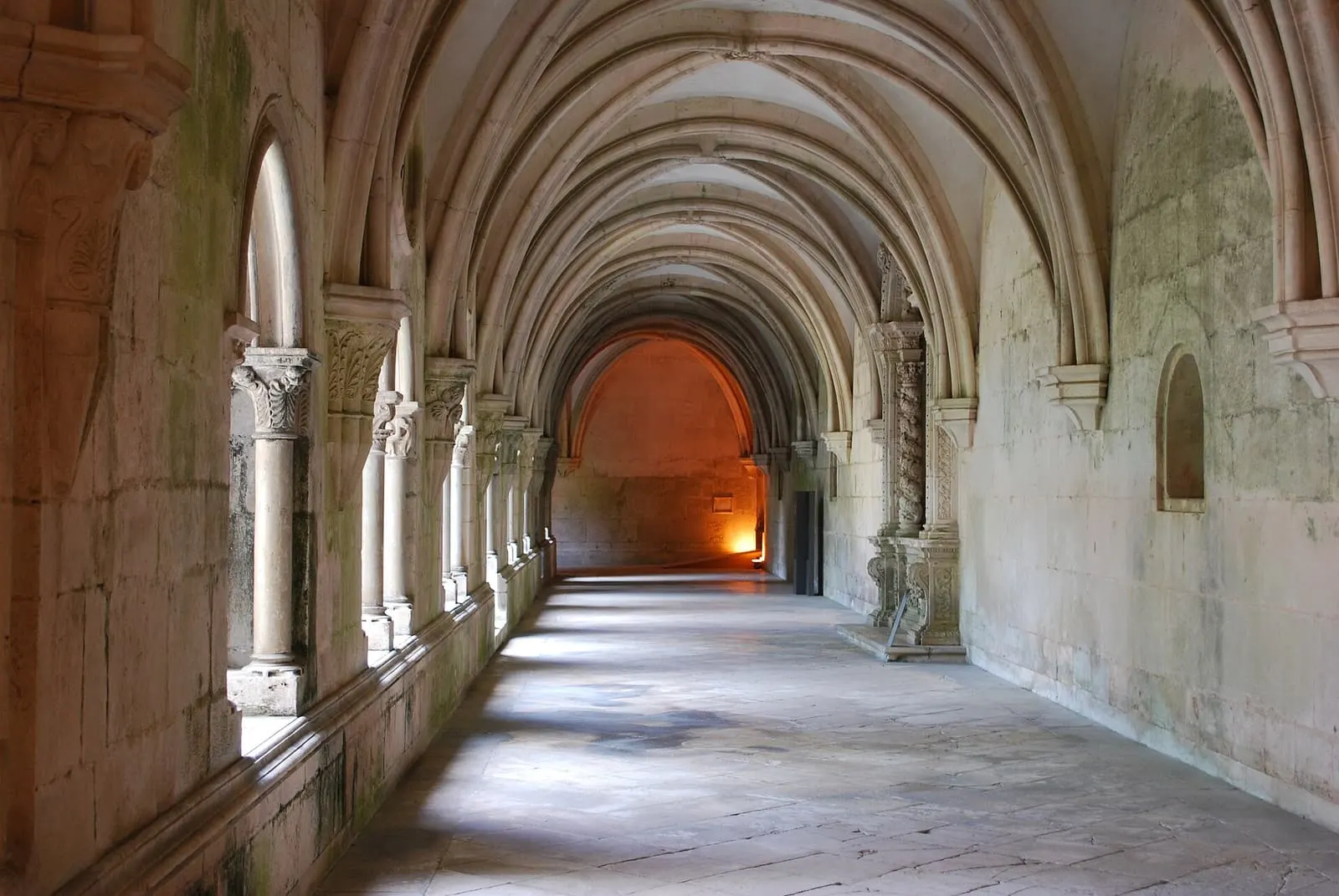
A monastery is not only read through its church. The true key is the cloister: around it are distributed the chapter house, the refectory, the dormitory, and the kitchen, organizing the daily routine of a community whose time was measured by the tolling of bells.
The Organization of Space
The heart of the monastery is the cloister, a quadrangular courtyard surrounded by galleries that connects all the dependencies and separates the world of the monks from the outside world. To the north or south rises the church, usually with a cruciform plan; around it are distributed the chapter house, where the community gathered, the refectory, the dormitory, and work dependencies such as the kitchen, the granary, and the presses. Large complexes, like Alcobaça or Tibães, even included several enclosures, guesthouses, and extensive walled farms.
This architecture spans all styles: the austere Romanesque of the early houses, the verticality of Gothic Alcobaça and Batalha, the exuberance of Manueline Jerónimos, and the opulence of Baroque reforms in the 17th and 18th centuries, with gilded carvings and azulejo tiles covering entire cloisters.
Wealth, Knowledge, and Extinction
More than houses of prayer, monasteries were economic and cultural engines. They dominated vast territories, organized agricultural production, copied and preserved books, and educated literate elites. Santa Cruz de Coimbra, of the Canons Regular of Saint Augustine, was one of the greatest intellectual centers of the Portuguese Middle Ages and the pantheon of the first kings.
This long history ended abruptly. The decree of May 30, 1834 abolished male religious orders and incorporated their assets into the National Treasury. The buildings were sold, demolished, or repurposed, and many have survived mutilated. Their recovery as national heritage—three of them classified by UNESCO—has restored the central place they always held in the country’s identity.
Monastery of Alcobaça
Mother house of Cister in Portugal, masterpiece of Cistercian Gothic.
MONASTERYMonastery of Batalha
Gothic-Manueline ex-voto erected in memory of Aljubarrota.
MONASTERYJerónimos Monastery
Pinnacle of Manueline style, by the Tagus, in Belém.
MONASTERYMonastery of Tibães
Mother house of Portuguese Benedictines, Baroque splendor.
MONASTERYMonastery of Santa Cruz
Pantheon of the first kings and cultural hub in Coimbra.
MONASTERYSão Vicente de Fora
Grand Mannerist monastery and pantheon of the Braganzas.
Frequently asked questions
- What is the difference between a monastery and a convent?
- Strictly speaking, a monastery is the house of monks from contemplative monastic orders—primarily Benedictines and Cistercians—who live in a closed community and place central value on stability in the same location. A convent refers to the house of mendicant orders, such as Franciscans and Dominicans, which are more focused on preaching and urban life. In practice, Portuguese popular usage often interchanged the two terms.
- What was the first Cistercian monastery in Portugal?
- São João de Tarouca, in the municipality of Lamego, was the first monastery of the Cistercian Order on Portuguese soil, affiliated around 1144. Alcobaça, founded from scratch in 1153, became the mother house and the largest and most influential Cistercian monastery in the kingdom.
- Why are many Portuguese monasteries in ruins or repurposed?
- In 1834, the liberal decree by Joaquim António de Aguiar abolished male religious orders and nationalized their assets. The monasteries were sold at public auction or repurposed as barracks, hospitals, schools, and town halls, which explains their uneven survival.