Monuments
Carmo Convent (Lisbon)
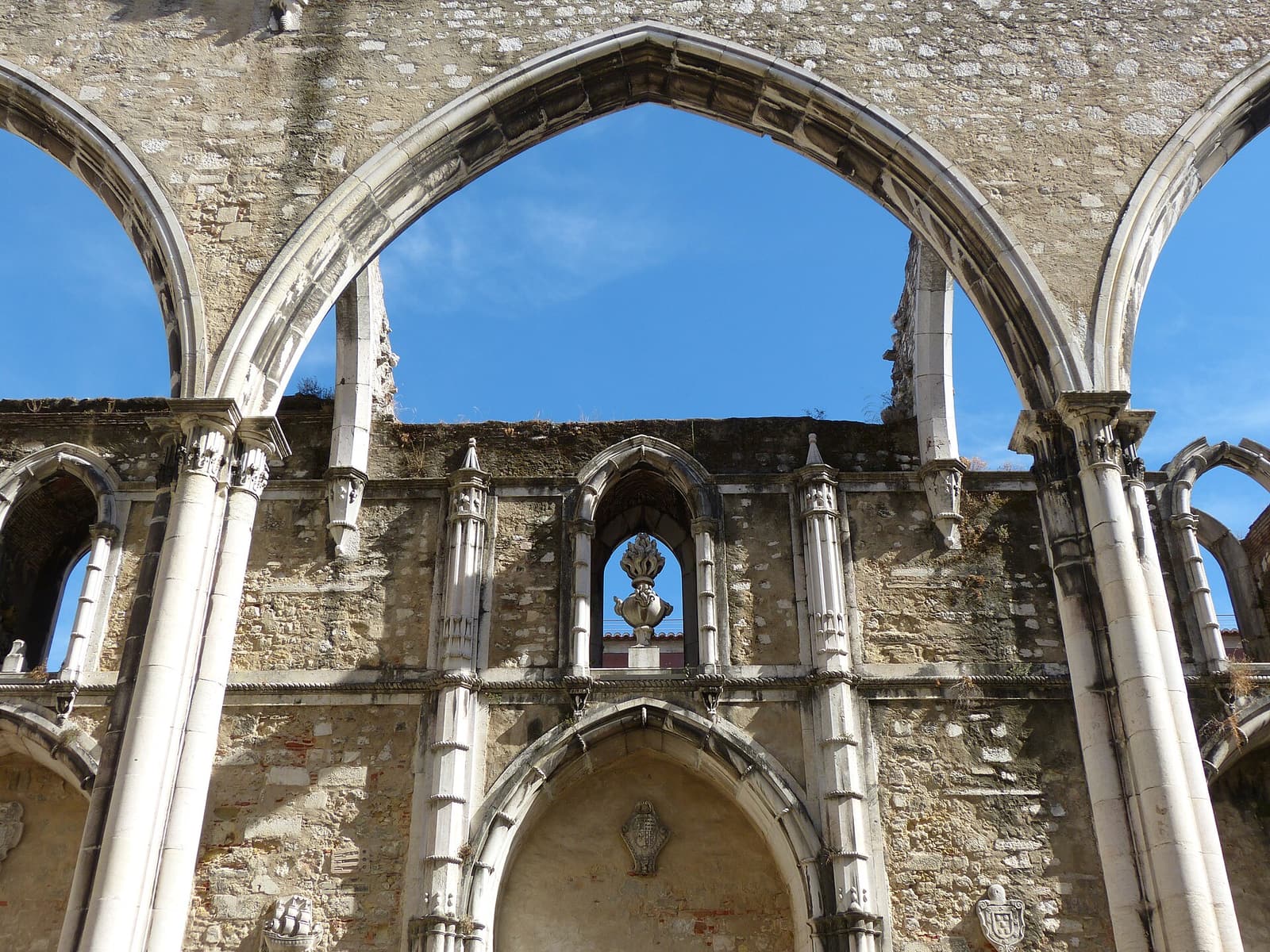
The Gothic ruins of the Carmo Convent, on Largo do Carmo in Lisbon, a living memorial to the 1755 earthquake and home of the Carmo Archaeological Museum.
- Location
- Lisboa, Lisboa
- Built
- 1389–1423
- Style
- Gótico mendicante
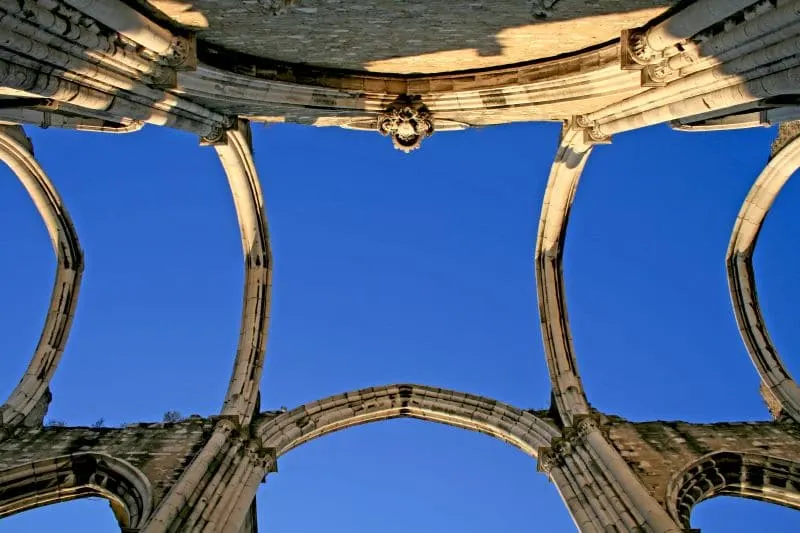
High on the hill that separates the Baixa from the Bairro Alto, the broken arcades of the Carmo Convent rise against the Lisbon sky. Stripped of its vault and exposed to the elements, this former Gothic church is one of the most moving places in the city: ruin, memorial and museum all at once, its very incompleteness preserves the memory of the disaster that redefined the Portuguese capital.
Foundation and apogee
The convent was founded in 1389 by D. Nuno Álvares Pereira, the Constable who had commanded the Portuguese troops at the battle of Aljubarrota and who, at the end of his life, took the Carmelite habit. The building of the church continued until around 1423, in a mendicant Gothic of great sobriety, close to the idiom then rising at the Batalha Monastery, itself a votive monument of the House of Avis.
With its broad naves and a transept pierced by pointed arches, the Carmo church established itself as the most imposing Gothic temple in Lisbon, rivalling in scale the Lisbon Cathedral. Around it grew a vast conventual enclosure spanning much of the hill, fed by the waters that the Águas Livres Aqueduct would later bring to the city.
The 1755 earthquake
On 1 November 1755, the great earthquake and the fire that followed laid the convent to ruin. The vault of the nave collapsed on the faithful gathered for the All Saints’ Day mass, and the building never recovered its integrity. Throughout the nineteenth century, in a time already marked by the Romantic taste for medieval ruins, the decision was taken to preserve the naves uncovered rather than rebuild them.
To leave the Carmo open to the sky was, more than a resignation, a choice: to turn the ruin into a permanent document of the force that shook Lisbon.
That decision made the Carmo the most eloquent testimony to the catastrophe still visible in the urban fabric — a silent counterpoint to the rational city rebuilt according to the principles of Pombaline Lisbon that was reborn in the Baixa, at the foot of the hill.
Museum and memory
Since 1864, the chancel of the former church has housed the Carmo Archaeological Museum, created by the Association of Portuguese Archaeologists under the direction of Joaquim Possidónio Narciso da Silva. The apsidal chapels bring together a heterogeneous collection of Roman and medieval epigraphy, Gothic tombs, architectural fragments and curiosities such as pre-Columbian mummies — a kind of cabinet of the history of Portuguese archaeology itself.
The Largo do Carmo, at the door of the convent, is also inscribed in contemporary history: it was there that, on 25 April 1974, the last president of the Council of the Estado Novo surrendered, ending the Carnation Revolution before the medieval ruins. The popular Portuguese expression “cair o Carmo e a Trindade” still preserves the memory of this place today.
Part of the ensemble of former convents and monasteries that punctuate the capital’s landscape, the Carmo Convent has been classified as a National Monument since 1907. A few steps away, in the Chiado, the Carmo Church and the Santa Justa Lift complete one of the most history-laden routes in Lisbon, between the hill of São Jorge Castle and the river.
Frequently asked questions
- Why is the Carmo Convent in ruins?
- The church collapsed during the 1755 earthquake and the fire that followed. The decision was taken not to rebuild it in full, leaving the naves open to the sky as a testimony to the catastrophe.
- What can be visited today at the Carmo Convent?
- The roofless Gothic naves and the Carmo Archaeological Museum, installed in the chancel of the former church, with collections of epigraphy, sculpture, medieval tombs and mummies.
- Who founded the Carmo Convent?
- It was founded in 1389 by D. Nuno Álvares Pereira, the Constable of Portugal and victor of Aljubarrota, who withdrew here as a Carmelite friar.
Sources
Keep exploring
Heritage nearby
More places to discover from here. Approximate straight-line distances, within 50 km.