Monuments
Convento de Jesus (Setúbal)
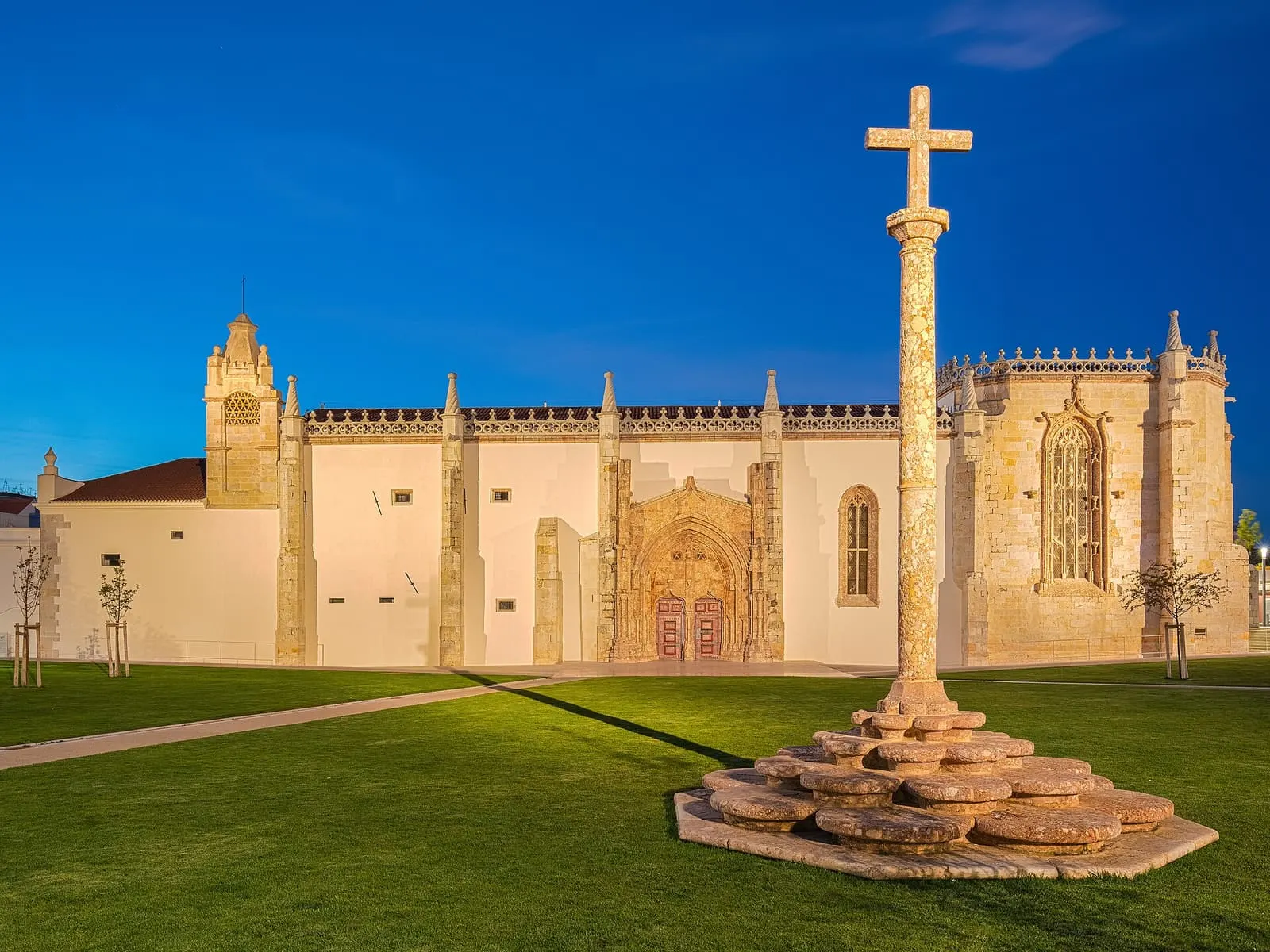
Convento de Jesus in Setúbal: the inaugural work of the Manueline style designed by Diogo de Boitaca, with twisted columns in Arrábida stone and the…
- Location
- Setúbal, Setúbal
- Built
- 1490–1500
- Style
- Manuelino
The Convento de Jesus in Setúbal is one of the founding works of Portuguese Renaissance architecture. Built at the turn of the fifteenth into the sixteenth century, it is widely recognised as the first monument conceived according to the grammar that would come to be called the Manueline style, anticipating by some years the great undertakings at Belém and Batalha. Its importance lies not in scale — it is a building of modest proportions — but in the experimental and inaugural character of the solutions first tried out here.
Foundation and construction
The origin of the convent is linked to a vow made by Justa Rodrigues Pereira, foster nurse of the future king D. Manuel I and a figure connected to the household of the dukes of Beja. Authorisation for the monastery’s foundation was granted by a bull of Pope Innocent VIII in 1489, with the royal consent of D. João II the following year; the foundation stone is thought to have been laid in 1490. Intended for a community of Poor Clare nuns, the complex was substantially completed around 1500.
The design of the church is attributed to Diogo de Boitaca, the same master who would shortly afterwards begin the Mosteiro dos Jerónimos in Lisbon. At Setúbal, Boitaca still worked with the freedom of one who experiments, without the weight of a monumental royal programme, and it was precisely that latitude that allowed the boldness of the structural solutions.
A new language in Arrábida stone
The interior’s most celebrated feature is the three tall twisted columns — spiralling shafts, like twisted ropes — that divide the nave aisles and rise to vaults whose ribs are likewise spiralled. The church is organised as a hall church (Hallenkirche), with the three aisles at the same height, this being the first known instance of this typology in Portugal. The result is a unified, luminous space, very distinct from the compartmented verticality of the earlier Gothic.
All this stonework was executed in the characteristic Arrábida stone, a pinkish-brown limestone quarried from the neighbouring range, whose warm tone lends the interior a singular atmosphere. The portal and the chancel likewise stand out for their expressive use of this local material.
The twisted columns of the Convento de Jesus are, strictly speaking, the gesture that opens the Manueline vocabulary: before they became a widespread ornament, they were here an engineering problem solved with elegance.
From hospital to the Museu de Setúbal
After the convent was suppressed in the context of the liberal reforms of the nineteenth century, the building saw various uses, even serving as the city’s hospital until 1959. In 1961 it reopened with a cultural vocation, and the complex — church, cloister and former chapter house — today houses the Museu de Setúbal. The collection is notable for its assemblage of sixteenth-century Portuguese painting, with works associated with the so-called master of the Setúbal school, and for groups of tilework that converse with the long tradition of the Portuguese azulejo.
The monument’s significance was recognised early: the church was classified as a National Monument in 1910 and, in 2011, the complex received the European Heritage Label. Visitors to Setúbal will also find, a short distance away, the same heritage at the neighbouring Igreja de Jesus, and may extend the itinerary to the seclusion of the Convento da Arrábida, in the range that gave its name — and its stone — to this inaugural work.
Frequently asked questions
- Who founded the Convento de Jesus in Setúbal?
- It was founded by Justa Rodrigues Pereira, the wet nurse of D. Manuel I, who thus fulfilled a vow. Papal authorisation dates from 1489 and the foundation stone was laid in 1490.
- Why is it considered the first Manueline monument?
- The church, designed by Diogo de Boitaca around 1494, introduced for the first time in Portugal the twisted columns and the hall-church scheme that would come to define the Manueline style.
- What can be visited today at the Convento de Jesus?
- The church, the cloister and the former chapter house survive and house the Museu de Setúbal, with its remarkable collection of sixteenth-century painting and azulejos.
Sources
Keep exploring
Heritage nearby
More places to discover from here. Approximate straight-line distances, within 50 km.