Periods & Styles
Neo-Arab Style in Portugal
The Neo-Arab style in Portugal: nineteenth-century Orientalist revivalism, from Sintra to the Campo Pequeno Bullring and the Arab Hall in Porto.
- Built
- c. 1840–1910
- Style
- Neoárabe (neomourisco / neoislâmico)
The Neo-Arab style — also called Neo-Moorish, Neo-Mudéjar or Neo-Islamic — was one of the currents of Romantic architecture that swept across nineteenth-century Europe, freely recreating the forms of medieval Islamic art. In Portugal it asserted itself above all in the second half of the nineteenth century, at a moment of political stabilisation and growing appetite for the picturesque and the exotic. Associated with luxury and escapism, it was also, owing to the expense its decoration demanded, a relatively rare revivalism when compared with the Neo-Gothic or the Neo-Manueline.
A caprice imported from an imagined Orient
The Neo-Arab style was not born of any local continuity with Andalusian or Mudéjar architecture, but of a Romantic and literary gaze upon the Orient. The fascination with the Alhambra of Granada, spread through engravings, albums and travellers’ accounts, supplied the decorative grammar that architects drew upon: the horseshoe arch, the polylobed arch, the bulbous dome, the lacework stucco, the geometric tilework and the ornamental calligraphy. It was an Orient reconstructed from afar, more dreamed than studied, integrated into the vast repertoire of the revivalisms of Romanticism.
The Portuguese Neo-Arab is less the memory of al-Andalus than the fantasy of an Orient read in books — an architecture of stage scenery, where the exotic counts as pleasure and not as root.
From Sintra to the capital: the first essays
It was through Sintra that the taste arrived, by the hand of the prince consort King Ferdinand II. In reworking the old Manueline convent that would become the Palácio Nacional da Pena, the monarch introduced, amid turrets and battlements, elements of Arab inspiration that would set a precedent. Shortly afterwards, the English industrialist Francis Cook and the architect James Knowles transformed the Palácio de Monserrate into an exuberant synthesis of oriental motifs, with its central hall crowned by a filigreed dome — a kind of Brighton Pavilion transposed to the hills. Still in Sintra, the Quinta do Relógio, attributed to António Tomás da Fonseca, would prolong this imagery of exotic retreat.
The consecration: Campo Pequeno and the Arab Hall
The most celebrated example of the Neo-Arab in Portugal is the Campo Pequeno Bullring in Lisbon. Designed by António José Dias da Silva and inaugurated on 18 August 1892 in the presence of the royal family, it rises upon a structure of iron and brick, modern materials concealed beneath an Islamicising garb. The continuous façade, faced with natural-coloured brick to underline its Mudéjar character, opens into round and horseshoe arches, crowned by turrets with bulbous domes and by a central cupola. It is the Portuguese manifesto of the style, where nineteenth-century engineering and Orientalist decoration merge.
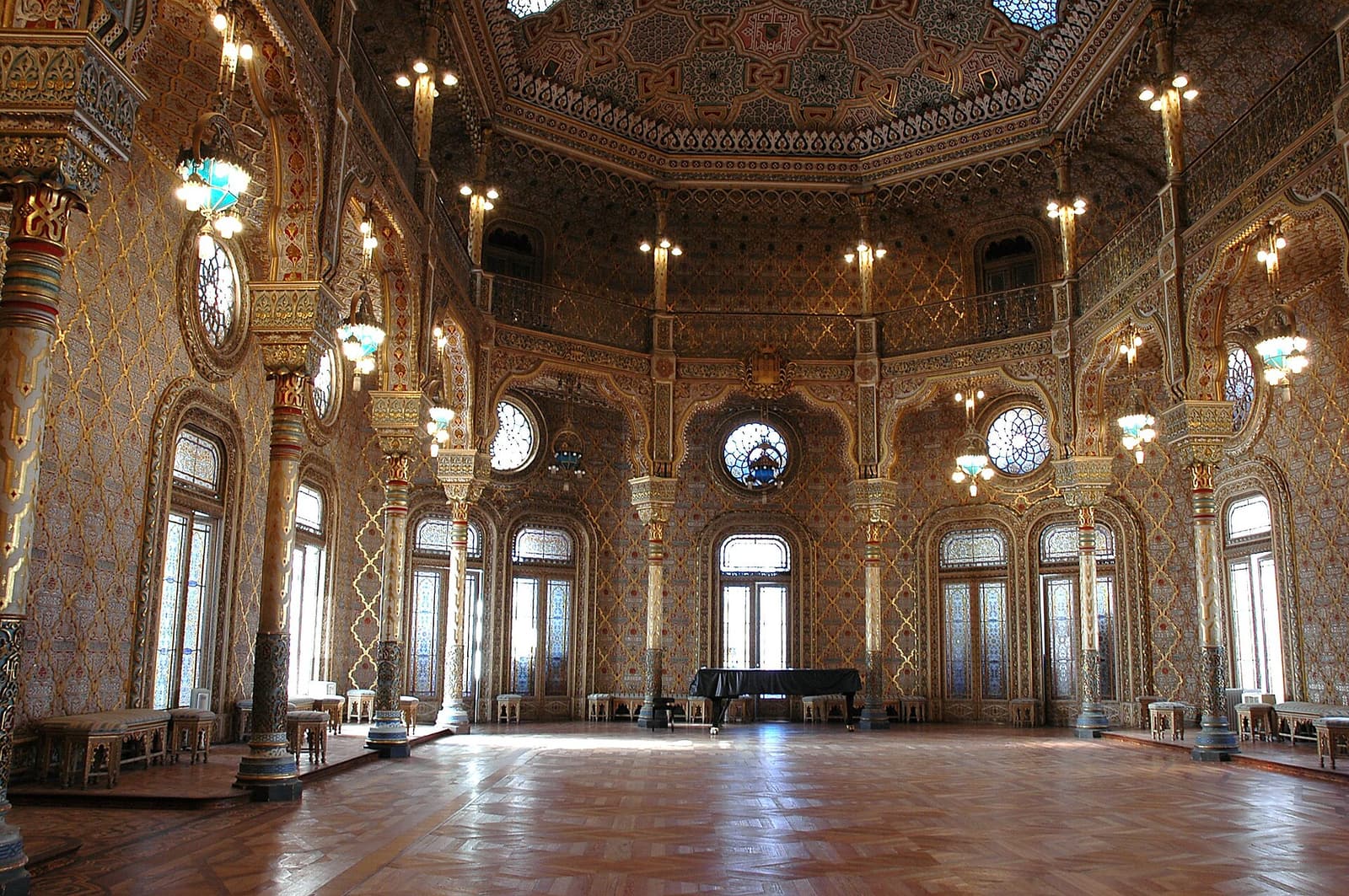
In Porto, the Arab Hall of the Palácio da Bolsa, decorated from the middle of the century under a design by Gustavo de Sousa and continued by Tomás Soller, carried ornamental virtuosity to its extreme: walls and vaults covered in gilded stucco and calligraphic inscriptions that reinterpret the Alhambra as a backdrop for bourgeois display. Alongside these landmarks, private houses and pavilions multiplied — such as the celebrated Neo-Arab House on Rua José Falcão in Porto —, which made of exoticism a sign of distinction and cosmopolitanism.
A legacy of stone, iron and fantasy
More than a coherent school, the Neo-Arab was a gesture of taste: episodic, costly and profoundly bound to the Romantic spirit and the Orientalism of the age. It survived above all in buildings of leisure, residences of exceptional ostentation and venues of spectacle, where the exotic could flourish without the cautions of everyday use. Today, those buildings are precious testimonies to how nineteenth-century Europe imagined the Orient — and to how Portugal, with its own Islamic memory, chose to recreate it not as inheritance, but as dream.
Frequently asked questions
- What is the Neo-Arab style?
- It is a revivalist and Romantic current of the nineteenth century that recreated the forms of medieval Islamic art — horseshoe arches, bulbous domes, lacework stucco and ceramic facings —, born of the European fascination with the exotic and with the Orient.
- What is the best-known Neo-Arab building in Lisbon?
- The Campo Pequeno Bullring, designed by António José Dias da Silva and inaugurated in 1892, with its exposed-brick façade, turrets and horseshoe arches.
- Where did the Neo-Arab taste first reach Portugal?
- In Sintra, through King Ferdinand II and the Romantic remodelling of the Palácio da Pena, followed by the Palácio de Monserrate, reworked by the English industrialist Francis Cook.