Intangible Heritage
Festa do Povo of Campo Maior (Community Festivities)
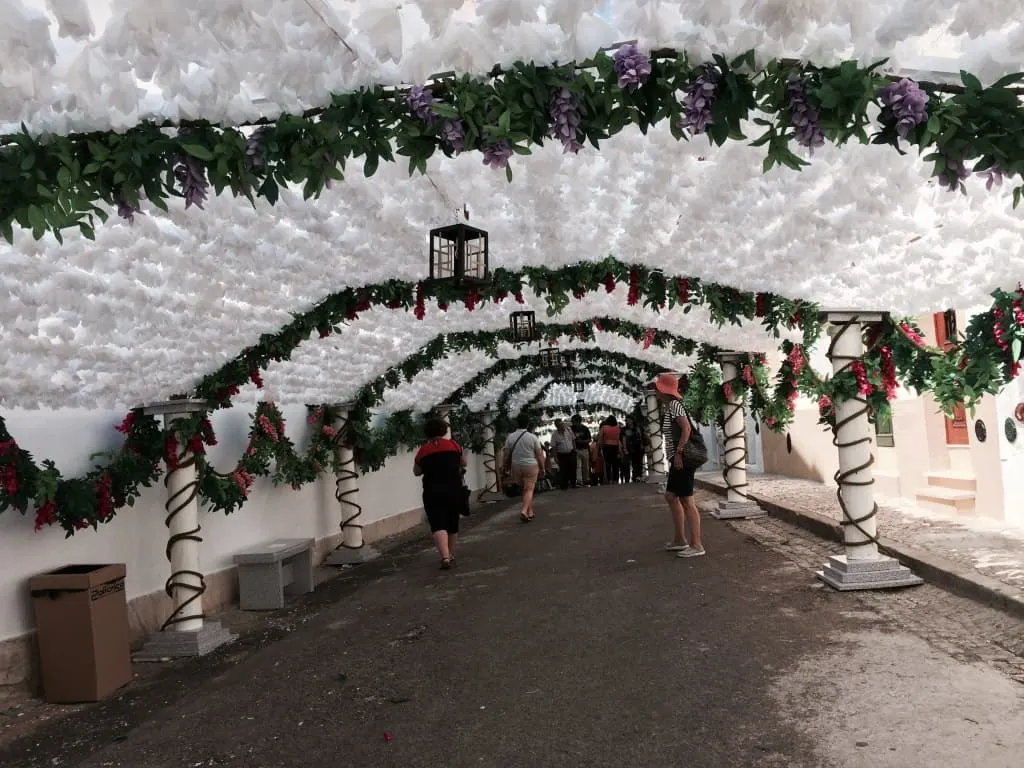
Festa do Povo of Campo Maior: streets adorned by the townspeople with millions of paper flowers, recognised by UNESCO in 2021 in the Alto Alentejo.
- Location
- Campo Maior, Portalegre
The Festa do Povo of Campo Maior — also known as the Festas do Povo, Festas das Flores or Festas dos Artistas — is a unique collective celebration in which the inhabitants of this border town in the district of Portalegre cover their streets with millions of handmade paper flowers, kept secret until the eve of the event. In December 2021, UNESCO inscribed it on the Representative List of the Intangible Cultural Heritage of Humanity (reference 01604), enshrining one of the most expressive traditions of the Alto Alentejo and of Portuguese intangible cultural heritage.
A town transformed overnight
The most striking feature of the festival is its secrecy. For months — sometimes almost a year — the residents of each street gather at night, in houses and warehouses, to design and build the decorations: flowers, arches, panels and entire scenes, made of crepe paper, card and wire, without any industrial support. Each street committee guards its project away from prying neighbours, in an atmosphere of healthy artistic rivalry.
On the eve of the opening, the decorations are finally assembled. The town, which goes to sleep bare, wakes up entirely covered in colour: ceilings of flowers, dressed façades, streets turned into open-air galleries. It is this sudden metamorphosis — the anonymous effort of hundreds of people revealed all at once — that gives the festival its almost magical character.
There are no bought flowers nor professional decorators: everything springs from the hands of the townspeople themselves, who organise by streets and decide, collectively, when to hold the festival again.
Religious roots and collective identity
The origin of the festivities is linked to the cult of Saint John the Baptist, patron saint of Campo Maior since the sixteenth century. Over time, the devotional dimension became intertwined with the affirmation of the community, and the custom of decorating the streets with paper flowers took root throughout the nineteenth and twentieth centuries as a central expression of local identity.
The festival follows no regular calendar. It is held when the townspeople so decide, in an informal assembly, which may mean intervals of several years between editions. This unpredictability heightens the sense of an extraordinary event and mobilises, at each celebration, virtually the entire town. The craftsmanship is passed down within families and in schools, ensuring the continuity of flower-making techniques across generations.
International recognition and nearby heritage
The Portuguese nomination, approved at the 16th session of the UNESCO Intergovernmental Committee, underscored the value of the festival as an example of community creativity and social cohesion, in which open doors and the absence of social distinctions mark the days of celebration. The inscription forms part of the growing body of intangible heritage of humanity recognised in Portugal, alongside other Alentejo expressions such as the Cante Alentejano.
Campo Maior lies just a few kilometres from the Spanish border, in a land of fortifications and plains. Visitors to the town find, beyond the living memory of the festivities, a historic centre of borderland character and the coffee tradition that also distinguishes the locality. The Festa do Povo nonetheless remains its greatest emblem: proof that an entire people can, in secret and together, make their streets blossom.
Frequently asked questions
- When does the Festa do Povo of Campo Maior take place?
- It has no fixed date: it is held irregularly, by collective decision of the townspeople, with intervals that may stretch to several years. It traditionally takes place in August, linked to the cult of Saint John the Baptist, patron saint of the town.
- Why was the festival recognised by UNESCO?
- In 2021 it was inscribed on the Representative List of the Intangible Cultural Heritage of Humanity (ref. 01604) for illustrating community creativity, the craftsmanship of paper flowers and a strong sense of collective belonging.
- How are the street decorations made?
- They are entirely handmade, in paper and card, produced in secret by the residents of each street over many months. They are only revealed on the eve of the festival, transforming the town overnight.