Intangible Heritage
Festa dos Tabuleiros of Tomar
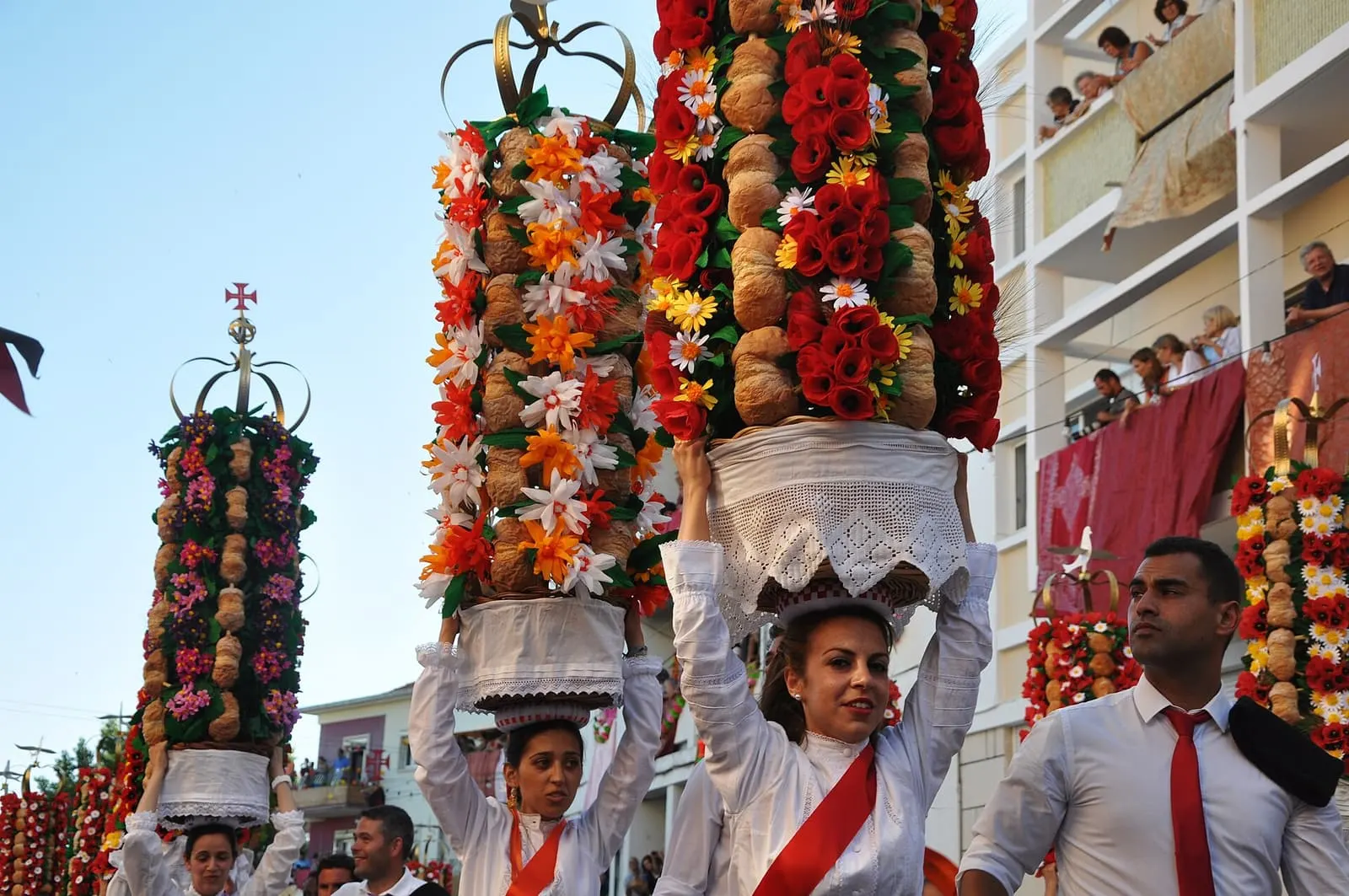
The Festa dos Tabuleiros of Tomar, a quadrennial celebration of the cult of the Holy Spirit in which young women carry trays of bread and flowers on their heads.
- Location
- Tomar, Santarém
- Built
- tradição documentada desde o século XIX
The Festa dos Tabuleiros is the most celebrated expression of popular culture in Tomar, in the district of Santarém, and one of the most singular festivities in Portugal. Every four years, hundreds of young women walk through the city’s streets carrying the tabuleiros on their heads — tall structures of loaves, flowers and ears of wheat — in a procession that mobilises the entire community and draws hundreds of thousands of visitors. In May 2023 it was inscribed on the National Inventory of Intangible Cultural Heritage.
Origins: from wheat to the Holy Spirit
The festival interweaves two roots. On the one hand, it evokes ancient agrarian celebrations of offering the first fruits of the harvest, linked to the fertility of the land. On the other, it forms part of the cult of the Empire of the Divine Holy Spirit, a devotion that spread through Portugal from the fourteenth century onward and that tradition associates with the deeds of Queen Saint Isabel and King Dinis. It was within this Christian framework that the act of sharing bread with the poorest — central to the festival — acquired its meaning: the equal distribution of gifts, bringing rich and poor together in the same celebration of Pentecost.
Although the firmest documented references date back to the nineteenth century, the festival’s present form took shape in the mid-twentieth century. Tomar was also the seat of the Order of Christ, heir to the Templars, whose mother house is the Convento de Cristo, and the Cross of Christ that crowns many tabuleiros symbolically links the festival to that historical memory of the city.
The tabuleiro and the procession
The tabuleiro is the festival’s emblem. Over a basket rises a shaft of canes onto which thirty loaves are threaded, arranged in rows and separated by multicoloured paper flowers and ears of wheat. At the top, a crown topped by the dove of the Holy Spirit or the Cross of Christ. The traditional rule is demanding: the tabuleiro must be as tall as the young woman who carries it, which calls for remarkable balance over several kilometres of route.
Each tabuleiro is at once a religious offering, a feat of physical endurance and a collective work — made by the families, blessed by the community and balanced by the young woman who bears it.
On the day of the Cortejo dos Tabuleiros, the young women dress in white, with a coloured sash over the shoulder, and advance accompanied by a young man who helps to bear the weight. The streets appear lined with bedspreads hung from windows and carpets of flowers on the ground. The programme stretches over about ten days and also includes the Cortejo dos Rapazes (the Procession of the Young Men), the arrival of the bulls and other ceremonies associated with the Holy Spirit.
The Pêza: sharing and continuity
The moment that gives the festival its ultimate meaning is the Pêza, or bodo: the distribution of the bread, meat and wine that the tabuleiros symbolise, shared out among the population on the day after the procession. It is in this gesture of sharing that the festival reveals its origin of solidarity, keeping alive a communal practice that is centuries old.
The four-year cycle, fixed since 1987, makes each edition an awaited and unrepeatable event, passed down from generation to generation. The festival belongs to the vast universe of Portuguese intangible cultural heritage, alongside other communal celebrations such as the Holy Spirit Festivals of the Azores, with which it shares devotion to the Divine. Visiting Tomar outside the festival season also allows one to discover its built heritage, from the Castelo de Tomar to the monumental ensemble that crowns the hill above the Nabão river.
Frequently asked questions
- How often is the Festa dos Tabuleiros held?
- Since 1987 it has been held every four years, usually in July. The most recent edition took place in 2023 and the next is scheduled for 2027.
- How is a tabuleiro made?
- Each tabuleiro gathers thirty loaves threaded onto canes arranged vertically over a basket, adorned with paper flowers and ears of wheat, and topped by a crown bearing the dove of the Holy Spirit or the Cross of Christ. By tradition, it must be as tall as the young woman who carries it on her head.
- Is the Festa dos Tabuleiros a UNESCO heritage site?
- It was inscribed on the National Inventory of Intangible Cultural Heritage in May 2023 and is currently a candidate for UNESCO's Intangible Cultural Heritage of Humanity.