Monuments
Castle of Silves
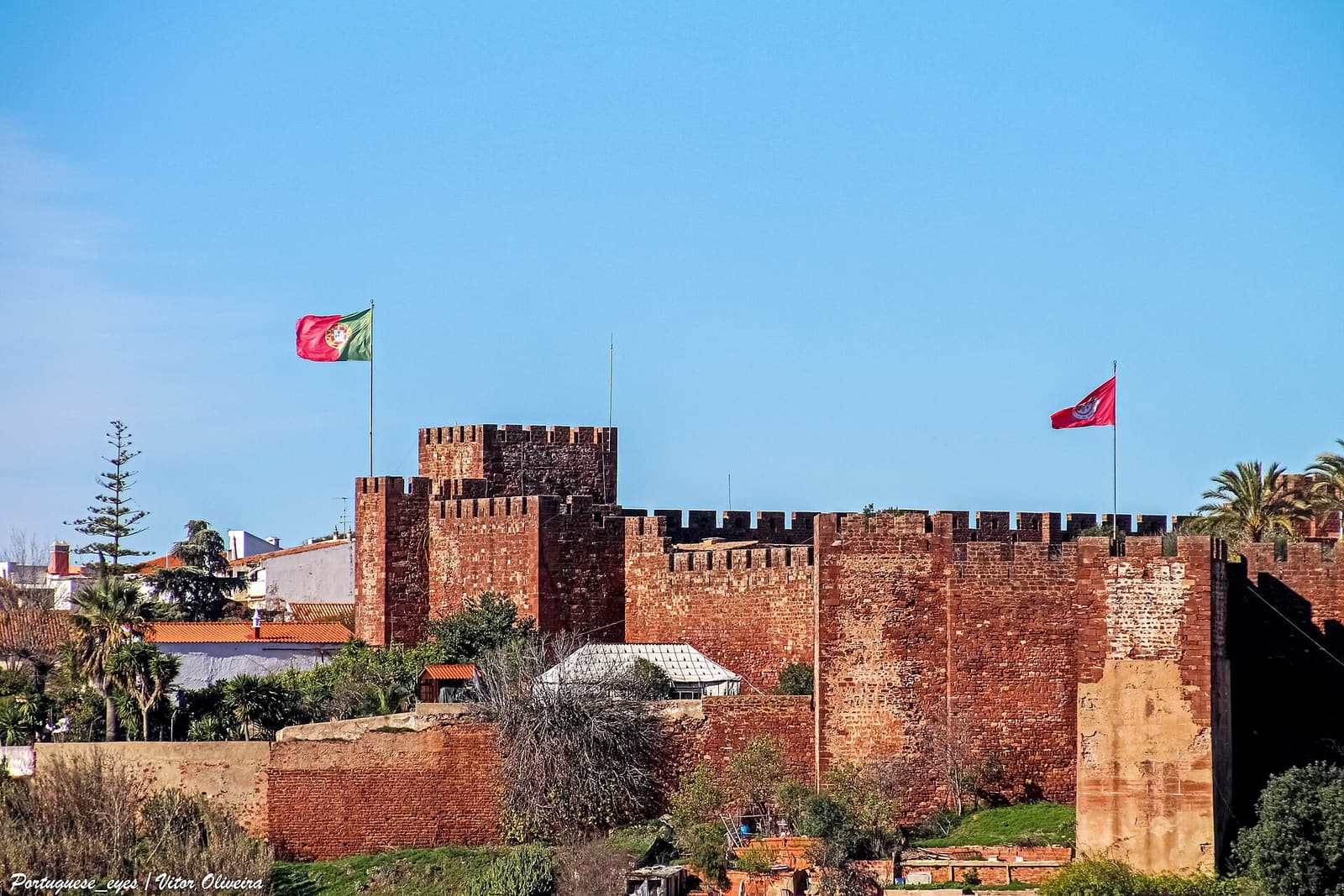
The Castle of Silves, in Faro: the largest Muslim fortification in the Algarve, built in rammed earth and red sandstone, the former citadel of the Islamic city…
- Location
- Silves, Faro
- Built
- séc. VIII–XIII
- Style
- Arquitetura militar islâmica (período almóada)
Rising on the hill that commands the valley of the river Arade, the Castle of Silves is the largest and most impressive fortification of Muslim origin in the Algarve and one of the most complete testimonies to Islamic military architecture in Portugal. Its red sandstone walls cut across the sky of the ancient Xelb, capital of a territory that, between the 8th and 13th centuries, rivalled Lisbon, Seville and Córdoba in prestige.
The citadel of Xelb
What survives today corresponds above all to the alcáçova, the fortified citadel that crowned the city and housed the administrative and military elite. The ensemble comprises a continuous wall, with a wall-walk extending for some 388 metres, and eleven towers — nine attached and two projecting albarrana towers, linked to the curtain by arches. Access was through a double gate with an atrium, flanked by towers, a defensive solution typical of Andalusi fortifications.
The building technique is the monument’s most distinctive feature: the core of the walls is of military rammed earth, soil compacted in moulds, later faced with ashlars of Silves sandstone. It is this reddish sandstone, quarried in the region itself, that gives the castle the warm tone that makes it unmistakable from afar.
The colour of the Castle of Silves is not a decorative addition, but the very geology of the Algarve turned into architecture: the red sandstone that defines the landscape rose here as a wall.
From Islamic foundation to the Reconquista
The earliest references to the fortified city date back to the 10th century, when the geographer al-Razi described Silves as possessing a castle and the finest town of the Algarve. Most of the visible structures, however, date from the Almohad period (12th–13th centuries), the phase of urban apogee in which Xelb was described as sumptuous and populous.
Within the enclosure, of some 12,000 m², remarkable remains are preserved: the great cistern, dug to ensure the water supply in the event of a siege, underground silos for storing grain, and the foundations of an Almohad palace — a rare example of Islamic palatial architecture known in Portuguese territory.
The Christian conquest was contested and protracted. The city fell in 1189 into the hands of King Sancho I, with the help of crusaders, returned to Almohad rule a few years later, and was only definitively integrated into the kingdom of Portugal in the mid-13th century, under King Afonso III, when the Algarve became part of Portuguese territory.
Significance and visit
Classified as a National Monument since 1910, the Castle of Silves is a central piece in the reading of the Andalusi past of southern Portugal and one of the highlights of the ensemble of Portuguese castles. Its importance sets it apart from other medieval strongholds of Christian origin, such as the Castle of Marvão, and places it within the long history of the fortifications that shaped the national territory.
Today, walking the wall-walk allows the eye to embrace the Serra de Monchique, the historic houses of the town and the old cathedral, heir to a city that was for centuries one of the most brilliant of the western edge of peninsular Islam.
Frequently asked questions
- What material are the walls of the Castle of Silves made of?
- The walls were raised in military rammed earth and faced with the red sandstone of Silves, the local sandy stone that gives the monument its characteristic reddish hue.
- Why was the castle known as Xelb?
- Xelb (or Xilb) was the Arabic name of the city during Muslim rule, between the 8th and 13th centuries. It was the capital of a prosperous territory of the Gharb al-Andalus, compared in grandeur to Lisbon, Seville and Córdoba.
- Can the Castle of Silves be visited?
- Yes. The grounds of the citadel are open to the public, with a wall-walk, cistern and remains of the Almohad palace, and it is managed by the municipality of Silves.
Sources
Keep exploring
Heritage nearby
More places to discover from here. Approximate straight-line distances, within 50 km.