Typologies
Hospitals and Holy Houses of Mercy (Misericórdias)
Churches, hospitals and buildings of the Holy Houses of Mercy (Misericórdias) in Portugal: origins in 1498, architectural typology and role in charitable assistance.
- Built
- 1498-séc. XX
- Style
- Arquitetura chã, maneirista e barroca
The Holy Houses of Mercy (Santas Casas da Misericórdia) are one of the most remarkable Portuguese institutional creations and have left a vast built legacy spread across almost the entire national territory and the former overseas dominions. Confraternities of a charitable and devotional character, they originated with the first brotherhood founded in Lisbon in 1498, on the initiative of Queen Leonor, widow of King John II and sister of King Manuel I. The model spread with remarkable speed: the Compromisso — the statute that governed each confraternity —, first printed in 1516, multiplied from the north to the south of the kingdom, fixing an organisational template and, by extension, a repertoire of buildings recognisable throughout the country.
A network of charitable assistance and its building programme
The vocation of the Misericórdias was summed up in the fourteen works of mercy — seven spiritual and seven corporal — that structured all their action: to feed the hungry, clothe the naked, visit the imprisoned, heal the sick, bury the dead. From this programme arose a characteristic set of buildings, which gathered, within a single urban nucleus, a church, a chapter house (the brotherhood’s meeting room), a hospital, a hostel for pilgrims and the poor and, at times, a refuge for women. From 1564, the Misericórdia of Lisbon even came to administer the Royal Hospital of All Saints (Hospital Real de Todos-os-Santos), inaugurating an association between confraternity and hospital that would become structural: from the sixteenth to the twentieth century, the Misericórdias managed most Portuguese hospitals.
The originality of the model lies in the fusion of devotion and administration: the same brotherhood that prayed for the dead managed accounts, hospital beds and orphans’ dowries, anticipating by centuries the idea of organised social welfare.
The architectural language
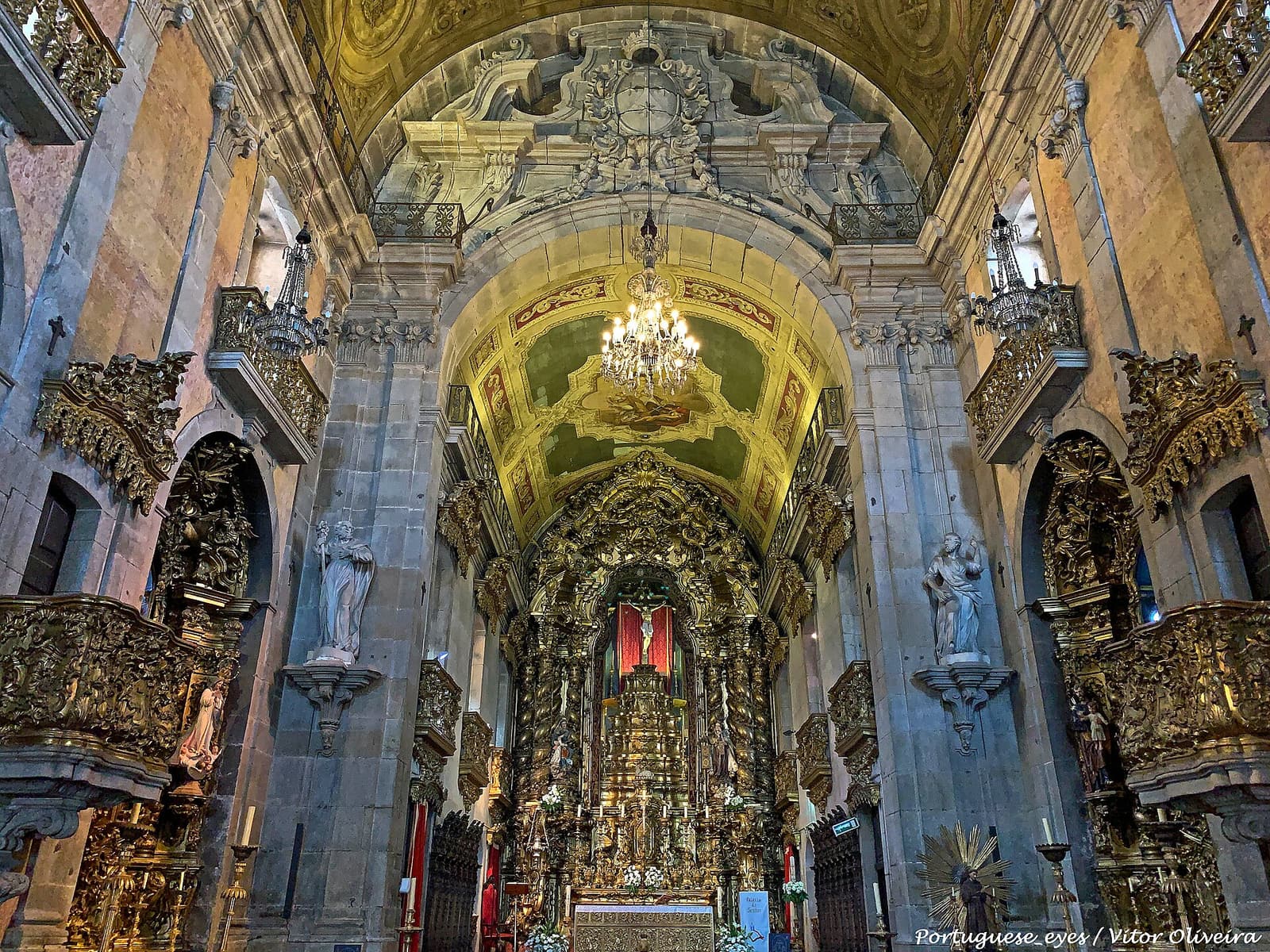
The churches of the Misericórdias follow, in the vast majority, a sober typology: a single nave, a narrower and deeper chancel, and a façade on which the institution’s emblem stands out. This restraint reflects both the economic limits of the confraternities and the dominant taste of the sixteenth and seventeenth centuries — the so-called plain architecture (arquitetura chã), of Mannerist roots, marked by decorative economy and structural clarity. A recurring element is the galilee or covered porch that precedes the entrance, sheltering the brethren during processions and public ceremonies.
From the eighteenth century onwards, many Misericórdias renovated their buildings according to the taste of Baroque architecture in Portugal, enriching façades and interiors with gilded woodwork, azulejo tiling and scenographic altarpieces. The most celebrated example is the Church of the Misericórdia of Porto, on Rua das Flores, whose façade was rebuilt by Nicolau Nasoni in the middle of the century, introducing Baroque and Rococo exuberance to the north of the country.
A dispersed and living heritage
Unlike typologies such as the convents, which were extinguished by nineteenth-century secularisation, many Misericórdias remain active, simultaneously maintaining worship, the historical archive and their social function. This continuity explains the remarkable preservation of their ensembles: churches, chapels, former hospitals and collections of sacred art, vestments and liturgical furnishings have come down to us with rare coherence. Distributed across hundreds of towns and cities, the Misericórdias form one of the densest networks of built heritage in the country, a material testimony to five centuries of institutionalised charity and of an architecture that knew how to translate, in stone, an ideal of mercy.
Frequently asked questions
- When and by whom was the first Portuguese Misericórdia founded?
- The first Misericórdia was established in Lisbon in 1498, on the initiative of Queen Leonor, sister of King Manuel I, in the form of a brotherhood dedicated to the Virgin of Mercy, with the king's support and papal confirmation.
- What functions did the Misericórdia buildings serve?
- They usually brought together a church, a chapter house, a hospital, a hostel and, at times, a refuge. They practised the fourteen works of mercy, seven spiritual and seven corporal, with assistance to the poor, the sick and prisoners as their central mission.
- What architectural styles characterise the churches of the Misericórdias?
- A single-nave plan with a narrower chancel predominates, following the sobriety of Mannerist plain architecture (arquitetura chã). From the eighteenth century onwards, façades and interiors were enriched with Baroque vocabulary, as in the Church of the Misericórdia of Porto.