Periods & Styles
Plain Architecture (Estilo Chão)
Plain architecture, or the estilo chão: the sober, stripped-down Mannerist current that dominated Portugal between c.
- Built
- c. 1580–1690
- Style
- Maneirismo / Estilo Chão
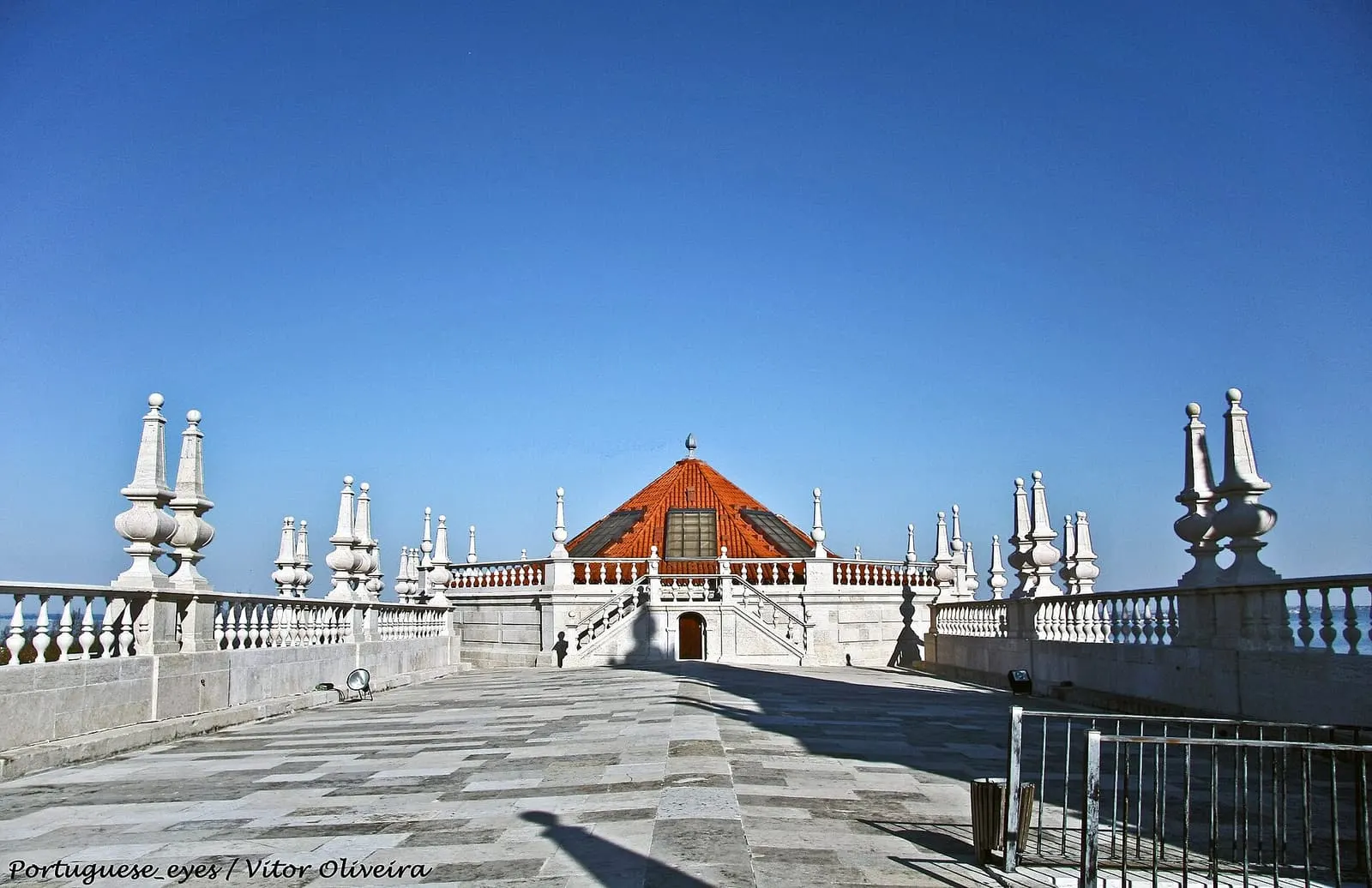
Plain architecture — also known as the estilo chão — is the architectural current that dominated Portugal and its empire during the long Mannerist period, between around 1580 and 1690. It is characterised by the austerity and sobriety of its forms: compact, orthogonal volumes, smooth surfaces, controlled classical proportions and ornament reduced to the indispensable. Where the earlier Manueline style had displayed an almost obsessive decorative exuberance, plain architecture asserts the opposite — the straight line defining almost everything, economy of means as a principle.
A concept by George Kubler
The term owes its fortune to the American art historian George Kubler (1912–1996), who enshrined it in the work Portuguese Plain Architecture between Spices and Diamonds (1521–1706), published in 1972 by Wesleyan University Press. The Portuguese version, A Arquitectura Chã, would appear in 1988, in a translation by Jorge Henrique Pais da Silva. Kubler defined this style as an architecture “vernacular, more bound to the traditions of a living dialect than to the great authors of Classical Antiquity”. He found the very expression in a book by Júlio de Castilho, Lisboa Antiga: o Bairro Alto (1902–1904), and traced the origin of the style back to suggestions by Italian military engineers, without ruling out influences from Northern Europe and from the Portuguese building tradition itself.
Kubler proposed reading two centuries of Portuguese construction not as decadence or want of means, but as a deliberate choice: an aesthetic of restraint, exportable from Lisbon to Goa and to Brazil, onto which ornament could be added later.
The thesis did not go unchallenged. Later historians debated whether the “chã” in fact constitutes an autonomous style or rather a particular facies of Mannerism in Portugal, and to what extent the label, created from outside, may have fixed a historiographical myth. Even so, the concept became unavoidable for understanding the Portuguese built landscape of the sixteenth and seventeenth centuries.
Characteristics and context
The style was born in a period of crisis and austerity — aggravated by the loss of King Sebastião at Alcácer Quibir (1578) and by the Iberian Union of 1580–1640 — which favoured practical, economical and replicable solutions. The typical model is the single-nave church, with a façade framed by pilasters and crowned by a pediment, a deep chancel and communicating side chapels. The white surfaces, the sober portals and the almost fortified silhouette lend the buildings a calm monumentality, without tracery.
Reference works
The foremost example of the style is the Church of São Vicente de Fora, in Lisbon, begun in 1582 with a design that involved Filippo Terzi, Juan de Herrera and, above all, Baltazar Álvares — whose plain façade became one of the founding models of the current. Among its direct antecedents is the Church of São Roque, by Afonso Álvares, with its single-nave plan and stripped-down exterior that contrasts so sharply with the decorative richness of the interior. The plain grammar would extend across the entire Portuguese territory, from the mainland to the islands and the overseas possessions, providing the structural support upon which, already in the seventeenth century, the exuberance of Baroque architecture in Portugal would unfold.
Frequently asked questions
- What is plain architecture?
- It is a Portuguese Mannerist current marked by the austerity and sobriety of its forms, with geometric volumes, smooth surfaces and ornament reduced to the essential. It dominated Portugal between around 1580 and 1690.
- Who coined the term 'estilo chão'?
- The concept was systematised by the American art historian George Kubler in the work 'Portuguese Plain Architecture between Spices and Diamonds (1521–1706)', published in 1972 and translated into Portuguese in 1988 as 'A Arquitectura Chã'.
- What are some examples of plain architecture?
- The Church of São Vicente de Fora, in Lisbon, is the foremost example of the style. The Church of São Roque, also in Lisbon, ranks among its direct antecedents.