Archaeology
The Bronze Age in Portugal
The Bronze Age in Portugal: settlements, metallurgy, cist burials and stelae of the South-Western Bronze and the Atlantic Bronze in Portuguese territory (c.
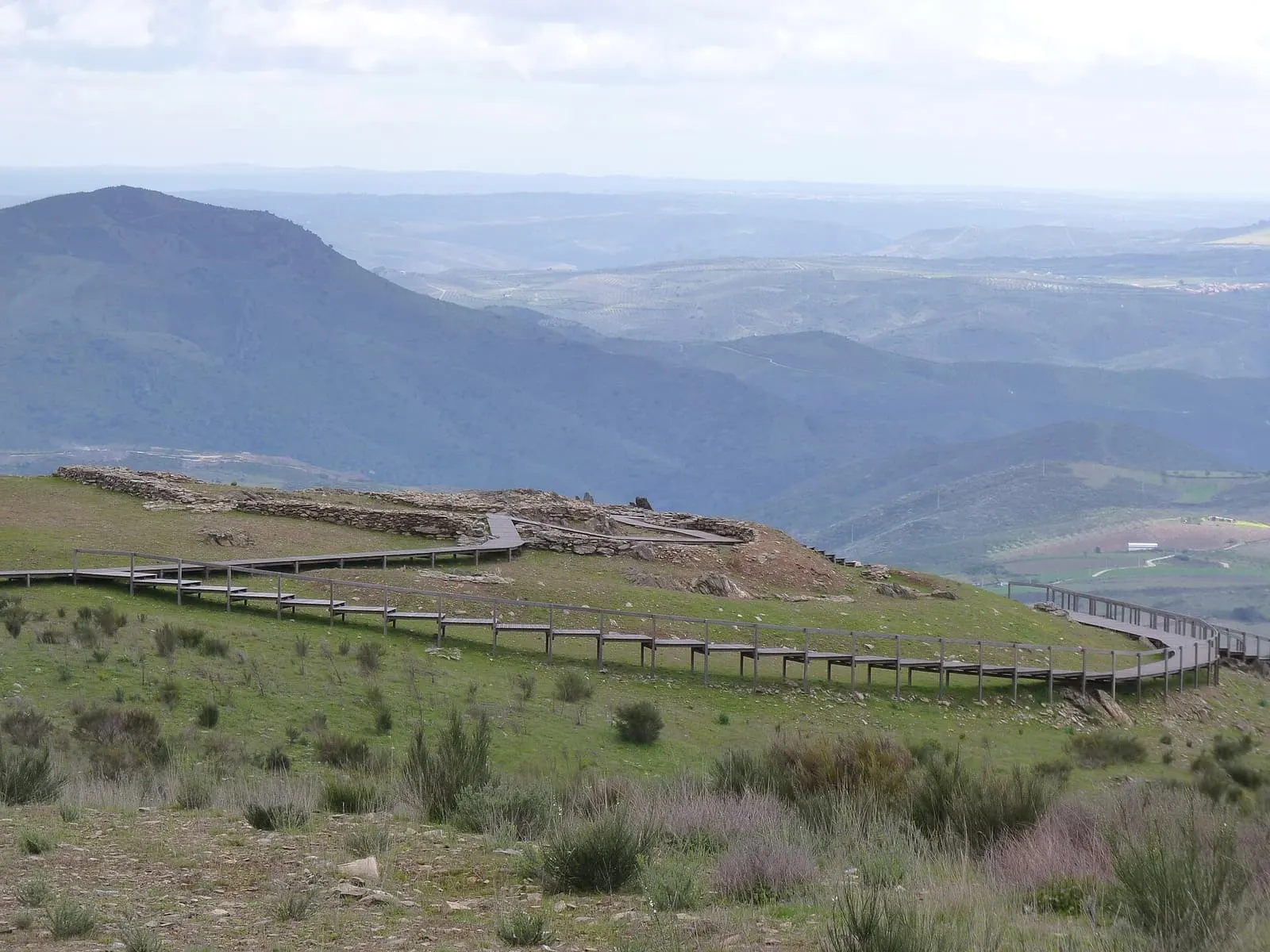
- Built
- c. 2200–700 a.C.
The Bronze Age designates, in the territory that would become Portugal, the long period of late prehistory in which bronze metallurgy — an alloy of copper and tin — became generalised as the basis of material culture, social prestige and exchange networks. Succeeding the Chalcolithic and preceding the Iron Age, it extends broadly from around 2200 to 700 BC, with chronologies and rhythms that vary appreciably between the Atlantic North and the inland South. There is no single Portuguese “Bronze culture”, but rather a mosaic of regional traditions, linked to one another by circuits for the circulation of metals and of ideas.
From the Chalcolithic collapse to the Bronze Age communities
The transition to the Bronze Age coincides, across much of the Centre and South, with the breakdown of the great fortified Chalcolithic settlements of Estremadura, such as Vila Nova de São Pedro and the Castro do Zambujal, whose walls and bastions cease to be maintained. The Early Bronze Age communities tend to disperse into open habitats, frequently near valleys and the best agricultural land, with an economy based on farming, herding and the local exploitation of metal resources.
In parallel, the collective funerary practices associated with megalithism fade away, replaced by increasingly individualised burials. This change in the treatment of the dead is one of the clearest markers of the new social order that asserts itself over the course of the second millennium BC.
The South-Western Bronze
In southern Portugal and adjoining areas of the south-western peninsula there developed the so-called South-Western Bronze, traditionally organised into successive horizons — Ferradeira, Atalaia and Santa Vitória — between, broadly speaking, the end of the third millennium and the beginning of the first millennium BC. It is characterised by individual burial in cists of stone slabs, in which the deceased was accompanied by a bronze dagger or knife and, at times, by ornaments. Some more monumental graves display at the surface circular pavements or structures with several compartments.
The decorated stelae of the South-West, engraved with shields, swords, spears, mirrors and, in the final phase, war chariots, constitute one of the most eloquent European testimonies to the warrior ideology of the Bronze Age.
These stelae — first the “Alentejo” type, then the warrior type — are distributed above all across the Alentejo and Baixo Alentejo, and the latest ones come to incorporate inscriptions in South-Western (Tartessian) script, already on the threshold of the Iron Age.
Metallurgy and the Atlantic Bronze
During the Late Bronze Age, above all between around 1300 and 700 BC, the western peninsula became fully integrated into the sphere of the Atlantic Bronze, a vast network of maritime contacts that linked Portugal to Galicia, Brittany, Cornwall, Ireland and Great Britain. Portuguese territory was one of the main metal-producing centres, valued in particular for its tin reserves, indispensable to the manufacture of bronze and sought after even in the Mediterranean.
From this period date metal assemblages of great quality: palstave and socketed axes, swords, spearheads, cauldrons, spits and flesh-hooks associated with elite banquets, as well as remarkable goldwork. The metallurgical deposit of the castro of Nossa Senhora da Guia, at Baiões (São Pedro do Sul), is an essential reference for the metallurgy of the Late Bronze Age in central Portugal, while gold pieces such as the Sintra collar attest to the technical and symbolic brilliance of these communities. Many of these objects have reached us in hoards or depositional finds, sometimes in aquatic contexts, suggesting ritual practices.
At the beginning of the first millennium BC, the Atlantic network goes into decline, as the spread of iron progressively renders the circuits of tin and bronze obsolete, opening the way to the transformations that would mark the Iron Age and, in the North, the consolidation of the castro culture. The study of these communities is today a central part of the Portuguese archaeology devoted to proto-history.
Frequently asked questions
- When did the Bronze Age take place in Portugal?
- In general terms, between around 2200 and 700 BC, following the Chalcolithic and lasting until the beginning of the Iron Age. The periodisation varies according to region, distinguishing an Early, Middle and Late Bronze Age.
- What is the South-Western Bronze?
- It is the Bronze Age culture of southern Portugal and neighbouring areas of south-western Spain, characterised by individual cist burials, a bronze knife as grave goods and, later, by the decorated Alentejo and warrior-type stelae.
- What was the Atlantic Bronze?
- It designates the network of maritime exchanges that, above all between c. 1300 and 700 BC, connected the coastal communities of Portugal, Galicia, Brittany, Cornwall, Ireland and Great Britain, sharing metal types such as axes, swords, cauldrons and goldwork.