Places
Monsaraz
Monsaraz, a medieval walled town in the Alentejo, in the municipality of Reguengos de Monsaraz, perched above the Guadiana and the Great Lake of Alqueva.
- Location
- Monsaraz, Évora
Few places distil the character of the Alentejo as well as Monsaraz. A white, walled town atop a schist hill, at around 340 metres in altitude, it commands a vast, undulating plain that ends, to the east, in the silvery line of the Guadiana. Today that line has widened into an immense sheet of water — the Alqueva reservoir — but the silhouette of the town, with its castle outlined against the sky, remains just as the medieval centuries drew it.
Frontier sentinel
The occupation of the heights of Monsaraz dates back to prehistory and runs through the Roman and Islamic presences, but the town we know was born of the Reconquest. Definitively conquered from the Muslims in the thirteenth century, it was handed over to the Order of the Temple, charged with its defence and settlement in a region still unstable along the Castilian border. In 1276, King Afonso III granted it a charter, establishing its status as a town and organising its administration.
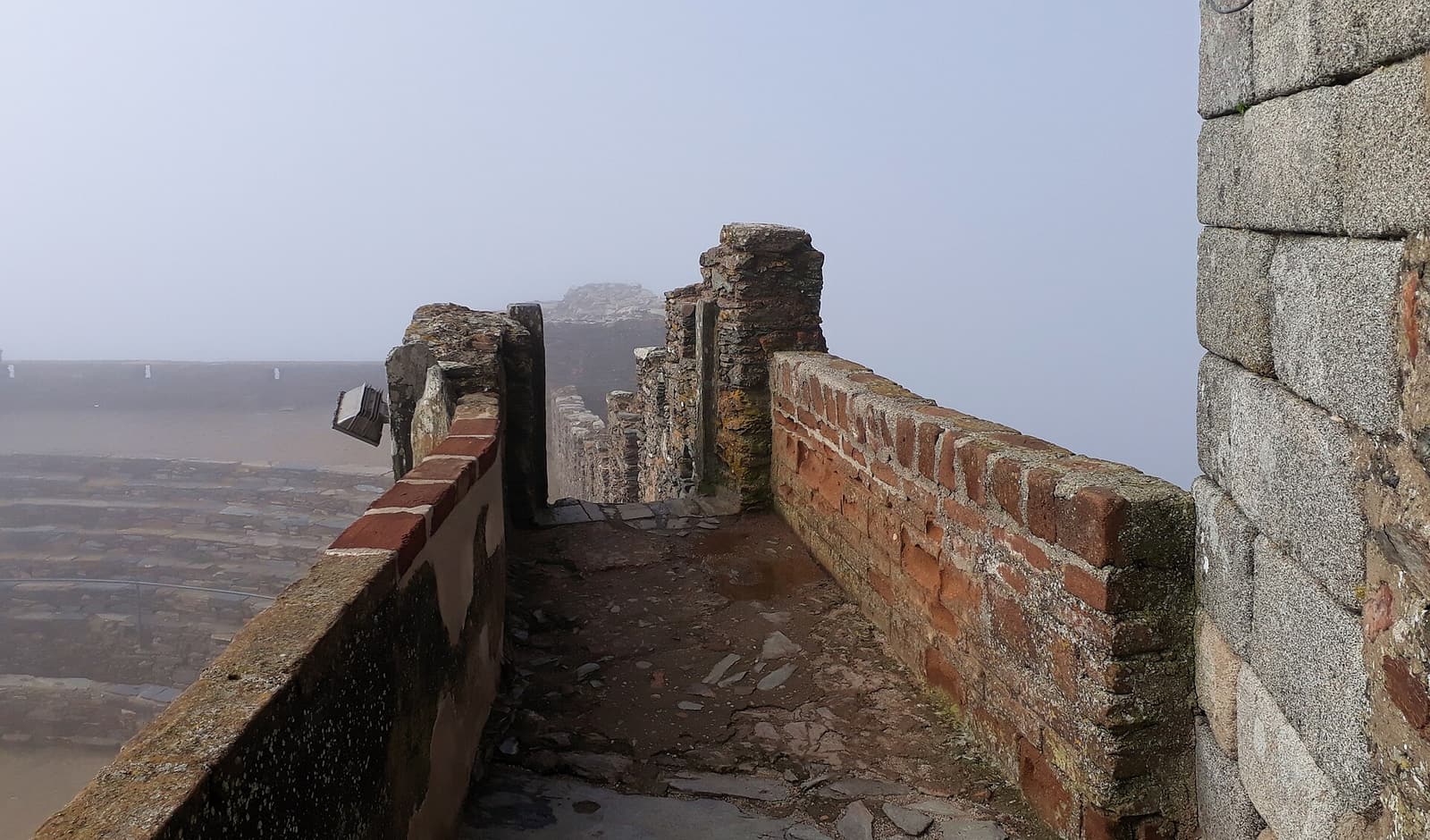
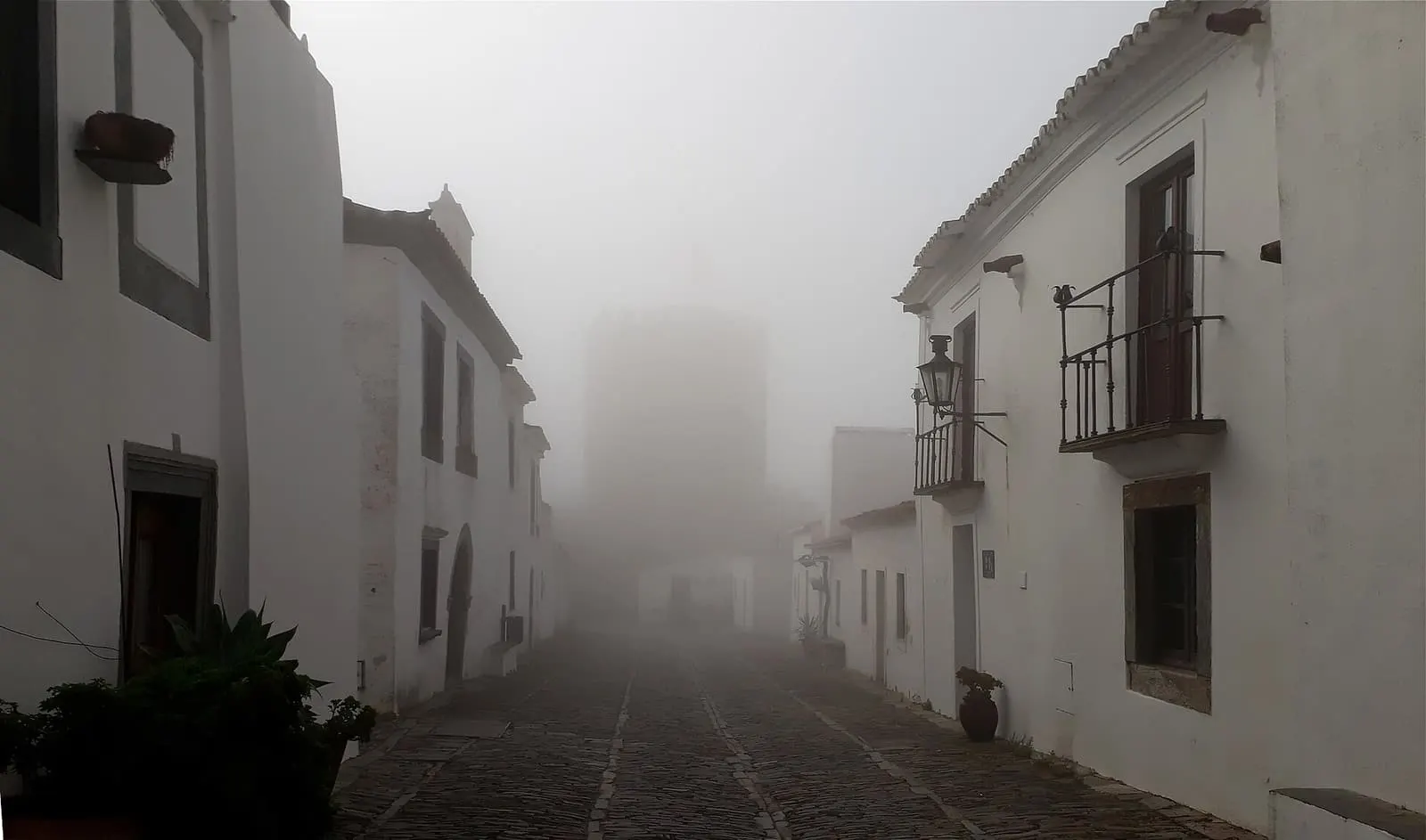
For centuries, Monsaraz fulfilled above all a military role: watching over the Guadiana valley and the border with Castile. The walled enclosure, narrow and elongated, opens through four gates and is arranged along parallel streets where the whitewashed houses, with their plain stonework and gables, lean against one another. At the southern end stands the fortress that best expresses this defensive vocation, ordered to be reinforced by King Dinis — one of the central elements of the castle of Monsaraz and of the network of strongholds that still dots the Alentejo today.
Monsaraz was not made to be looked at, but to look out: every stretch of wall was conceived to watch the horizon, and it is from that role as a watchtower that its panoramic beauty arises, almost by chance.
The town within the walls
Inside the walls, the tightly packed houses preserve a genuinely medieval scale. The parish church of Santa Maria da Lagoa, the former court of audience with its frescoes of Justice, the pillory and the stone streets form an ensemble of remarkable coherence. The absence of major modern growth — in part a consequence of the transfer of the municipal seat to Reguengos de Monsaraz in 1838 — has preserved this historic core from disfiguring change. Popular recognition came in 2017, when Monsaraz was among the winners of the 7 Wonders of Portugal in the category of monument-villages.
Between megaliths and water
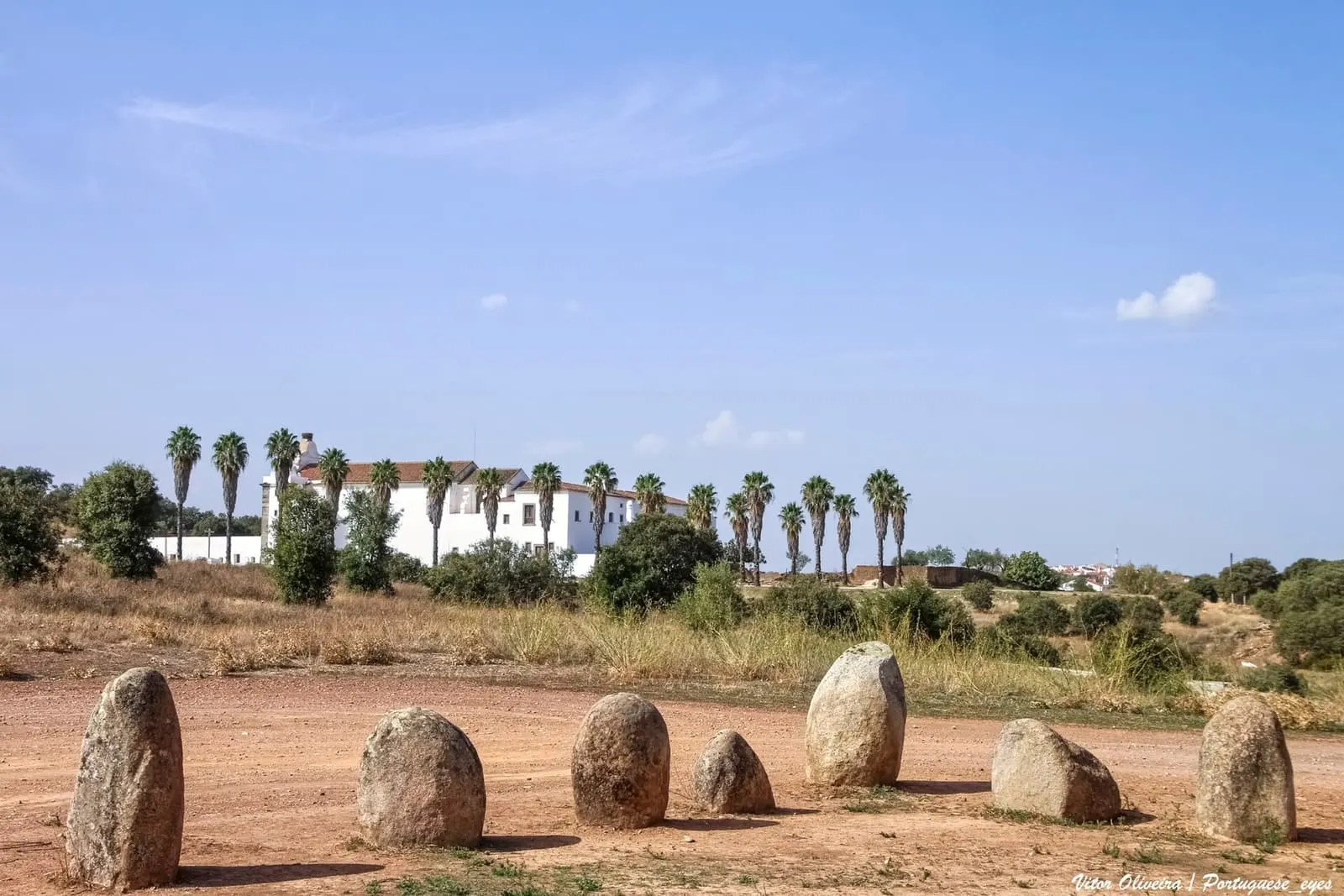
The territory around Monsaraz is one of the densest megalithic sanctuaries of the Iberian Peninsula. Menhirs, dolmens and cromlechs scattered across the olive groves bear witness to Neolithic communities that, some five thousand years ago, raised stones of astronomical and symbolic orientation. This ensemble — linked to the megalithic complex of Monsaraz and to the broader phenomenon of Alentejo megalithism — makes the landscape a palimpsest of overlapping human presences.
The construction of the Alqueva dam, at the beginning of the twenty-first century, profoundly altered this landscape. The rising waters submerged fields and forced the rescue of prehistoric monuments, while at the same time creating the Great Lake, today classified as a dark-sky tourism destination. Reflected in the reservoir at dusk, Monsaraz has become one of the most recognisable images of the Alentejo interior — a short distance from Évora, the historic and cultural capital of the region.
To visit Monsaraz is therefore to traverse at once the long time of the megaliths, the medieval time of the frontier and the recent time of the water. Few places offer, within a single horizon, so complete a reading of how humankind inhabited and transformed the Alentejo.
Frequently asked questions
- Where is Monsaraz?
- Monsaraz is a parish in the municipality of Reguengos de Monsaraz, in the district of Évora, in the Alentejo. It stands atop a hill on the right bank of the Guadiana, close to the border with Spain.
- Why did Monsaraz cease to be the seat of a municipality?
- The seat of the former municipality was transferred to Reguengos de Monsaraz in 1838, in the aftermath of the Liberal Wars, moving the administrative centre to the more accessible and populous town in the valley.
- What is the Great Lake of Alqueva seen from Monsaraz?
- It is the reservoir of the Alqueva dam, on the Guadiana, one of the largest artificial lakes in Europe. From the walls of Monsaraz there is one of the broadest views over the body of water.
Sources
Keep exploring
Heritage nearby
More places to discover from here. Approximate straight-line distances, within 50 km.