Places
Santa Cruz da Graciosa
Santa Cruz da Graciosa, a town and municipal seat on Graciosa Island in the Azores, featuring its parish church, hermitages, Flemish windmills, and the Furna…
- Location
- Santa Cruz da Graciosa, Açores
- Built
- 1486
- Style
- Arquitetura tradicional açoriana
Santa Cruz da Graciosa is the only town and municipal seat on Graciosa Island, located on its northern coast in the central group of the Azores archipelago. It grew around a central square where two lagoons converge, alongside the parish church and whitewashed houses that preserve the character of Azorean settlements from the 16th to 18th centuries. Its urban layout retains its historic design and is classified as a heritage site, now part of the Graciosa Island Biosphere Reserve, recognized by UNESCO.
History and Settlement
The settlement of Graciosa began in the first half of the 15th century, attracting colonists mainly from northern Portugal and Flanders. Administrative organization was established with the arrival of Pedro Correia da Cunha, brother-in-law of Christopher Columbus, who served as the donatary captain. In 1486, the settlement of Santa Cruz was elevated to town and municipal seat status, granting the island its own municipal authority, with judges and privileges, and elevating the local church to parish status.
In the following centuries, the town prospered through agriculture, vineyards, and the export of cereals, wine, and orchil lichen. Its military history is reflected in coastal forts built to defend against pirates, such as the Forte do Corpo Santo. From the mid-20th century onward, intense emigration to Brazil and the United States significantly reduced the municipality’s population.
Built and Natural Heritage
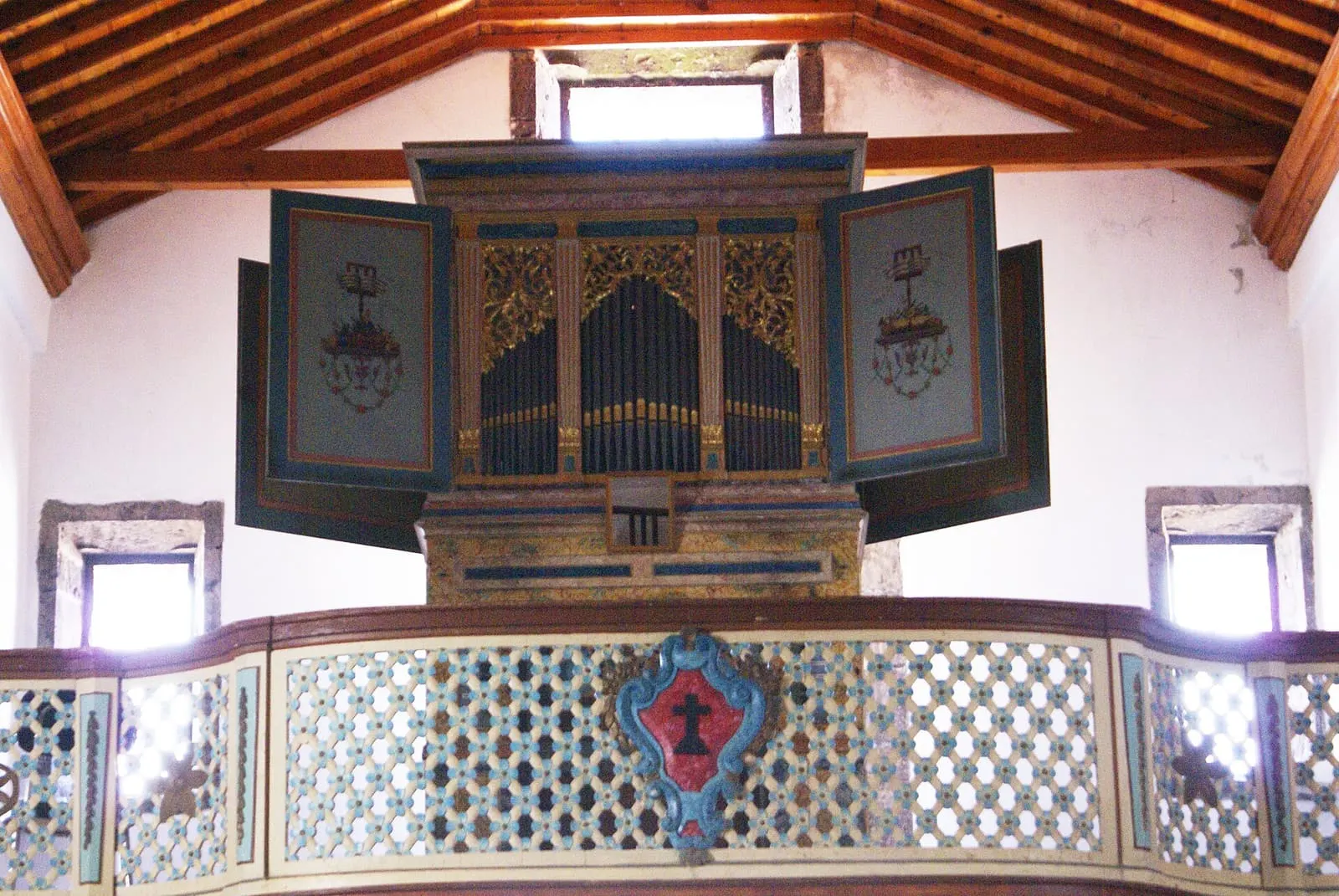
The town’s most notable monument is the Parish Church of Santa Cruz, whose current structure resulted from a reconstruction completed in 1701. Baroque in style, it retains Manueline elements inside, particularly in the baptistery vault, and houses a valuable 16th-century polyptych attributed to the Master of Arruda dos Vinhos. Scattered throughout the town and its surroundings are several hermitages and chapels that document the island’s popular devotion and are part of the tradition of Azorean chapels and hermitages. The Holy Ghost Empires, spread across the island’s parishes, host the Azores Holy Ghost Festivals, among the most vibrant expressions of local identity.
The town’s landscape is also marked by Flemish-style windmills with rotating red domes and by houses that exemplify traditional Azorean architecture, characterized by the contrast between whitewashed walls and dark volcanic stonework.
The Furna do Enxofre
A few kilometers from the town, inside the Caldeira da Graciosa, lies the Furna do Enxofre, the island’s landmark and one of the archipelago’s most unique volcanic cavities. Access to its interior is via a tunnel-tower descending dozens of meters into a vast domed cavern, at the bottom of which lies an underground lake of cold sulfurous waters. Classified as a Regional Natural Monument, the cave attracts visitors and researchers, highlighting the geological significance that distinguishes Graciosa among the Azorean islands.
Frequently asked questions
- Where is Santa Cruz da Graciosa located?
- It is situated on the northern coast of Graciosa Island, in the central group of the Azores archipelago, and is the island's only town and municipal seat.
- What is the Furna do Enxofre?
- It is a volcanic cavity located inside the Caldeira da Graciosa, featuring a vast domed cavern and an underground lake of cold sulfurous waters, classified as a Regional Natural Monument.
- When was the town founded?
- The settlement was elevated to town and municipal seat status in 1486, as part of the colonization led by the donatary captain Pedro Correia da Cunha.