Archaeology
Roman Roads
Roman roads in Portuguese territory: the road network of Lusitania and Gallaecia, milestones, bridges, and the Antonine Itinerary.
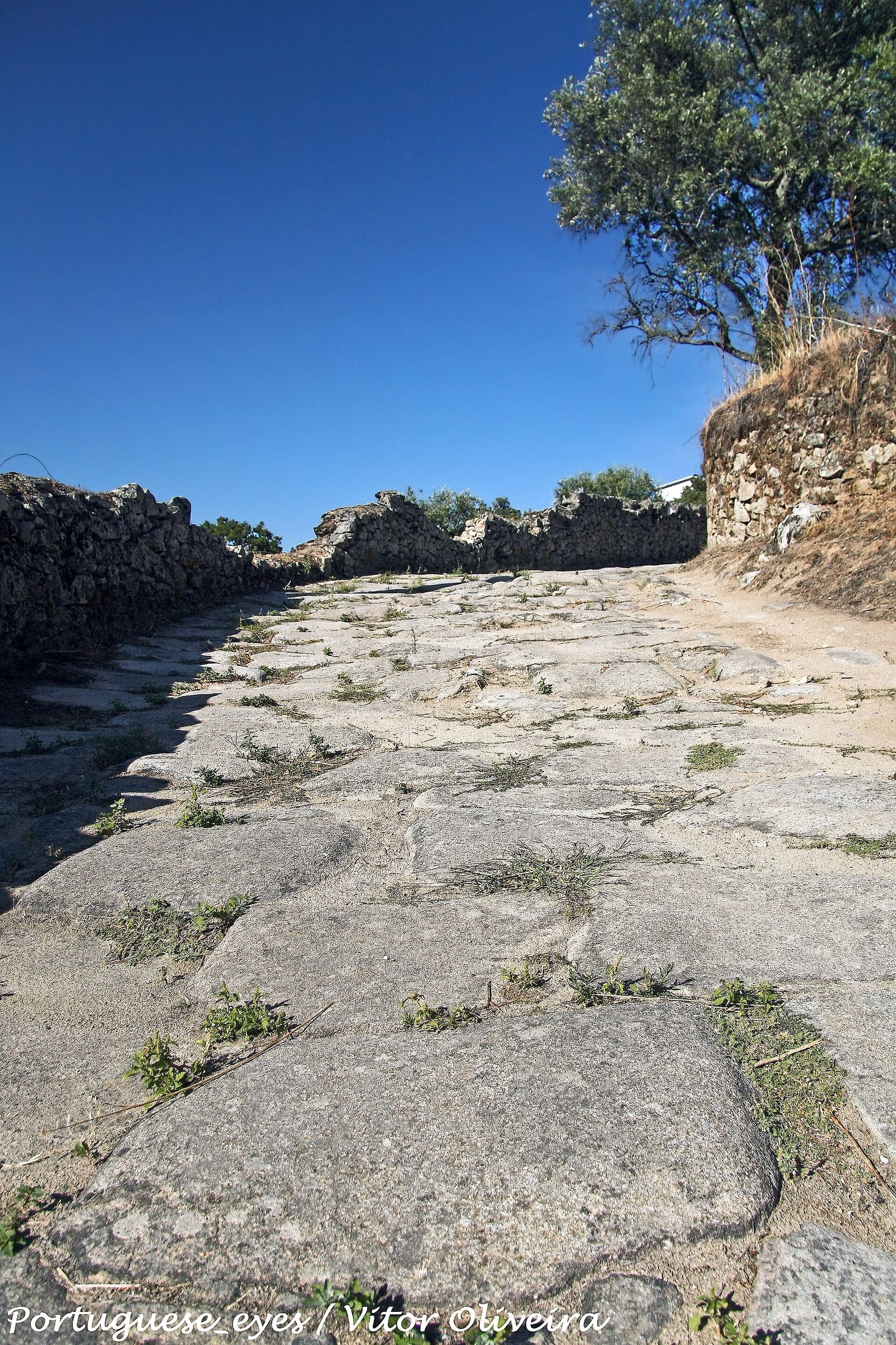
The Roman road network was one of the most enduring instruments of integrating the western Iberian Peninsula into the Empire. Built between the late 1st century BC and the 3rd century, it connected the province of Lusitania and southern Gallaecia, linking the main urban centers — Olisipo (Lisbon), Ebora (Évora), Scallabis (Santarém), Conimbriga, Bracara Augusta (Braga), Aquae Flaviae (Chaves) — to ports, mines, and the provincial capital, Emerita Augusta (Mérida). More than simple paths, the roads were engineering works serving administration, the military, and commerce.
A Network Serving the State
Our current knowledge of the road grid relies mainly on the Antonine Itinerary, a record of imperial routes with their respective stations (mansiones) and distances expressed in Roman miles (about 1,480 meters). Of the 372 itineraries compiled in the document, 34 pertain to Hispania, and about eleven crossed what is now Portuguese territory. Among the main axes are Via XVI, which connected Olisipo to Emerita Augusta, and the network of roads in the northwest — Via XVII through Chaves, Via XVIII or Via Nova through Gerês, and Via XIX through Ponte de Lima — which linked Bracara Augusta to Asturica Augusta (Astorga).
Contrary to the common image of a uniform paved road, most Hispanic roads had a surface of compacted earth or gravel, with stone paving reserved for urban sections, slopes, and difficult crossings.
Technique and Materials
Construction adapted to the terrain. Surveys of sections like Via XVIII revealed variable layers — sands, river pebbles, and coarser gravel — often laid directly on bedrock, without the drainage ditches and rigid stratigraphy described for Italy. This plasticity explains why so many segments are now confused with medieval paths: the Roman road was, above all, a practical solution for moving people and goods over hundreds of kilometers.
Milestones and Bridges
Milestones are the most reliable testimony of the network. They were stone columns, often about two meters tall, marking miles and bearing inscriptions with the emperor’s name, distances, and references to repair works. It is estimated that about four hundred survive in Portugal, concentrated north of the Douro. The Via Nova or Geira, which crosses the Peneda-Gerês National Park, has over a hundred of these markers still in place, making it the best-preserved road in the Peninsula.
Inseparable from the roads are the Roman bridges, many of which remained in use for centuries — like the remarkable Roman bridge of Chaves, over the Tâmega River, in ancient Aquae Flaviae. The road layout also structured settlement: stations like Bobadela or the major urban centers studied by Roman Portugal archaeology owe their importance to their position along these axes.
A Lasting Legacy
The road network lastingly shaped Portugal’s geography. Numerous medieval paths, pilgrimage routes, and even modern roads follow layouts inherited from Rome, and the study of their remains — integrated into Roman architecture in Portugal — continues to provide crucial data on the economy, administration, and movement in antiquity. Each recovered milestone, each identified stretch of pavement, is a piece that helps reconstruct the design of an empire on the landscape scale.
Frequently asked questions
- How many Roman roads crossed what is now Portuguese territory?
- The Antonine Itinerary records about 34 routes for Hispania, of which approximately 11 crossed the territory corresponding to modern Portugal, connecting Lusitania and southern Gallaecia.
- Which is the best-preserved Roman road in Portugal?
- The Via Nova or Geira (Via XVIII), between Braga and Astorga, which crosses the Gerês mountain range through Portela do Homem, is considered the best-preserved in the Iberian Peninsula, with over a hundred milestones still in situ.
- What are milestones?
- They are stone columns placed along the roads to mark distances in Roman miles. Due to their inscriptions and indisputably Roman origin, they are the most reliable evidence of the layout of ancient roads.