Monuments
Trajan's Bridge (Chaves)
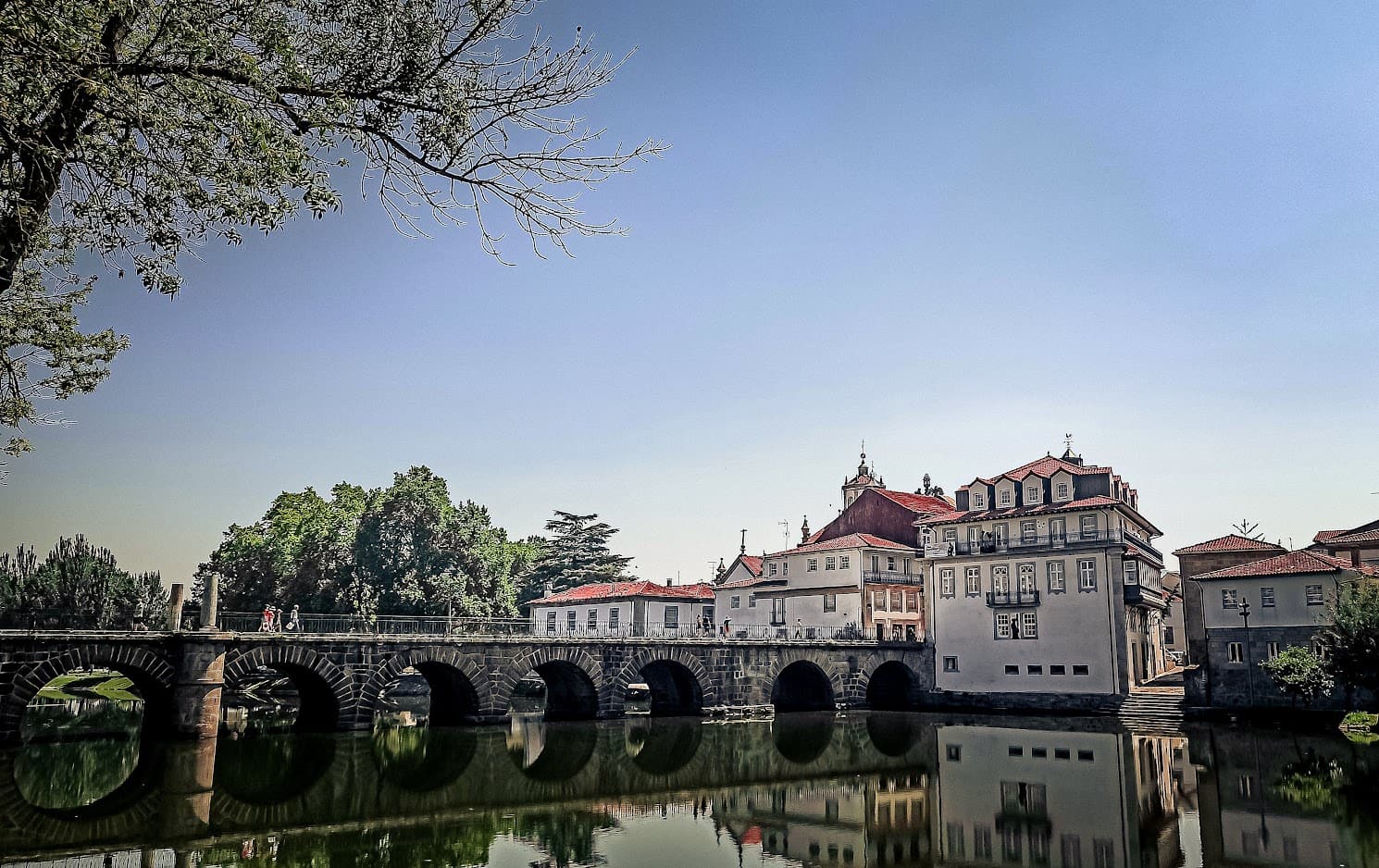
Trajan's Bridge, or the Roman bridge of Chaves, spans the Tâmega River in the ancient Aquae Flaviae and preserves epigraphic markers from the 2nd century.
- Location
- Chaves, Vila Real
- Built
- século I-II d.C.
- Style
- Arquitetura romana
Trajan’s Bridge, also known as the Roman bridge of Chaves, spans the Tâmega River in the heart of the Trás-os-Montes city, in the district of Vila Real. Built of solid granite at the end of the 1st century and beginning of the 2nd century AD, it connected the two banks of the flourishing Roman city of Aquae Flaviae — the “Waters of Flavius,” so named in honor of the Flavian dynasty that recognized the importance of its thermal springs. The bridge was a key component of the road linking Bracara Augusta (Braga) to Asturica Augusta (Astorga), one of the structural axes of the road network in the Hispanic northwest.
An engineering feat of the imperial era
Approximately 140 meters long, the bridge now rests on a series of perfect semicircular arches, several of which have been buried over the centuries by river alluvium and urban growth on the banks. The structure illustrates Roman mastery of ashlar construction: perfectly fitted granite blocks, triangular cutwaters upstream to split the current, and a robust deck capable of supporting the military and commercial traffic that traversed the via XVII of the Antonine Itinerary. The original stone parapets were dismantled in the 19th century and replaced with iron railings, a modification that still marks the monument’s appearance today.
In Roman design, a bridge was not merely a crossing: it was an instrument of sovereignty that projected Rome’s power over the territory and etched into the landscape the memory of those who funded it.
The epigraphic markers
The most notable feature of the bridge are the two commemorative columns — the padrões — that stand at the center of the deck. One of them, known as the Padrão dos Povos, bears an extensive Latin inscription listing ten indigenous communities (civitates) associated with the construction and paying tribute to Emperors Vespasian and Titus, also mentioning the Legio VII Gemina. The second column records that the bridge was built by the inhabitants of Aquae Flaviae at their own expense, dedicating it to Emperor Trajan. Together, they constitute one of the most significant epigraphic documents of Roman engineering in Portuguese territory, providing a precious portrait of the administrative organization and identity of the northern inland populations. The originals are now safeguarded in the Museu da Região Flaviense, with faithful replicas standing on the bridge.
Endurance and heritage value
Classified as a National Monument in 1910, Trajan’s Bridge remained the only crossing of the Tâmega in Chaves until the mid-20th century, when the construction of new bridges allowed traffic to be diverted and the monument preserved; since 2008, it has been exclusively pedestrian. Its survival for nearly two millennia makes it one of the most intact testimonies of Roman presence in northern Portugal, alongside the network of Roman bridges and the system of Roman roads that structured the territory. The bridge also dialogues with the nearby Chaves Castle, forming an urban ensemble where layers of Roman, medieval, and modern history overlap, and it integrates into the broader panorama of Portuguese Roman archaeology.
Frequently asked questions
- Who ordered the construction of Trajan's Bridge in Chaves?
- The bridge was built during the reign of Emperor Trajan, at the end of the 1st century and beginning of the 2nd century AD, funded by the inhabitants of the Roman city of Aquae Flaviae, present-day Chaves.
- What is the 'Padrão dos Povos'?
- It is one of the two epigraphic columns standing at the center of the bridge. The inscription lists ten peoples (civitates) who collaborated in its construction and honors Emperors Vespasian and Titus; the originals are now preserved in the Museu da Região Flaviense.
- Can the bridge still be crossed on foot?
- Yes. Since 2008, Trajan's Bridge has been exclusively pedestrian, after centuries of serving as the only crossing of the Tâmega in Chaves.
Sources
Keep exploring
Heritage nearby
More places to discover from here. Approximate straight-line distances, within 50 km.