Archaeology
Bobadela: The Roman City of Oliveira do Hospital
The Roman ruins of Bobadela, in Oliveira do Hospital: amphitheatre, monumental forum arch and the epigraphy of a splendidissima civitas of the Beira.
- Location
- Bobadela, Oliveira do Hospital, Coimbra
- Built
- Século I d.C.
- Style
- Romano
In the heart of the Beira Serra, on a granite plateau halfway between the Serra da Estrela and the Mondego valley, the village of Bobadela preserves one of the most remarkable and best-conserved Roman archaeological ensembles in Portugal. Beneath the present-day houses lies an ancient city whose name has been lost, but whose monumentality can still be read in the stones: a solemn arch, an amphitheatre of elliptical plan and a handful of inscriptions that evoke a prosperous and well-organised community.
A city without a name
Roman Bobadela was probably born in the first century AD, most likely associated with the Augustan territorial reorganisation and with the road network that linked Emerita Augusta (Mérida) to Bracara Augusta (Braga). The excavations have revealed an urban layout with a forum, public buildings and venues for spectacle, signs of a settlement with status and ambitions. The inscriptions speak of a splendidissima civitas — the “most splendid city” — and mention figures such as Júlia Modesta, but, paradoxically, none of them records the ancient toponym. Despite more than a century of study, the Roman name of Bobadela remains unidentified, which makes it one of the greatest enigmas of Roman archaeology in Portugal.
Few sites combine so much monumentality with so little certainty: Bobadela is a city that proclaims itself “most splendid” in its stones, yet refuses to say what it was called.
The forum arch and the amphitheatre
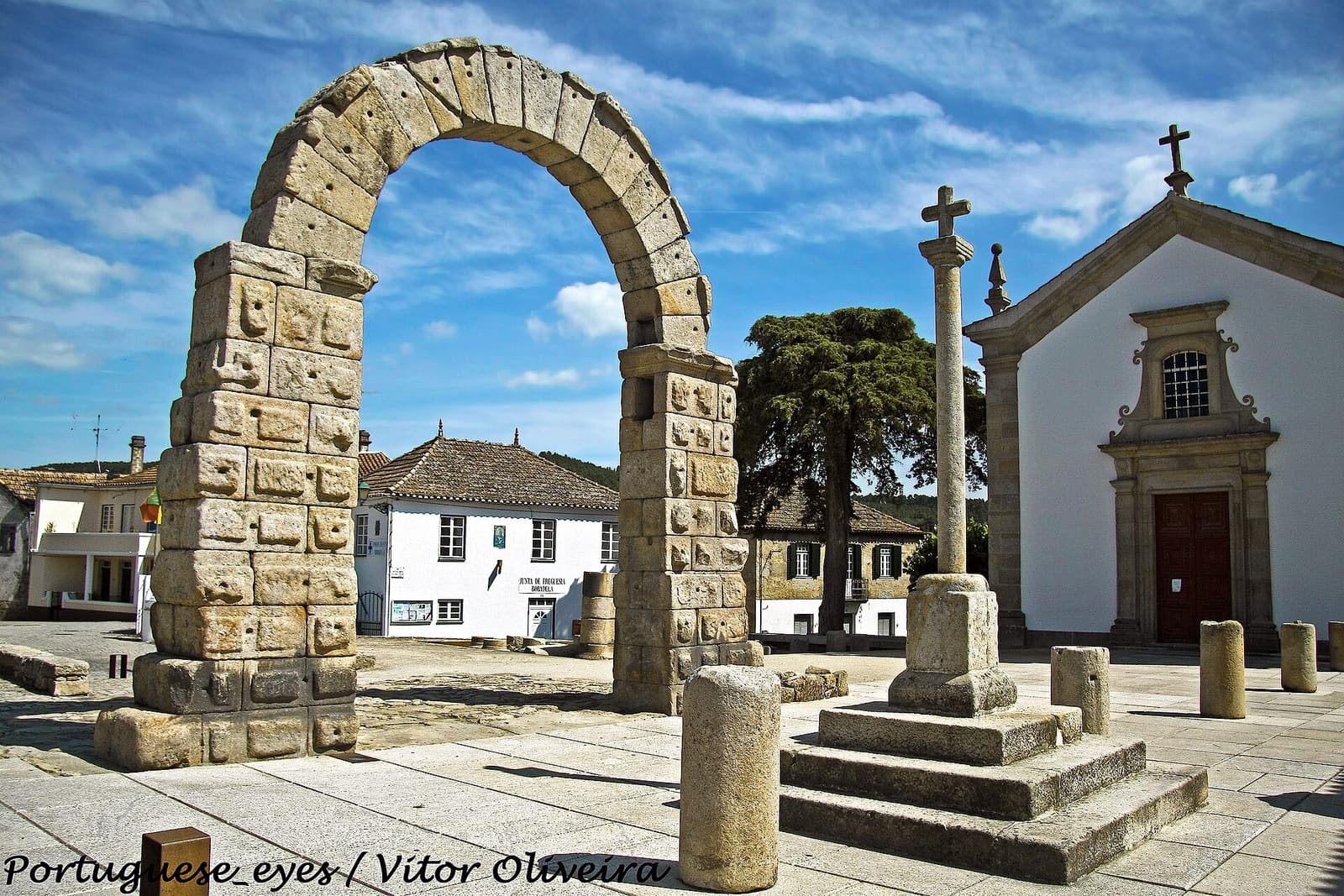
The most celebrated piece of the ensemble is the monumental arch, which corresponded to the eastern access of the forum. Raised with great granite ashlars in cushioned bond and laid without any mortar, it survives to this day with its perfect curve, displaying in the blocks the holes for the forfex — the metal pincers used to hoist the stone during construction. This “dry” engineering, relying solely on the precision of the cut, largely explains the longevity of the monument.
A few steps away rises the amphitheatre, with an elliptical arena of about 50 by 40 metres, bounded by a podium wall. Oriented from north to south and partly cut into the rock, it was probably built in the last quarter of the first century AD and used for games and combats until the end of the fourth century. It is today recognised as the best-preserved Roman amphitheatre in the country — a rare case in a territory where these venues for spectacle were uncommon outside the great centres such as Conímbriga.
Epigraphy and classification
Epigraphy is one of Bobadela’s greatest treasures. In addition to the altars and dedications that allude to the civitas and to Júlia Modesta, an inscription consecrated to Neptune is preserved, possibly linked to a monument or cult associated with water. This collection makes the site a reference field for the study of Roman epigraphy and of the organisation of the communities of the Beira interior, frequently discussed within the broader context of Roman Portugal.
Official recognition came early: the arch was classified as a National Monument in 1910 and, in 1936, the protection was extended to the ensemble, then renamed the Roman Ruins of Bobadela. More recently, processes have been undertaken to enlarge the classified area, incorporating the amphitheatre and the archaeological surroundings, in an effort of enhancement that keeps Bobadela a benchmark destination for those seeking to understand the Roman presence in the interior Beira.
Frequently asked questions
- Where is the Roman city of Bobadela?
- In the parish of Bobadela, municipality of Oliveira do Hospital, district of Coimbra, in the Beira Serra, between the Serra da Estrela and the Mondego valley.
- What was the Roman name of Bobadela?
- It is unknown. The inscriptions refer to a splendidissima civitas, but none reveals the ancient toponym of the settlement.
- Can the amphitheatre of Bobadela be visited?
- Yes. It is regarded as the best-preserved Roman amphitheatre in Portugal and forms part of the classified ensemble of the ruins, which is freely accessible.
Sources
Keep exploring
Heritage nearby
More places to discover from here. Approximate straight-line distances, within 50 km.