Monuments
Roman Villa of Rabaçal
Roman villa of Rabaçal in Penela (Coimbra): 4th-century AD aristocratic residence with octagonal peristyle and unique mosaics, National Monument.
- Location
- Rabaçal, Penela, Coimbra
- Built
- meados do século IV d.C.
- Style
- Arquitetura romana tardia
The Roman villa of Rabaçal is one of the most original examples of late Roman residential architecture in central Portugal. It stands on a hillside in the parish of Rabaçal, municipality of Penela, Coimbra district, about 12 km south of Conímbriga, in the territory of the ancient civitas and near the route of the Roman road linking Olisipo (Lisbon) to Bracara Augusta (Braga). Dated to the mid-4th century AD, it was classified as a National Monument in 2021.
A rare octagonal peristyle
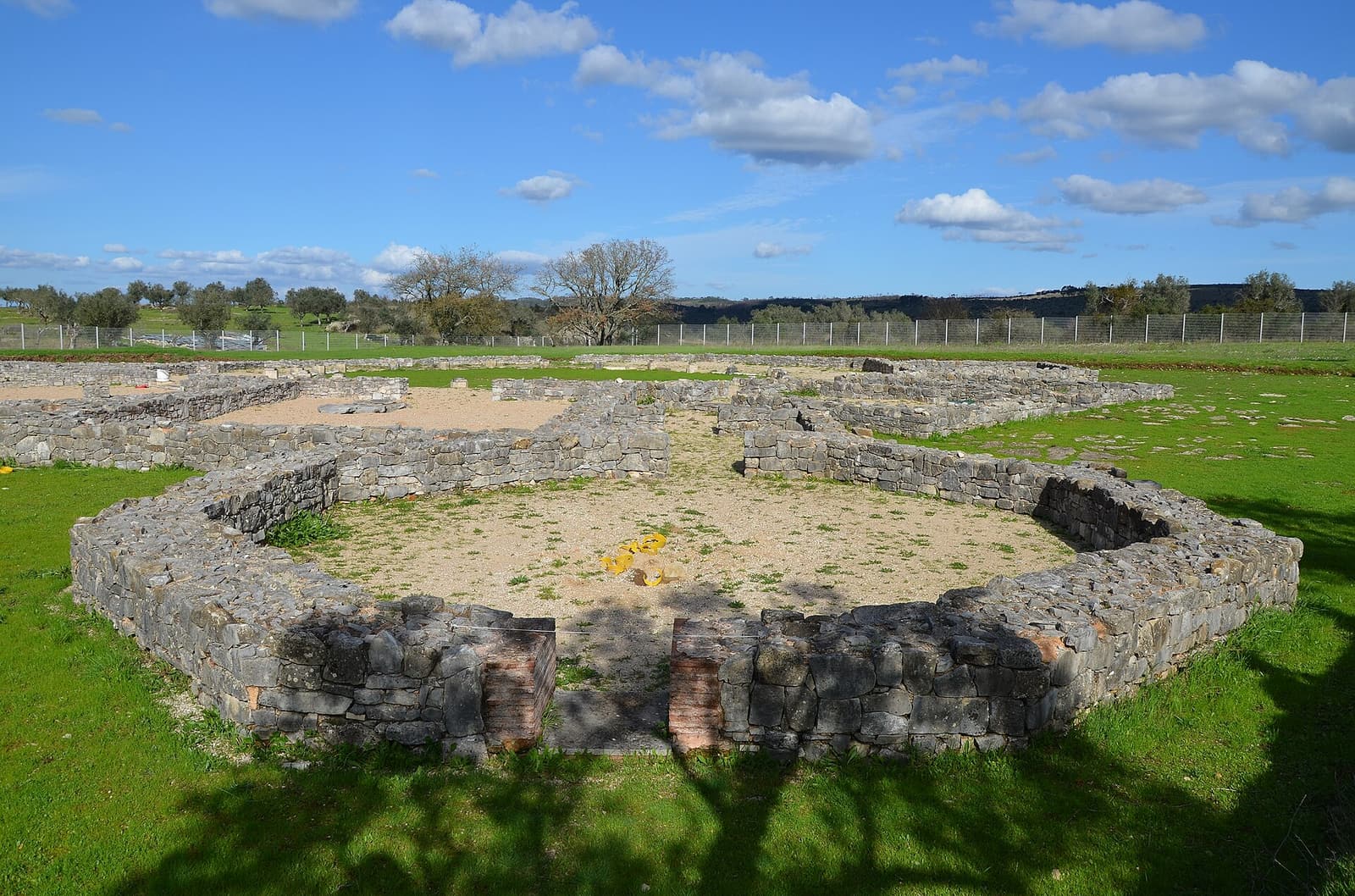
The most distinctive feature of the building is its octagonal-plan peristyle, whose sides are aligned to the cardinal points and around which the compartments of the pars urbana are symmetrically arranged. This solution, unusual among Hispano-Roman villas, gives Rabaçal particular interest for the study of Roman architecture in Portugal during the Late Empire period, when large rural residences sought to assert their owners’ status through ambitious decorative and spatial programs.
The residential area comprises more than twenty-seven differentiated spaces, organized into functional areas: the vestibule and service compartments to the south; open spaces facing the landscape to the east; service dependencies to the north; and, to the west, the noble area, with ceremonial rooms — the oecus and triclinium — where ceremonial life and guest receptions took place. The villa also had its own bathhouse and a water supply and elevation system, signs of the comfort sought by its occupants.
Unparalleled mosaics
The mosaic floors covering the peristyle corridors and various rooms combine limestone, glass, and ceramic tesserae in geometric, vegetal, and figurative compositions. Among the figurative themes are the seasons, a quadriga, and a seated female figure. Critics recognize in these panels African and Eastern influences that have no parallel in other Portuguese sites, which is why the ensemble is interpreted as a distinct stylistic group within the broader context of Roman rural archaeology. The site’s dating relies mainly on an abundant numismatic collection from the 4th century AD, whose circulation extends to the time of the Suebi incursions, indicating occupation until the 5th century.
From excavation to museum space
The villa was first identified in 1979 during the survey of the Roman archaeological map of the Conímbriga area, with systematic excavations beginning in 1984. The site now forms part of a monographic museum space, distributed across several nuclei — the archaeological station protected by shelters, the museological nucleus, and the Chã viewpoint — which combines the conservation of the ruins with the exhibition of collected materials. Along with other regional explorations, such as the Roman villa of Pisões, Rabaçal contributes to the understanding of the ancient rural landscape of the town of Penela and the inland Beira region.
Frequently asked questions
- What distinguishes the architecture of Rabaçal villa?
- The most singular feature is the octagonal-plan peristyle, with sides aligned to the cardinal points, around which the compartments of the pars urbana are symmetrically arranged. This solution is rare among Hispano-Roman villas.
- Is Rabaçal villa a National Monument?
- Yes. The Roman villa of Rabaçal was classified as a National Monument in 2021, recognizing the value of its late Roman architectural ensemble and mosaic floors.
- Where is the Roman villa of Rabaçal located?
- It is situated in the parish of Rabaçal, municipality of Penela, Coimbra district, about 12 km south of Conímbriga, in the territory of the ancient civitas and near the Roman road between Olisipo and Bracara Augusta.
- Can the villa be visited?
- Yes. The archaeological site is protected by shelters and is part of a monographic museum space in Rabaçal, which includes the Roman station, the museological nucleus, and the Chã viewpoint.