Themes
Stained Glass in Portugal
History of stained glass in Portugal: from the medieval ensemble at Batalha Monastery, the country's oldest, to modern designs by Almada Negreiros and Lino António.
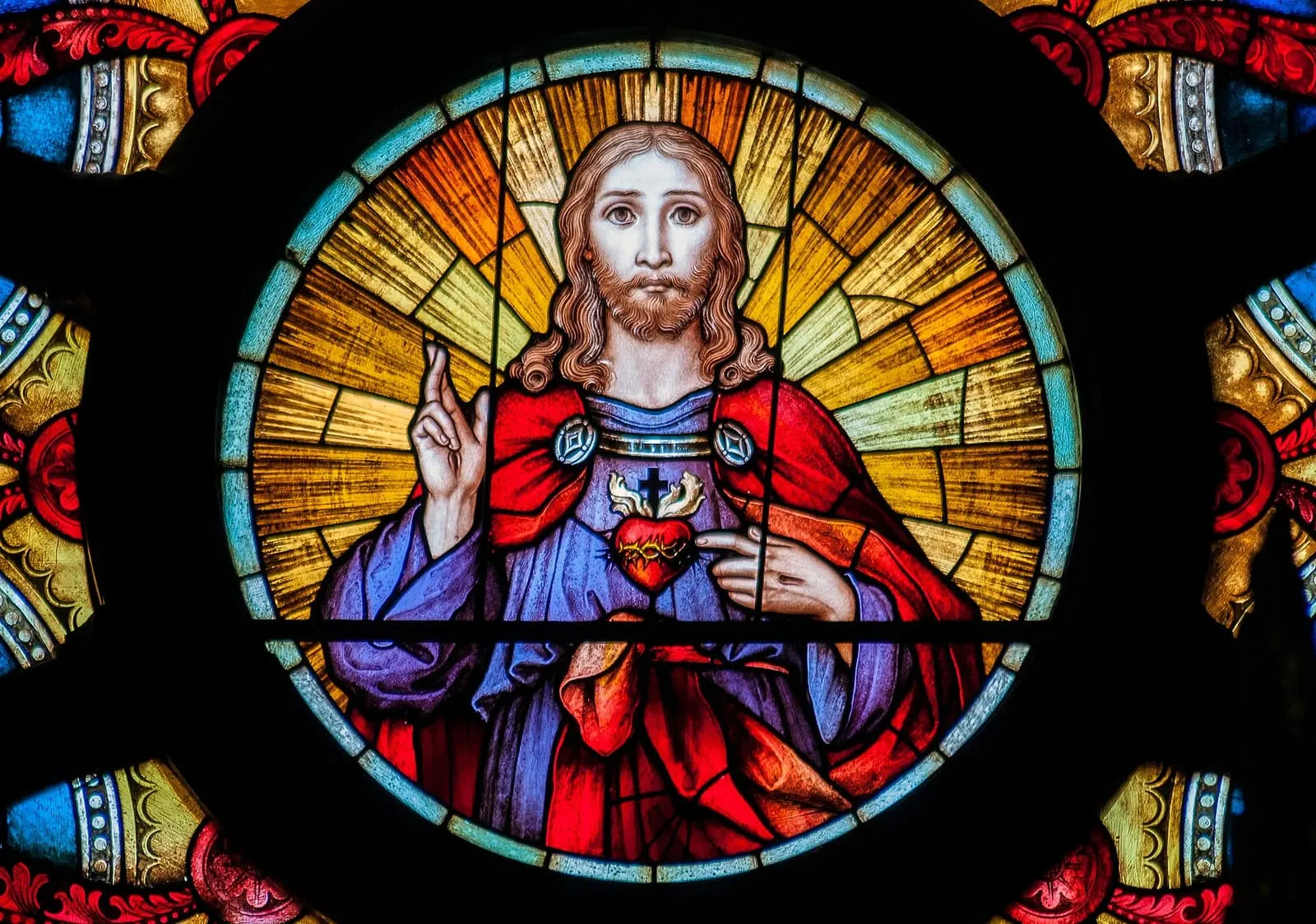
Stained glass — compositions of colored glass joined by lead cames and set into architectural openings — arrived in Portugal alongside the expansion of European Gothic. More than mere window closures, it was conceived as a “translucent wall,” where light filtered through color symbolically represented the communion between the divine and the human. Imported from Germany, France, England, and Flanders, the designs, techniques, and even the master glaziers gradually took root in the territory, giving rise to a tradition that, though discontinuous, spans six centuries.
The Medieval Ensemble at Batalha
The foundational collection of this art in Portugal is found at Batalha Monastery, built by King João I to fulfill a vow made before the Battle of Aljubarrota (1385). The stained-glass windows of its chancel and Chapter House, created from the first half of the 15th century, are the oldest preserved in the country and the most complete testimony of the royal workshop that operated here. Around the monastery’s construction site, a true school formed, active for over two centuries: it documented the glaziers of the period, who departed from here to fulfill commissions for the king and noble patrons.
The themes belong to the biblical and hagiographic universe — scenes from the life of Christ, figures of saints — alongside heraldic emblems of royal houses and geometric and phytomorphic motifs. One of the chancel panels, dated 1508, develops a Passion cycle that illustrates the transition from late Gothic taste to Manueline sensibility.
The rarity of 16th-century ensembles is explained by material fragility: stained glass is, of all monumental arts, the most exposed to weather, wars, and the 1755 earthquake, which destroyed much of Lisbon’s glass heritage.
Collecting, Romanticism, and 19th-Century Revival
After a long eclipse, stained glass reentered Portuguese taste through Romanticism. King Fernando II, an artist-king, assembled a remarkable collection of antique stained glass, integrating it into the decoration of Pena National Palace in Sintra — pieces later transferred to Ajuda National Palace. This royal collecting anticipated, in the second half of the 19th century, the rehabilitation of glass art, which then followed historicist fashion and engaged with the resurgence of Portuguese decorative arts.
Modern Stained Glass and Ricardo Leone’s Workshop
The true revitalization of the art came in the early 20th century. The workshop founded by Cláudio Azambuja in 1905, acquired in 1920 by Ricardo Leone after the master’s death, became the country’s main production center. In the 1930s and 1940s — its most prosperous years — the Stained Glass and Mosaic Art Workshop translated designs by leading painters like Almada Negreiros and Abel Manta into glass.
The greatest example is the Church of Nossa Senhora do Rosário de Fátima in Lisbon, consecrated in 1938 and the first Modernist church in Portugal. There, Almada Negreiros designed the stained-glass windows and baptistery mosaics, while Lino António executed the frescoes of the triumphal arch — a synthesis of the arts that made the building a manifesto of national modernism. Around the same time, the decorative vocabulary of Art Nouveau also left its mark on civil stained-glass windows in facades, staircases, and commercial establishments.
Today, the conservation of this heritage is centered at the restoration workshop of Batalha Monastery, keeping alive one of the most specialized and fragile artistic techniques in Portugal’s cultural legacy.
Frequently asked questions
- Where are the oldest stained-glass windows in Portugal?
- At Batalha Monastery, whose stained-glass windows in the chancel and Chapter House date back to the first half of the 15th century and constitute the country's most important medieval collection.
- Which modernist painters designed stained-glass windows in Portugal?
- Almada Negreiros, creator of the stained-glass windows at the Church of Nossa Senhora de Fátima in Lisbon, and Lino António, who executed stained-glass windows for public buildings, both collaborating with specialized workshops like that of Ricardo Leone.