Monuments
Church and Tower of the Clérigos
The Church and Tower of the Clérigos, in Porto, a Baroque masterpiece by Nicolau Nasoni, with its 75-metre bell tower that is the emblem of the city.
- Location
- Porto, Porto
- Built
- 1732–1763
- Style
- Barroco
The Church and Tower of the Clérigos rises in the heart of the historic centre of Porto, on a rocky spur between the downtown and the Vitória district. Conceived by Nicolau Nasoni for the Brotherhood of the Clergy, it is the most emblematic work of Porto Baroque and the undisputed emblem of the city, with its bell tower cutting against the sky like a granite needle.
A Baroque complex in three stages
The complex is the result of construction carried out in phases over several decades. The church was built between 1732 and 1749, on an unusual elliptical plan that gives the interior space a remarkable fluidity and theatricality — a solution rare in Portugal and typically Roman, which Nasoni brought from his Italian training. This was followed by the House of the Brotherhood, which links the church to the rest of the building, and finally the celebrated tower, raised between 1754 and 1763 at the head of the temple.
More than a belfry, the Clérigos tower was conceived as an urban landmark: tall enough to serve as a reference for the navigators who sailed up the Douro and for the travellers approaching Porto by land.
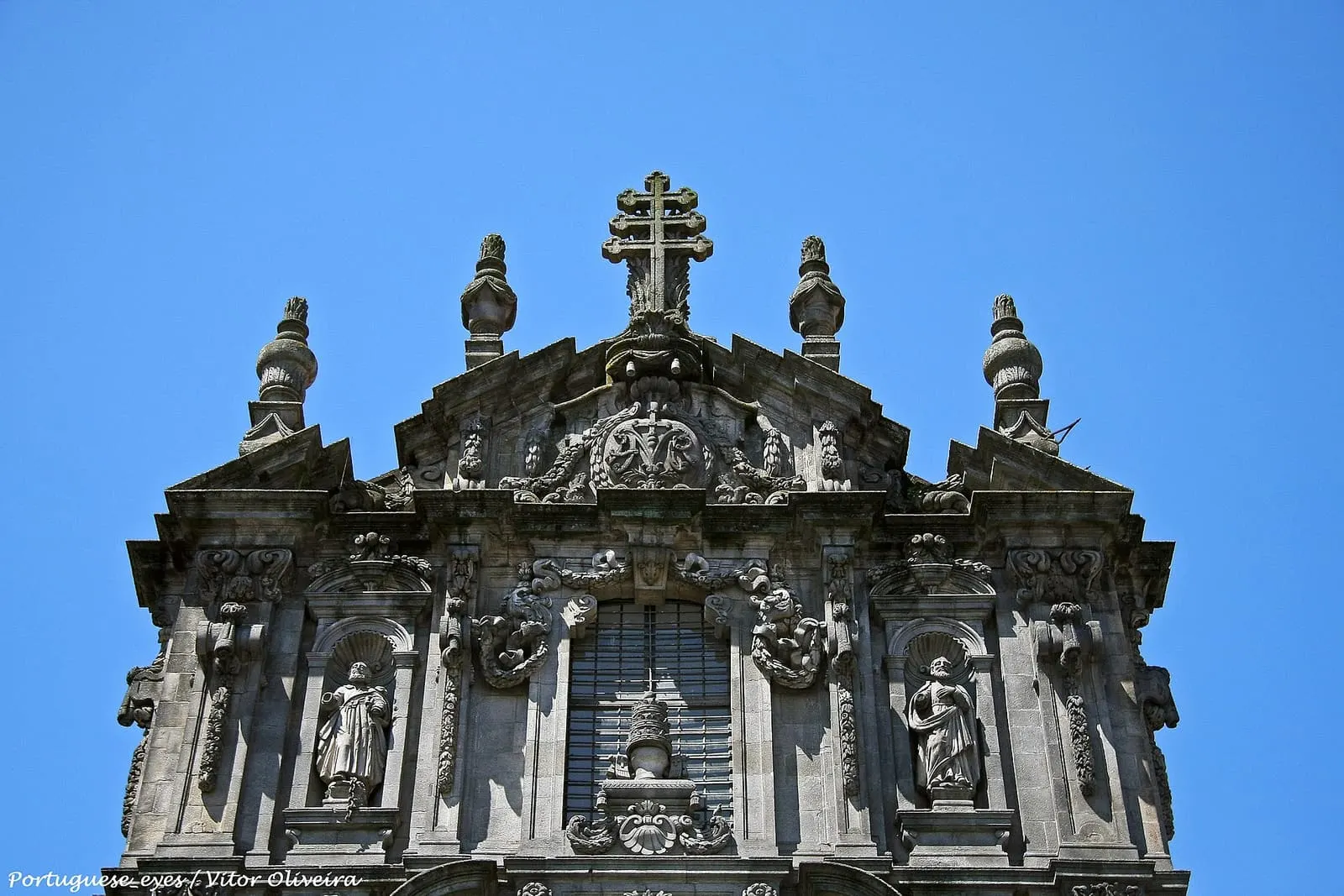
The main façade of the church, richly ornamented with volutes, festoons and sculptural elements in granite, is one of the most expressive examples of Nasoni’s decorative grammar, which knew how to combine seventeenth-century Roman classicism with local taste and materials.
The tower that defines Porto
About 75 metres high and six storeys tall, the Clérigos tower was for a long time the tallest structure in the city. It is climbed by a narrow spiral staircase of approximately 225 steps up to the upper terraces, from which a 360-degree panorama opens out over the rooftops of Porto, the river Douro and Vila Nova de Gaia. Inside it still houses a carillon of several dozen bells, which continues to mark moments in the life of the city.
The very figure of Nasoni is inextricably linked to the monument: having joined the Brotherhood, the architect asked to be buried in the crypt of the church, where he rests in a place now unknown — a discreet epilogue for the man who shaped the Baroque landscape of northern Portugal.
Significance and protection
Classified as a National Monument since 1910, the Church and Tower of the Clérigos is part of the protected area of the historic centre of Porto, inscribed on UNESCO’s World Heritage list. The monument converses, just a few steps away, with other major landmarks of the city, such as the neighbouring Church of São Francisco, profusely covered in gilded woodwork, and the austere Porto Cathedral, of Romanesque origin.
Today fully turned into a museum and restored, the complex receives hundreds of thousands of visitors each year and maintains its dual role: that of a place of worship and that of a privileged viewpoint over the city. Climbing the Clérigos tower remains, for the people of Porto and for visitors alike, one of the gestures that best expresses the identity of Porto.
Frequently asked questions
- How many steps does the Clérigos Tower have?
- The interior spiral staircase has around 225 steps, leading up to the panoramic terraces at the top, from which Porto and the Douro valley are revealed.
- Who was the architect of the Church and Tower of the Clérigos?
- The complex was designed by Nicolau Nasoni, an architect and painter of Tuscan origin who lived much of his life in Porto and chose to be buried here, in the crypt of the church itself.
- How tall is the Clérigos Tower?
- The bell tower is about 75 metres high, which made it for a long time the highest and most visible point in the city of Porto.
Sources
Keep exploring
Heritage nearby
More places to discover from here. Approximate straight-line distances, within 50 km.