Periods & Styles
Mannerism in Portugal
Mannerism in Portugal (c. 1540-1650): the transition between the Renaissance and the Baroque, marked by the sobriety of the plain style and the Counter-Reformation.
- Built
- c. 1540-1650
- Style
- Maneirismo
Mannerism was the dominant artistic language in Portugal between the middle of the sixteenth century and the middle of the seventeenth, occupying the interval between the fullness of the Renaissance and the exuberance of the Baroque. More than a decorative style, it expressed a new sensibility: the awareness that the classical rules, far from being a destiny, could be bent, elongated and recombined. In place of serene balance, Mannerism cultivated tension, calculated elegance and, above all in Portugal, a severe sobriety that would become its distinctive hallmark.
From the beautiful manner to the Counter-Reformation
Historians identify three moments in the evolution of Portuguese Mannerism. In a first phase, from the 1540s onward, the Italian models disseminated by the treatises of Sebastiano Serlio and Vignola were absorbed, read avidly in the royal workshops. There followed the “triumph of the beautiful manner”, in which the elongated form, the torsion of the figures and the invention of viewpoints asserted themselves as values in their own right. Finally, with the Council of Trent and the rise of the Counter-Reformation, art was summoned to a more coherent and didactic discourse, in the service of preaching and doctrinal clarity.
In painting, this trajectory can be seen in the work of masters such as Gregório Lopes, Cristóvão de Figueiredo and Garcia Fernandes — at times so close that they merge under the label “Masters of Ferreirim” — and, later, in António Campelo, Gaspar Dias and Diogo de Contreiras, who renewed the chromatic palette and gave new expressiveness to sacred figures.
The plain style
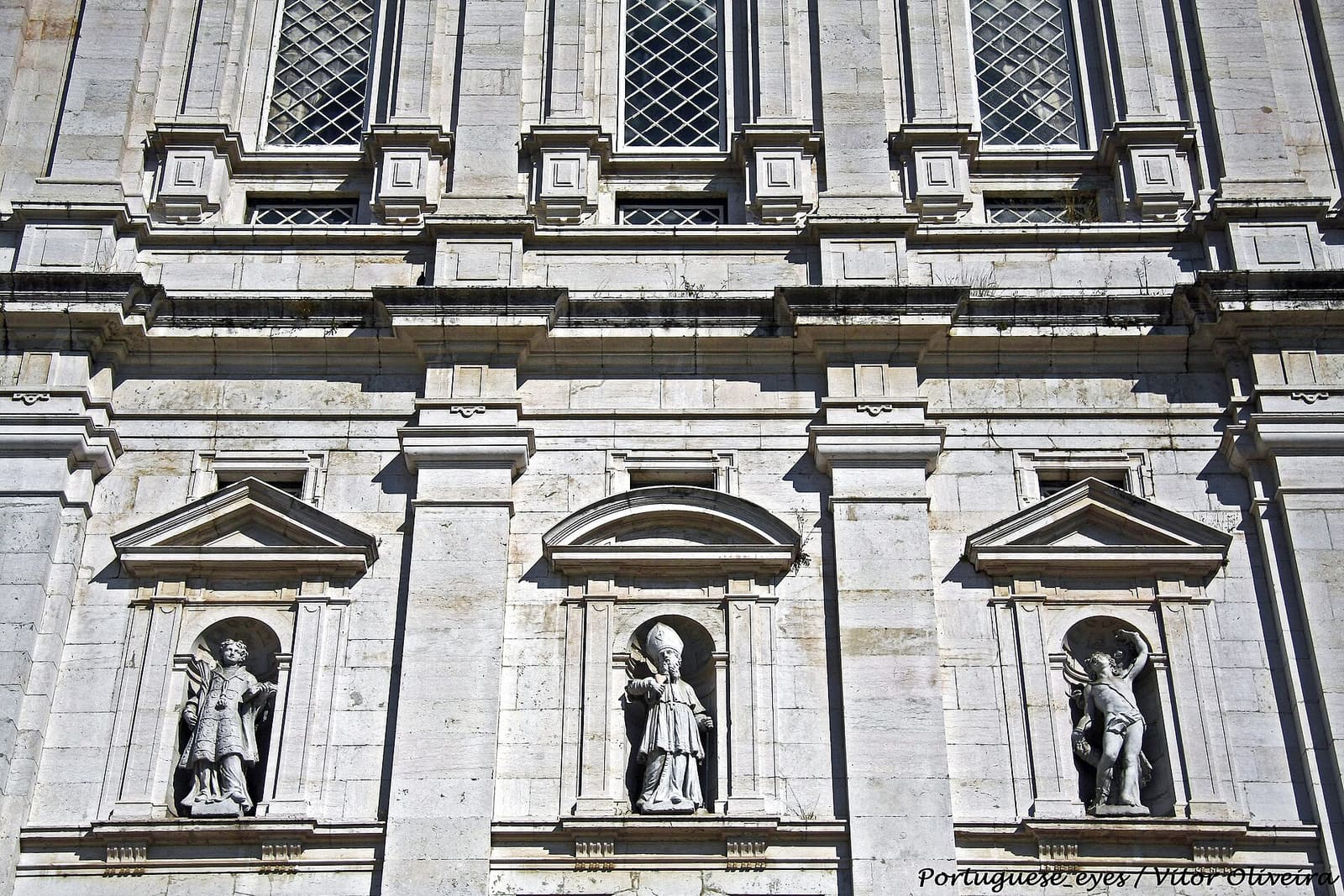
It is in architecture that Portuguese Mannerism acquires its most original face. The façade strips itself of ornament and is organised by clean planes and clear proportions, in a register that came to be called the plain style (arquitetura chã) — sober on the outside, often sumptuous within, where azulejo and gilded woodwork would, in the following century, make up for the bareness of the exterior. This economy of means served both the Counter-Reformation Church and the State, especially during the Iberian Union, being easily reproducible throughout the empire.
The great lesson of Portuguese Mannerism lies not in what it adds, but in what it removes: by stripping the wall bare, it turns sobriety into an act of taste and discipline.
The turning point lies in the main cloister of the Convento de Cristo, in Tomar, begun by Diogo de Torralva in 1554 and completed by the Italian Filippo Terzi. Its composition in two storeys of Serlian arches is frequently cited as the country’s first fully Mannerist work. Terzi, an engineer and architect arrived from the court, would go on to leave his mark on the religious landscape of Lisbon, notably at the Mosteiro de São Vicente de Fora, begun in 1582 and a model for the generations that followed.
Temples of the Society of Jesus
The spread of the Jesuit church model — a broad, single-nave space conceived for preaching — was decisive. The Igreja de São Roque, in Lisbon, erected between 1565 and 1587 to a plan by Afonso Álvares and finished by Terzi, exemplifies this formula: a restrained exterior, an interior in which the capital’s only great painted Mannerist ceiling survives. In Coimbra, the Sé Nova, designed by Baltazar Álvares, repeats the scheme with equal rigour. When, in the seventeenth century, this vocabulary became charged with movement and gold, the bridge to Portuguese Baroque architecture was laid, inheriting from Mannerism the sober plan upon which it would make decoration explode.
Frequently asked questions
- What distinguishes Mannerism from the Renaissance in Portugal?
- While the Renaissance sought classical balance and harmony, Mannerism strains those rules: it elongates figures in painting, multiplies viewpoints and, in architecture, pares the façade down to an almost bare sobriety, the so-called plain style (arquitetura chã).
- Who were the main Portuguese Mannerist architects?
- Diogo de Torralva, author of the main cloister of the Convento de Cristo in Tomar; the Italian Filippo Terzi, associated with São Vicente de Fora; and Baltazar Álvares, responsible for the Sé Nova of Coimbra.
- When did Portuguese Mannerism begin and end?
- It took hold from the middle of the sixteenth century and continued until the middle of the seventeenth, spanning the period of the Iberian Union (1580-1640) and the spread of the Jesuit church model.