Monuments
Moura Castle
Moura Castle, a medieval fortress of the Baixo Alentejo tied to the legend of the Moorish maiden Salúquia, overlooking the town of Moura, in the district of…
- Location
- Moura, Beja
- Built
- séculos XI-XII (origens muçulmanas); reedificação a partir de D. Dinis (1279-1325)
- Style
- Gótico
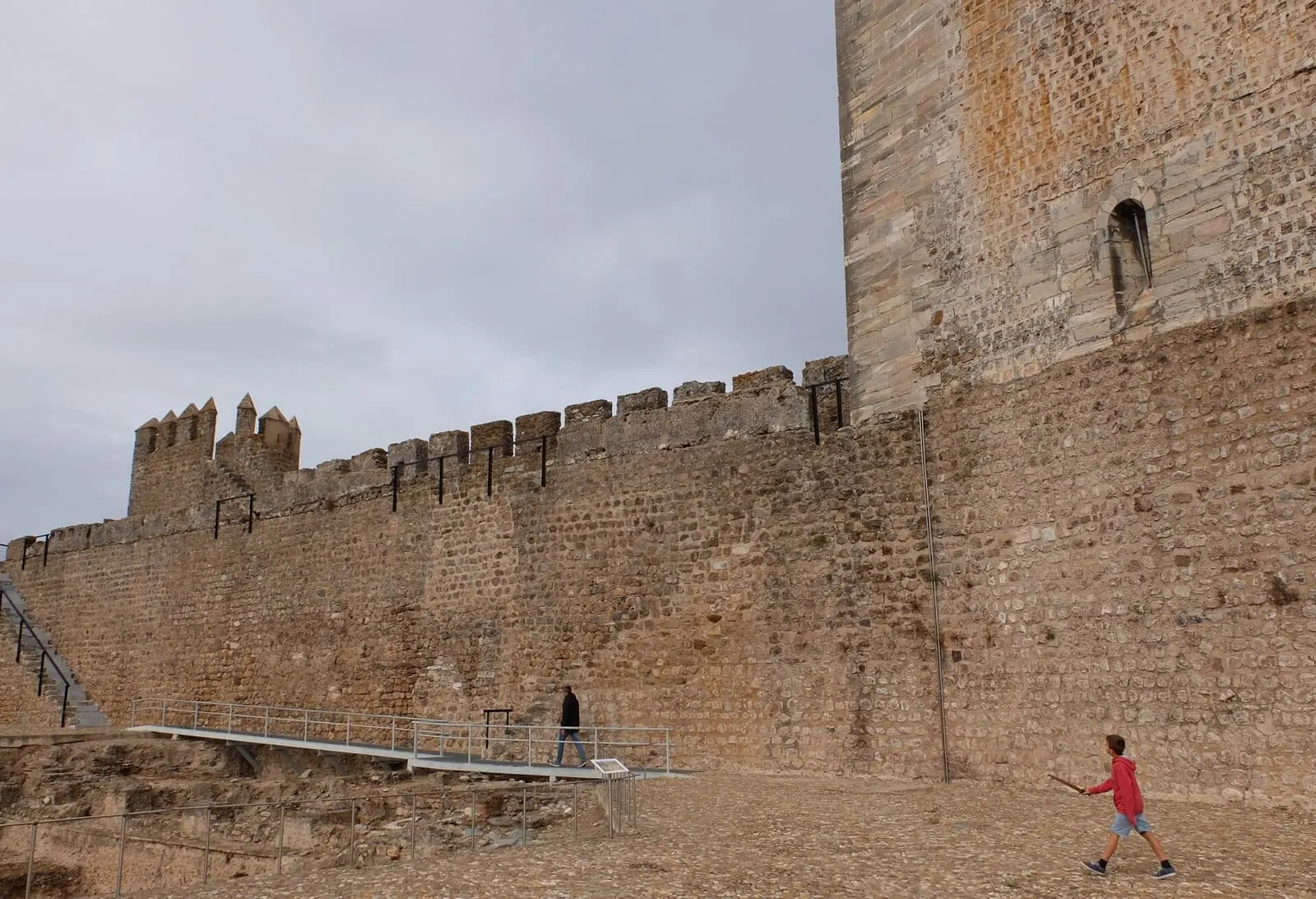
Overlooking the town of Moura, in the Baixo Alentejo, the castle commands a spur that leans out over the Guadiana valley, near the confluence of the Brenhas and Lavandeira streams. The position is no accident: this was a point of watch and defence in a frontier land disputed for centuries between Muslim rule and the Christian kingdoms of the peninsula. Today the fortified complex, with its keep and the remains of its walls, is both a monument and the setting of one of the best-known legends of the Alentejo.
From Muslim origins to the reconquest
The first significant fortification dates back to the Islamic period, with rammed-earth structures raised between the mid-eleventh century and the early twelfth. The settlement was taken in 1166 by the brothers Pedro and Álvaro Rodrigues, in the context of the Christian advance over the Alentejo, although its definitive consolidation within the kingdom came only later. It fell to King Dinis (1279-1325) to launch the rebuilding programme that gave the castle its essential Gothic appearance, with the square keep crowned by pyramidal merlons. At the end of the fourteenth century, under King Fernando, a second curtain of wall was added.
Among the elements of greatest interest is the so-called Hall of the Alcaides, an octagonal chamber covered by a ribbed vault on the upper floor of the keep — a detail that aligns the castle with other achievements of Dionisian military architecture found across the country. As happened at Mértola and at other strongholds along the Guadiana, the medieval structure was adapted over time to the demands of each age.
The legend of the Moorish maiden Salúquia
No narrative is so closely bound to Moura as that of the young Salúquia, daughter of the Muslim governor Abu Hassan. Tradition holds that, from the top of a tower, she awaited the arrival of her betrothed, the commander of a neighbouring fortress, who had set out to fight the Christians. The Christian forces, however, had ambushed and killed him; donning the clothes of the vanquished, they deceived the defenders and had the castle gates opened to them. On realising the ruse, Salúquia is said to have cast herself from the tower, choosing death over captivity. The legend took such hold that the name of the town — Moura — came to be popularly read as a tribute to this figure, an eloquent example of the enchanted Moorish maidens that people the imagination of the Alentejo.
From the Restoration to classification
During the Restoration War, in the seventeenth century, Moura’s strategic importance on the frontier line with Castile led to the reinforcement of its defences: the engineer Nicolau de Langres designed a girdle of bastions of bastioned layout, surrounded by a moat, integrating the medieval castle into the modern defensive system of the Alentejan borderland. In the twentieth century, the complex was classified as a Property of Public Interest in 1944, a recognition that enshrines its historical and architectural value. The keep and the surviving curtains remain the visual landmark of the town, sharing with neighbouring castles such as that of Serpa the memory of a long-fortified frontier.
Frequently asked questions
- Where is Moura Castle?
- It rises in a commanding position above the town of Moura, in the district of Beja, in the Baixo Alentejo, beside the left bank of the river Guadiana.
- What is the legend associated with Moura Castle?
- The legend of the Moorish maiden Salúquia, a young Muslim woman who, on realising that disguised Christians had taken the castle and killed her betrothed, is said to have thrown herself from a tower. Tradition links her name to the origin of the town's place name.
- What heritage classification does Moura Castle hold?
- It has been classified as a Property of Public Interest since 1944.
Sources
Keep exploring
Heritage nearby
More places to discover from here. Approximate straight-line distances, within 50 km.