Monuments
Penedono Castle
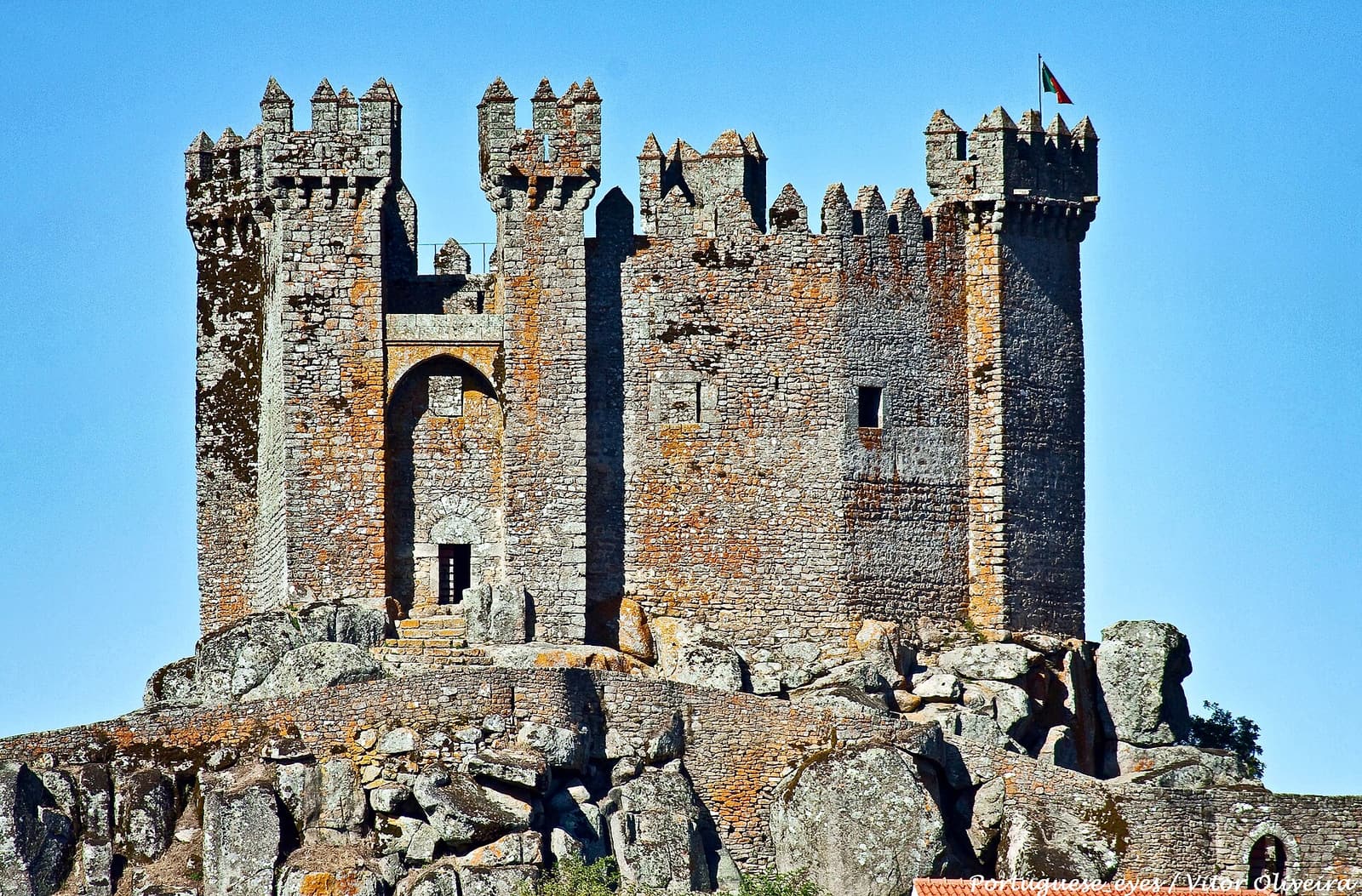
Penedono Castle, a medieval rock fortress of the Beira Alta in the district of Viseu, a national monument linked to the legendary knight Magriço.
- Location
- Penedono, Viseu
- Built
- Reconstrução de finais do século XIV
- Style
- Arquitetura militar românica e gótica
Penedono Castle, also known as the Castle of Magriço, is a medieval rock fortress set upon a granite outcrop in the heart of the town of Penedono, in the district of Viseu, deep in the Beira Alta. Its jagged silhouette, with pointed turrets and pyramidal merlons, makes it one of the most scenic castles in Portuguese territory and a defining landmark of the highlands that border, to the north, the demarcated region of the Douro.
History
The occupation of the site goes back to the Christian Reconquest, the region being resettled in the wake of the Leonese advances against Muslim rule. Throughout the Middle Ages, Penedono was part of the defensive systems of the inland frontier, its settlement being included, in the late fourteenth century, within the territory of Trancoso. It is to that period, under the initiative of the Coutinho family, that the present configuration of the fortress is attributed, raised in granite and schist.
The castle is inseparably linked to the figure of Álvaro Gonçalves Coutinho, the Magriço, a knight immortalised by Luís de Camões in The Lusiads (Canto VI) as one of the Twelve of England, a group of Portuguese knights said to have set out for the English court in defence of the honour of ladies. Although the knight’s direct connection to this stronghold belongs more to tradition than to contemporary documentation, the epithet “Castle of Magriço” has become deeply rooted in local memory.
Architecture
Small in scale yet notably complex, the castle has an irregular polygonal plan, roughly hexagonal, adapted to the contour of the crag that serves as its base. The walls, crowned by merlons with pyramidal tops, are reinforced at the angles by rectangular turrets and by small bastions, lending the whole a robust and strongly verticalised volume.
Inside, a vaulted cistern is preserved, indispensable for withstanding a siege, as well as traces of residential functions that distinguish this fortress from purely military castles. The construction combines features of late Romanesque architecture with the Gothic idiom, in an example that well illustrates the transition of Portuguese castellology in the fourteenth and fifteenth centuries.
Classification and enhancement
Penedono Castle has been classified as a national monument since 1910, forming part of the set of fortifications that structure the reading of the defensive heritage of the Beira. Between the 1940s and 1950s, it was the subject of restoration campaigns promoted by the heritage administration, which consolidated the walls and restored to the monument part of its lost image.
Today open to visitors, the castle is the main point of interest in the town and connects with other landmarks of the network of castles of the Beira Alta, such as the nearby Castelo de Numão, helping to compose an itinerary through the military heritage of the lands between the Côa and the Douro.
Frequently asked questions
- Where is Penedono Castle?
- The castle rises on a granite outcrop in the centre of the town of Penedono, in the parish of Penedono e Granja, municipality of Penedono, district of Viseu, in the Beira Alta.
- Why is it called the Castle of Magriço?
- Because of the tradition that links it to Álvaro Gonçalves Coutinho, the Magriço, a knight of the legendary Twelve of England celebrated by Camões in The Lusiads, whose family was connected to the region.
- Is Penedono Castle a national monument?
- Yes. It has been classified as a national monument since 1910, being one of the most singular rock fortresses of the Beira.
Sources
Keep exploring
Heritage nearby
More places to discover from here. Approximate straight-line distances, within 50 km.