Places
Trancoso
Trancoso, a walled city in the Guarda district, with its medieval castle, Dinisian walls, and one of the most important Jewish heritages in Beira Alta.
- Location
- Trancoso, Guarda
- Built
- Foral atribuído por D. Afonso Henriques (séc. XII)
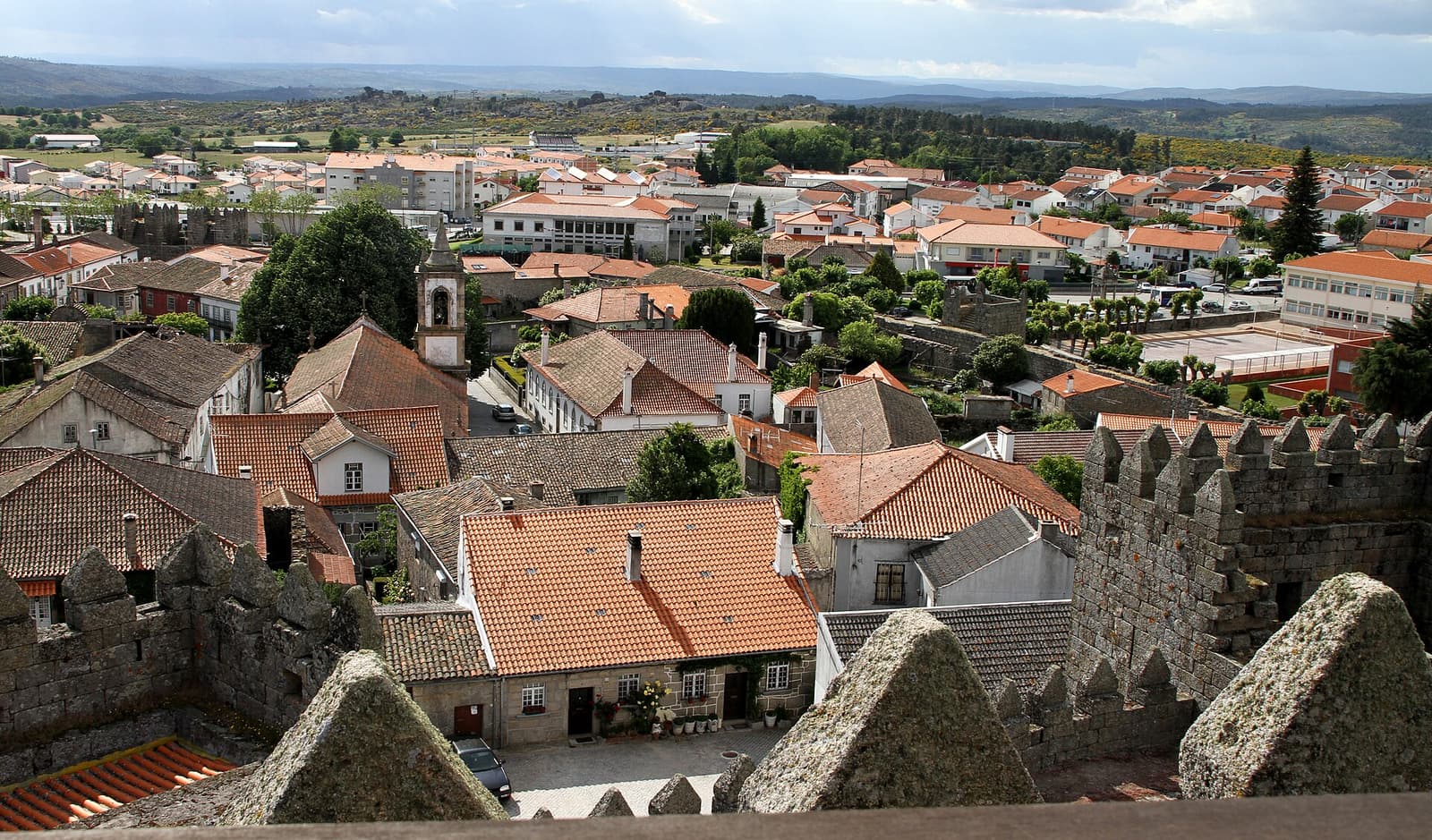
Perched on a granitic plateau in Beira Alta, overlooking the lands stretching from Serra da Estrela to the Douro valley, Trancoso is one of the twelve Historic Villages of Portugal and one of the most complete walled settlements in the country’s interior. Its clustered houses within the defensive perimeter, dominated by the silhouette of the castle, make it a rare example of a medieval town that has preserved, almost intact, its original morphology.
The antiquity of Trancoso predates the nation itself. The castle existed even before the foundation of the kingdom, and the strategic position of the place, on the disputed border between Christians and Muslims, earned it campaigns and raids—including that of Almanzor in the late 10th century. With the consolidation of the kingdom, D. Afonso Henriques granted it a charter, formalizing a town that would become a first-rate military stronghold in the defense of Beira.
The walls and the castle
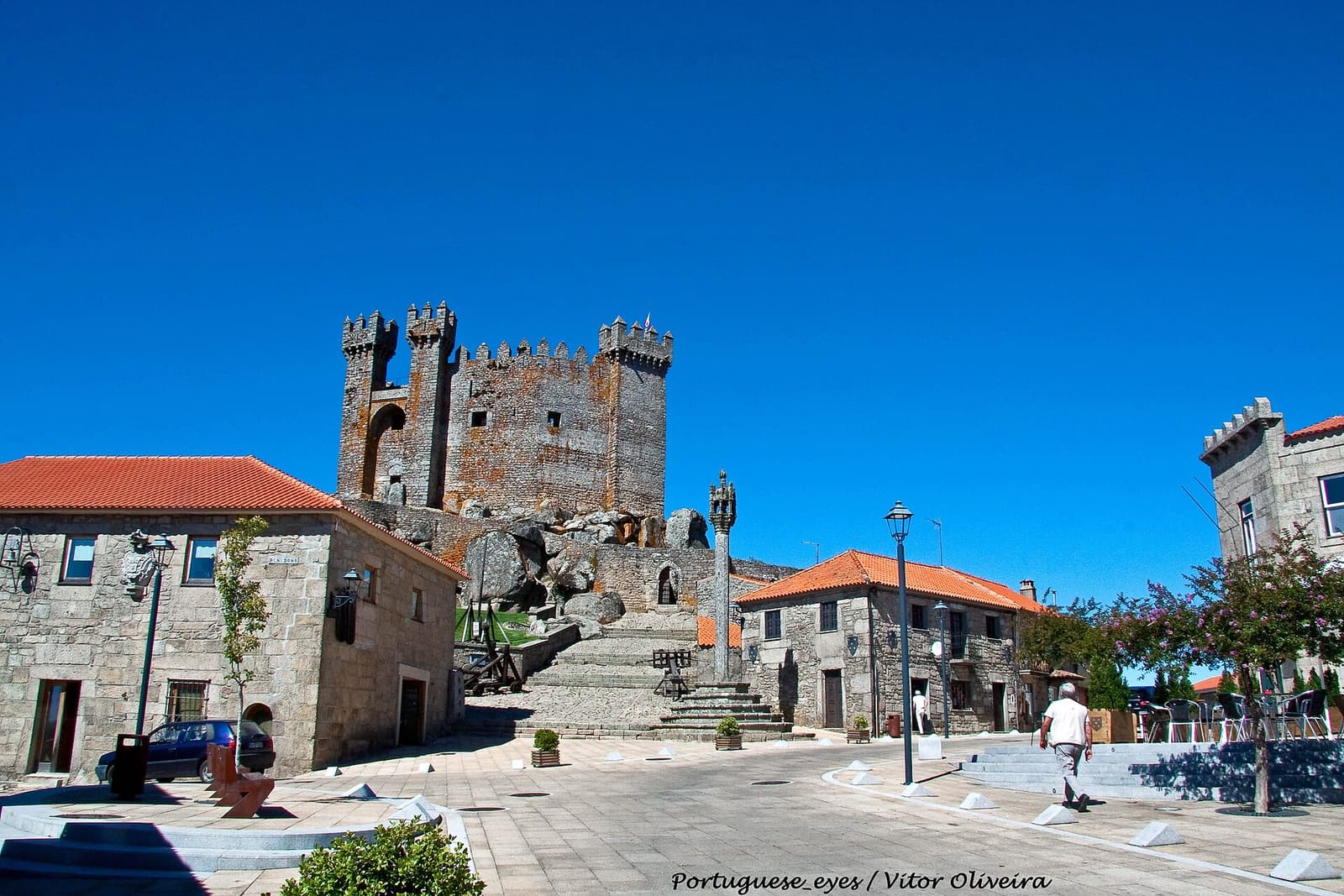
The fortified complex of Trancoso is its greatest treasure. The Dinisian walls, ordered to be built and reinforced by D. Dinis in the late 13th century, completely encircle the historic center, with towers and gates that still regulate access today—among them the Porta d’El-Rei and the famous Portas do Carvalho. At the top of the hill, the Castle of Trancoso, with its keep and barbican, was the stage for decisive episodes: it was here that, in 1385, shortly before Aljubarrota, Portuguese troops achieved a victory that paved the way for the affirmation of the Avis dynasty.
Few Portuguese towns preserve such an intact ring of walls, capable of returning to the visitor the exact scale of a medieval city.
The importance of Trancoso is also linked to a dynastic episode: it was in this town that, in 1282, the marriage of D. Dinis to the Aragonese infanta Isabel, the future Holy Queen, was celebrated. This event reinforced the town’s status and partly justified the royal investment in its defenses.
The Jewish quarter and Sephardic memory
Throughout the Middle Ages, Trancoso hosted one of the largest and most prosperous Jewish communities in the region. The ancient Jewish quarter occupied a dense block of narrow streets, where portals with traces of inscriptions and the so-called Casa do Gato Preto, a 16th-century building with symbolism traditionally associated with Jewish presence, still stand. After the expulsion edict of 1496, many inhabitants converted to Christianity, secretly maintaining their faith—a crypto-Jewish heritage that links Trancoso to other Beira towns like Belmonte.
From this world emerges the most singular figure of the town: Gonçalo Anes Bandarra, a shoemaker born around 1500, whose prophetic and messianic Trovas were widely copied and censored. Prosecuted by the Inquisition, Bandarra would become one of the roots of Sebastianism, and his work would echo centuries later in Padre António Vieira and Fernando Pessoa’s Mensagem. His memory lives on today in the Isaac Cardoso Jewish Culture Interpretation Center, located in the heart of the old Jewish quarter.
A route of granite and border
Elevated to city status in 2004, Trancoso keeps alive the tradition of the São Bartolomeu fair, rooted in the medieval fair charter, and is part of a route of fortresses and granitic villages dotting the Beira plateau. Visitors naturally extend their itinerary to the nearby Sortelha, nestled in its rock, or to the border city of Guarda, the highest in Portugal. Walking through the walls of Trancoso, among heraldic houses, cobbled alleys, and ancient portals, is to traverse, in one place, the medieval border, the coexistence of faiths, and the prophetic memory that gave this Beira city its name.
Frequently asked questions
- Where is Trancoso located?
- Trancoso is situated in the Guarda district, in the sub-region of Beira Interior Norte (Central region), on a plateau in Beira Alta, approximately 30 km northwest of the city of Guarda.
- Who was the Bandarra of Trancoso?
- Gonçalo Anes Bandarra was a shoemaker and poet born in Trancoso around 1500, author of the Trovas that fueled Sebastianism. He was prosecuted by the Inquisition, and his work influenced Padre António Vieira and Fernando Pessoa.
- Why is Trancoso important for Jewish heritage?
- Trancoso had one of the largest Jewish communities in Beira. The old Jewish quarter preserves portals and the so-called Casa do Gato Preto, and today hosts the Isaac Cardoso Jewish Culture Interpretation Center.
Sources
Keep exploring
Heritage nearby
More places to discover from here. Approximate straight-line distances, within 50 km.