Monuments
Vila Viçosa Castle
The medieval Castle of Vila Viçosa, in the Alentejo: cradle of the House of Braganza, bastioned enceinte of the Restoration War and sanctuary of Our Lady of…
- Location
- Vila Viçosa, Évora
- Built
- séc. XIII–XIV; cerca abaluartada 1663–1664
- Style
- Gótico, Manuelino e fortificação abaluartada
The Castle of Vila Viçosa rises in the historic centre of the Alentejo town, in the municipality of Vila Viçosa, district of Évora. A fortress of medieval origin, it was for centuries the centre of the power of the dukes of Braganza and still holds, within its walled enclosure, churches, museums and a sanctuary that perpetuate the memory of one of the oldest Portuguese seigneurial houses.
Medieval origin and growth
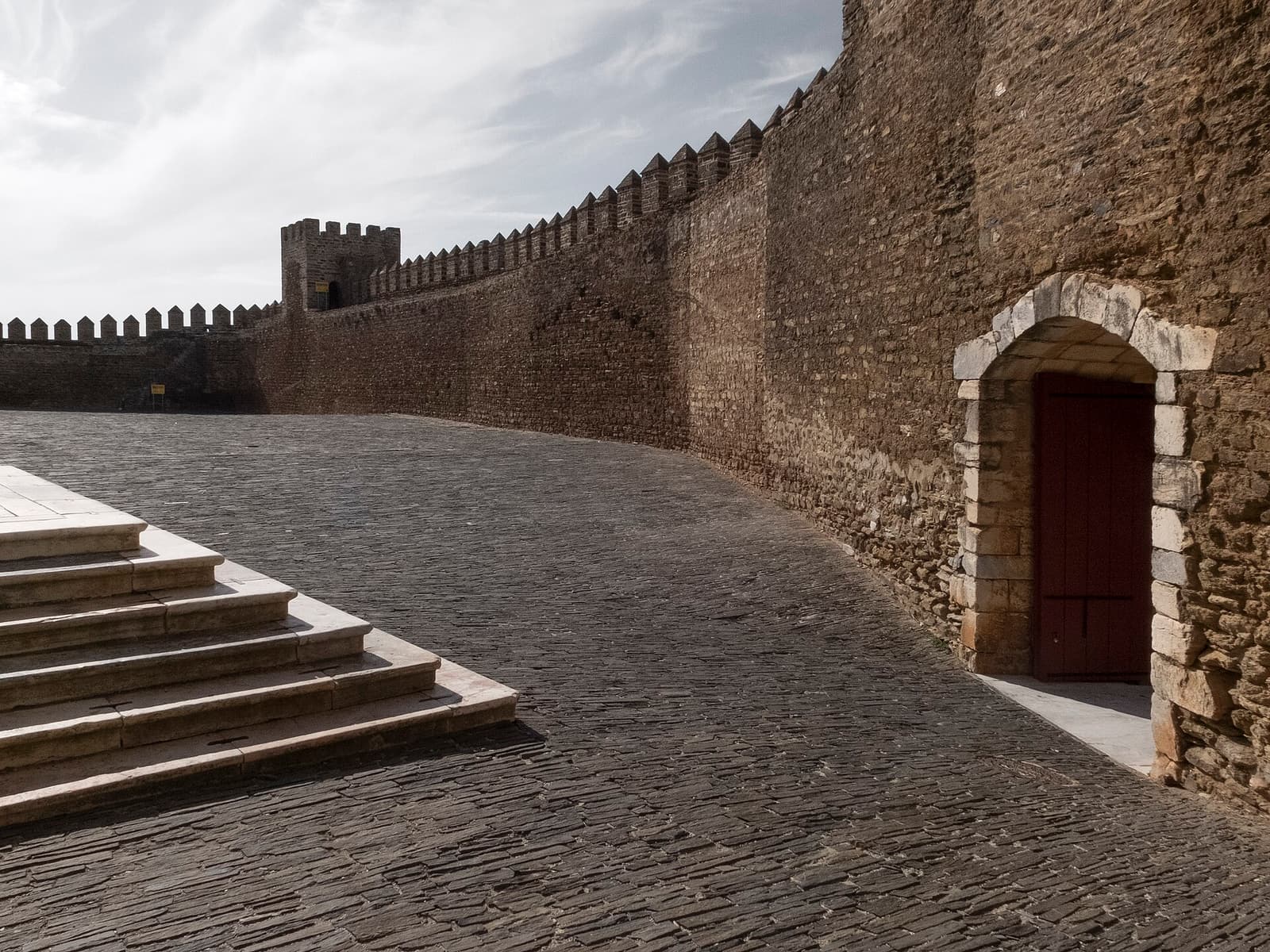
The establishment of a fortified settlement at this point of the Alentejo goes back to the Christian reconquest of the territory. King Afonso III granted the town a charter in 1270 and, under King Dinis, decisive works of construction of the castle took place, with its characteristic square plan of about sixty metres on each side, reinforced by circular turrets at the corners. In the reign of King Fernando I (1367–1383) the fortification was again improved, in a period of intense concern with the defence of the frontier.
Once the dynastic crisis of 1383–1385 had ended, the domains of Vila Viçosa formed part of the vast donation made by King João I to the Constable Nuno Álvares Pereira. By this means the town and its castle passed to the House of Braganza, becoming the seat of the duchy. Fernando, 2nd Duke, ordered a palace to be raised within the enclosure, making the castle the residence of the ducal family.
From medieval fortress to palace
At the beginning of the sixteenth century, the relationship of the Braganzas with the castle changed profoundly. Jaime I, marked by the execution of his father Fernando II by order of King João II, chose to begin, from 1501, the construction of the neighbouring Ducal Palace of Vila Viçosa, which would become the great residence of the house. The castle then lost its residential function, but retained its military and symbolic role.
In the context of the Restoration War, the medieval fortification was enclosed by a new bastioned enceinte, raised between 1663 and 1664, with a polygonal star-shaped layout adapted to modern artillery. This adaptation placed Vila Viçosa within the defensive system of the Alentejo frontier, a theme that the nomination gathered in the Tentative List of Vila Viçosa helps to contextualise.
Significance and visit
Within the enclosure survives the former parish church, today the Sanctuary of Our Lady of the Conception, patroness of Portugal proclaimed by King João IV in 1646. The complex, classified as a National Monument by decree of 23 June 1910, is owned by the Foundation of the House of Braganza and houses the Museum of Archaeology and the Hunting Museum.
Part of the network of fortresses and castles that dot the Alentejo, the Castle of Vila Viçosa allows one to read, in superimposition, the medieval fortification, the Renaissance palace and the military engineering of the seventeenth century, offering the visitor a rare synthesis of Portuguese military and dynastic history.
Frequently asked questions
- When was the Castle of Vila Viçosa built?
- The medieval core dates from the thirteenth and fourteenth centuries, following the charter granted by King Afonso III in 1270 and the works promoted by King Dinis. The bastioned enceinte that surrounds the castle today was raised between 1663 and 1664, during the Restoration War.
- What is the castle's connection with the House of Braganza?
- Granted to Nuno Álvares Pereira after the crisis of 1383–1385, the castle became the seat of the Duchy of Braganza. Fernando, 2nd Duke, ordered a palace to be built within it before the family moved its residence to the Ducal Palace, begun in 1501.
- What can be visited at the castle today?
- The complex, owned by the Foundation of the House of Braganza, houses the Museum of Archaeology and the Hunting Museum, as well as the Sanctuary of Our Lady of the Conception, the town's former parish church.
Sources
Keep exploring
Heritage nearby
More places to discover from here. Approximate straight-line distances, within 50 km.