Places
Castro Marim
Castro Marim, an Algarve town at the mouth of the Guadiana: medieval castle, Fort of São Sebastião, seat of the Order of Christ, and the saltmarsh nature reserve.
- Location
- Castro Marim, Faro
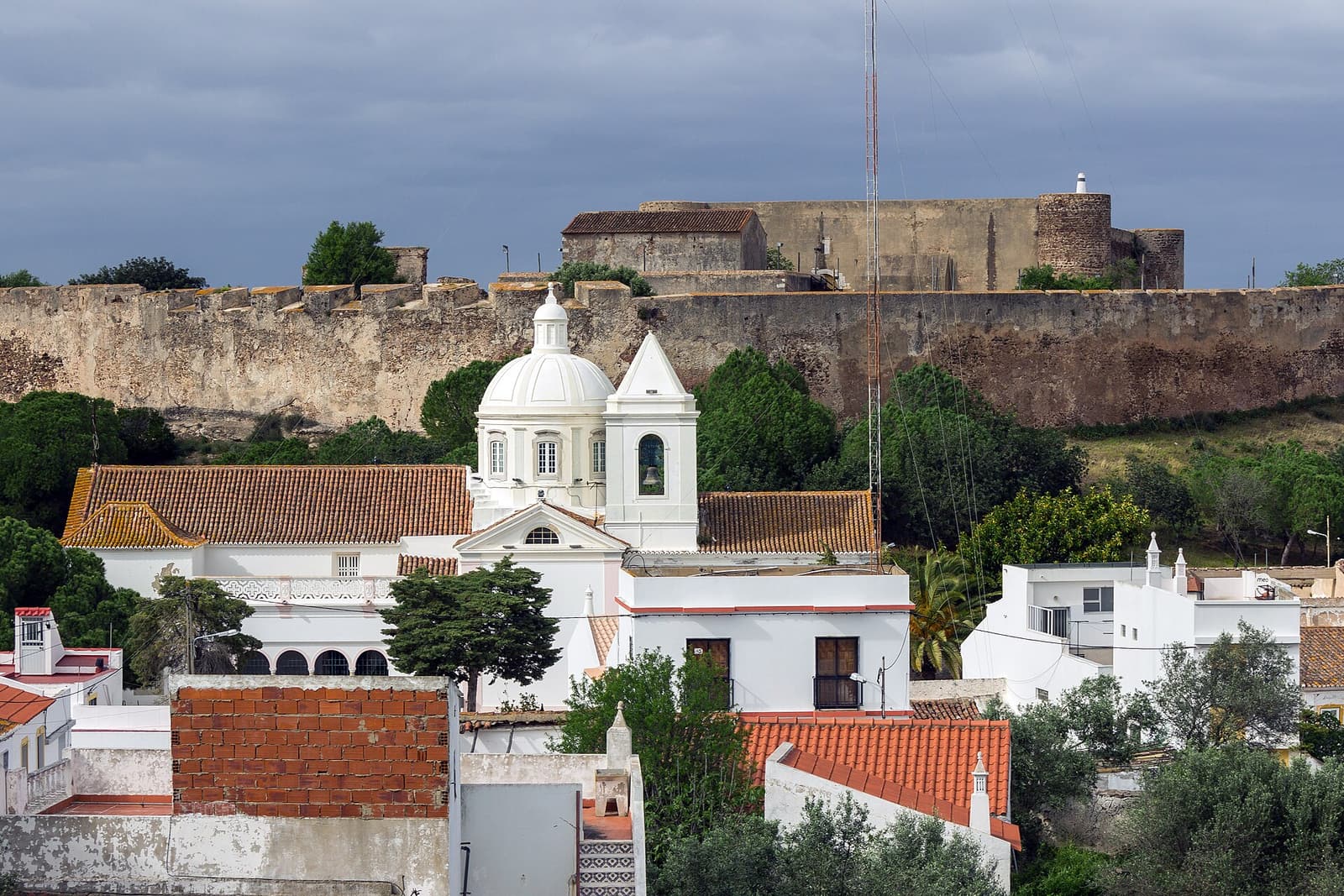
On the edge of the mouth of the Guadiana, in the south-easternmost corner of Portuguese territory, Castro Marim rises over two small hills that command a vast saltmarsh and the river frontier with Spain. Its position is strategic and immensely ancient: the hill was occupied in succession by prehistoric peoples, Phoenicians, Carthaginians, Romans and Muslims, drawn by control of navigation on the river and by the wealth of its salt. Today the town condenses into a single silhouette the overlay of centuries of fortification and the singular landscape of the salt pans.
A frontier stronghold
Castro Marim was taken from the Moors in 1242 and, in 1277, received a charter (foral) from King Afonso III, who ordered the rebuilding of its defences. The medieval castle, square in plan and reinforced by cylindrical towers at its corners, was enlarged in the reign of King Dinis with an outer wall meant to protect the civilian settlement. Its military importance arose from its simultaneous proximity to the sea, to the kingdom of Castile and to the lands then in dispute, which made it one of the kingdom’s principal strongholds in the far south.
The fortified complex gained a new layer in the seventeenth century. During the Restoration War, King João IV ordered, from 1641, the construction of the Fort of São Sebastião on the hill facing the castle, on the site of a former hermitage of the same patron. It is the best-preserved example of the town’s bastioned renewal and was classified as a National Monument. The 1755 earthquake ruined much of the construction within the walls of the old castle, including the keep, hastening the depopulation of the historic enclosure.
The first seat of the Order of Christ
Before Tomar became synonymous with the knights of Christ, it was at Castro Marim that the new order took its first steps.
After the Order of the Temple was dissolved, the Order of Christ was created in 1319 by a bull of Pope John XXII, inheriting part of the Templar patrimony in Portugal. Castro Marim was granted to it and became the order’s first seat, a role it held from 1319 until around 1356, when the mother house moved to Tomar. That episode inscribes the Algarve town in one of the founding chapters of the history of the military orders in Portugal, linking it to the path that would culminate in the great maritime enterprises.
The saltmarsh and the salt
Around the town stretches one of the most valuable ecosystems in the south of the country. The salt flats at the mouth of the Guadiana — a combination of saltmarshes, salt pans, tidal creeks and brackish water bodies — sustained for centuries the traditional extraction of salt, an activity that still persists and remains close to the techniques described in the world of Portuguese saltpans and salinas. In 1975 the area was classified as the Nature Reserve of the Saltmarsh of Castro Marim and Vila Real de Santo António, the first nature reserve created in Portugal, covering some 2,300 hectares and forming a refuge for waterbirds such as the flamingo.
To visit Castro Marim is thus to travel at once through the military history and the water geography of the Algarve. From the walls one looks out over a panorama embracing the fort, the saltmarsh, the river and the international bridge, in a permanent dialogue between frontier and nature. The town fits well into an itinerary of the eastern Algarve, close to historic centres such as Tavira and to the set of coastal defences that protected the shore, addressed on the page devoted to coastal forts.
Frequently asked questions
- Where is Castro Marim?
- Castro Marim is a town in the far south-east of the Algarve, in the district of Faro, lying on the right bank of the mouth of the River Guadiana, facing Spain.
- Why was Castro Marim the seat of the Order of Christ?
- In 1319, by papal bull, the newly created Order of Christ received Castro Marim and established its first seat there, which it kept between 1319 and around 1356, before being transferred to Tomar.
- What is the Castro Marim saltmarsh?
- It is a wetland of salt flats, salt pans and estuary at the mouth of the Guadiana, protected since 1975 as the Nature Reserve of the Saltmarsh of Castro Marim and Vila Real de Santo António, the first nature reserve created in Portugal.
Sources
Keep exploring
Heritage nearby
More places to discover from here. Approximate straight-line distances, within 50 km.