Monuments
Domus Municipalis of Bragança
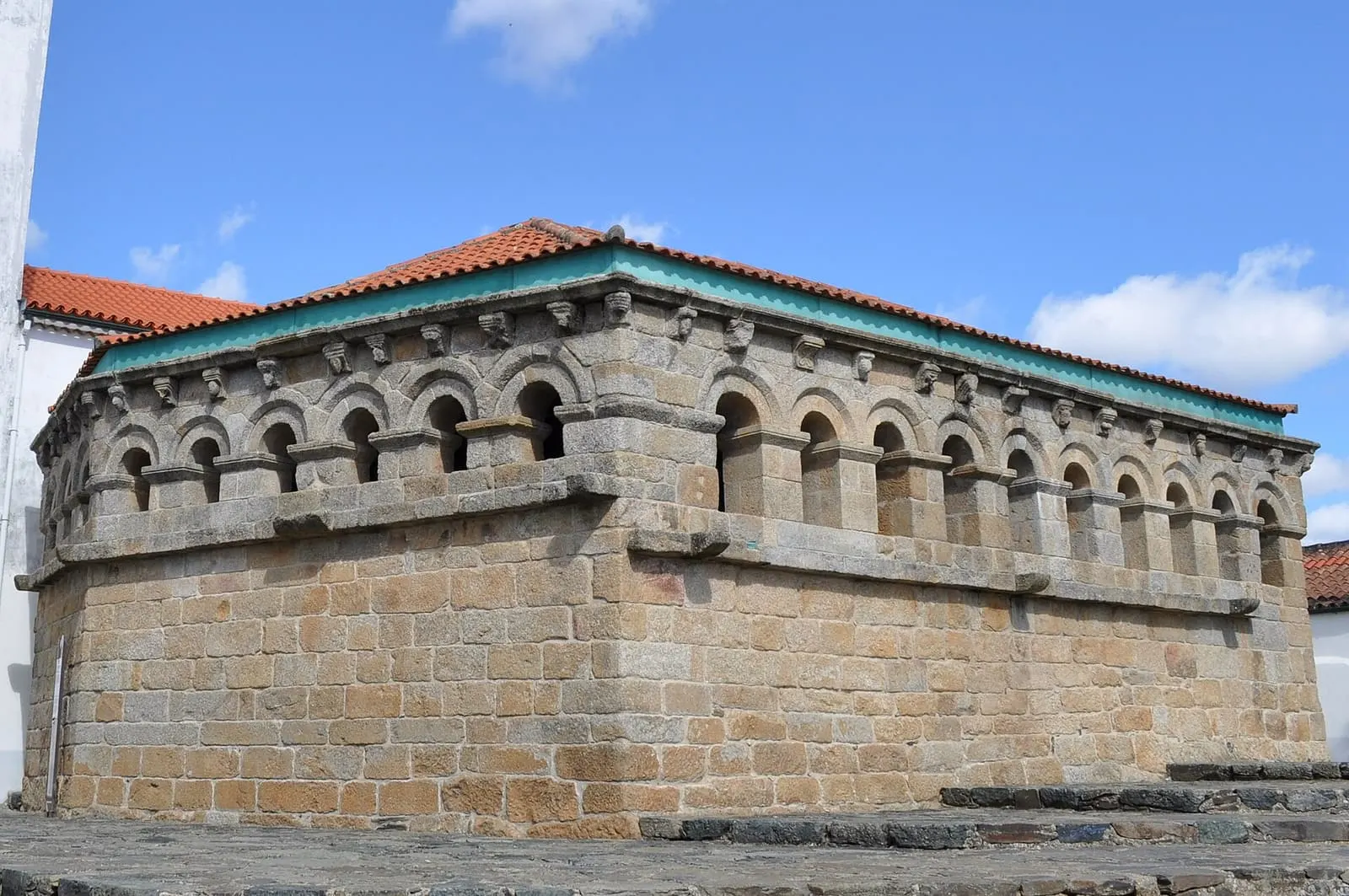
The Domus Municipalis of Bragança, within the Trás-os-Montes citadel, is the only Romanesque civic building with a pentagonal plan in the Iberian Peninsula.
- Location
- Bragança, Bragança
- Built
- séculos XII–XIV
- Style
- Românico
Within the medieval citadel of Bragança, sheltered in the shadow of the keep and the church of Santa Maria, stands a low and enigmatic building that the inhabitants simply nickname the Domus. The Domus Municipalis is, on a European scale, a rarity: while almost all of the Romanesque architecture that has come down to us is religious or military, this small civic hall has survived as an exceptional testimony to the way medieval communities organised and governed themselves. It is frequently described as the only known example of Romanesque civic architecture with a pentagonal plan in the entire Iberian Peninsula.
One body, two functions
The originality of the Domus begins with its conception. The building, with its irregular pentagonal plan and covered by a five-sided roof, resolves two distinct problems within a single structure. At the base, taking advantage of a hollow in the rock, lies a broad semi-buried cistern, covered by a barrel vault reinforced by two transverse arches, designed to collect and preserve rainwater and spring water — a vital resource for a population enclosed by walls. Above this cistern rests the flagstone floor of a spacious hall, pierced by a continuous succession of small round-arched windows that wrap around the building like a fenestrated gallery.
Few monuments express so clearly the medieval idea of the municipal council: the water that sustained the community and the hall where that community decided its own fate literally shared the same building.
It was in this upper hall that the good men of the neighbouring community of Bragança gathered to deliberate on matters of local government, the management of water, and collective life. The association between the reservoir and the assembly is no accident: the administration of water was, in many municipal communities, one of the principal reasons for the very existence of the municipality.
Stone, dating, and debate
Built in granite masonry, the Domus is sober but not devoid of ornament. The cornices, both exterior and interior, rest on dozens of corbels carved with floral, geometric, zoomorphic, and anthropomorphic motifs, a repertoire typical of the Romanesque grammar that here continues in a late and conservative form. It is precisely this late survival that fuels one of the most persistent debates about the building: some scholars, such as the Abbot of Baçal, argued for an origin in the late 12th or early 13th century, while later research points instead to the end of the 14th century, in a Romanesque that endured well beyond its canonical age in these frontier lands.
Whatever the exact date, the Domus belongs to the same defensive universe that gave rise to the impressive castle of Bragança and the walled enclosure that surrounds it. To fully understand its place in the history of building in Portugal, it is worth situating it within the broader panorama of Romanesque architecture in Portugal, in which monasteries and churches predominate.
The emblem of Bragança
Classified as a National Monument in 1910, the Domus Municipalis became the emblem of the city and one of the most reproduced symbols of the heritage of Trás-os-Montes. Its singular silhouette, nestled within the citadel, makes it an essential stop for anyone visiting the city of Bragança and exploring the ensemble of monuments that crown the hill, including the neighbouring Cathedral of Bragança. More than an architectural curiosity, the Domus is a document in stone: in it one reads the way a medieval community of north-eastern Portugal knew how to unite, in a single building, the material need for water and the political dignity of self-government.
Frequently asked questions
- Why is the Domus Municipalis such a singular monument?
- It is considered the only known example of Romanesque civic architecture with a pentagonal plan in the Iberian Peninsula, distinct from the general run of Romanesque buildings, which are religious or military.
- What was the Domus Municipalis used for?
- It combined two functions: an underground cistern, which stored rainwater and spring water, and an upper hall, where the council met — the so-called 'good men' of the neighbouring community.
- From what period does the building date?
- Its dating is debated. Tradition pointed to the 12th–13th centuries, but recent studies place the construction in the late 14th century, in a late and conservative Romanesque style.
Sources
Keep exploring
Heritage nearby
More places to discover from here. Approximate straight-line distances, within 50 km.