Monuments
Church of São Martinho de Mouros
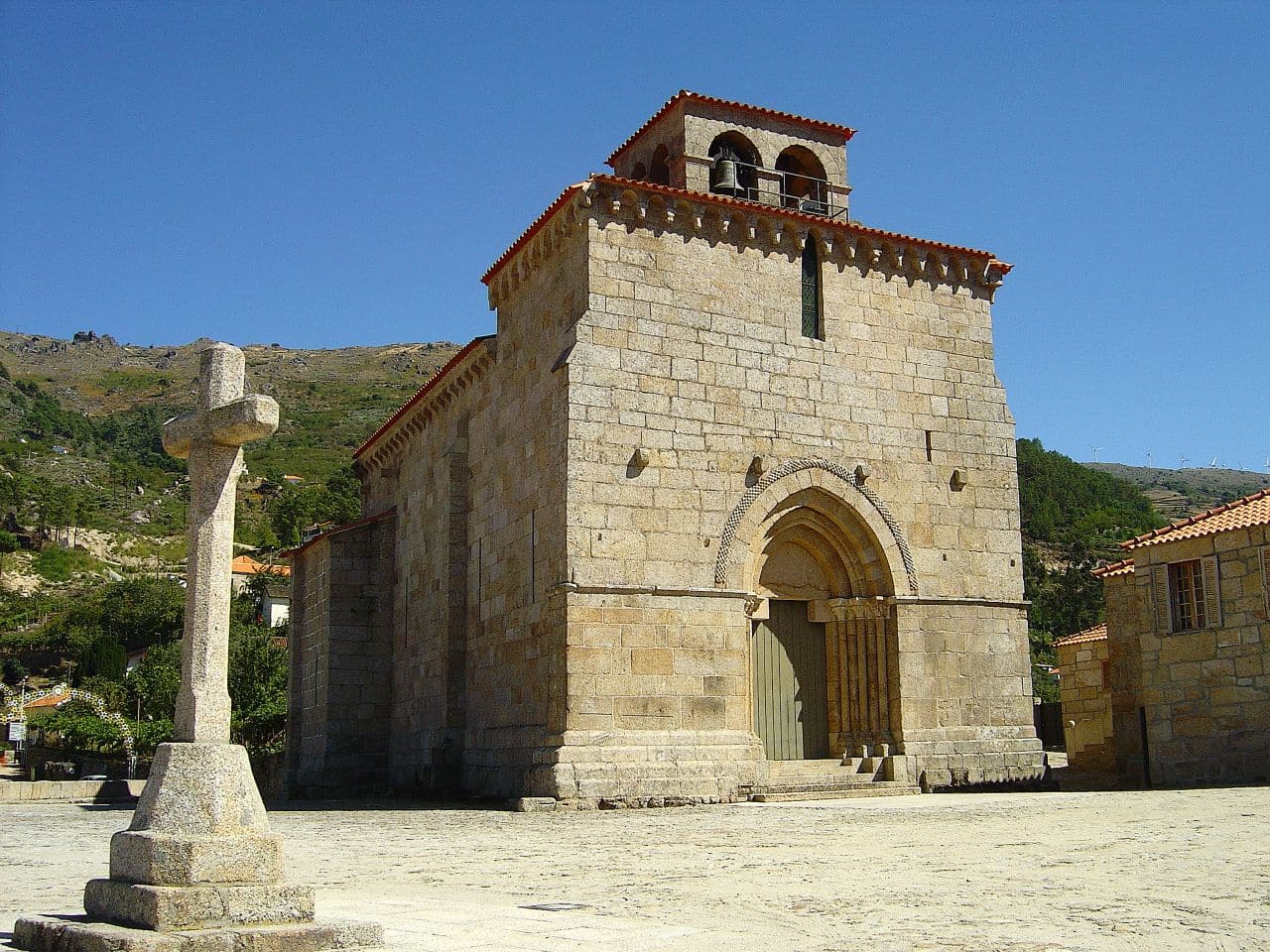
The Church of São Martinho de Mouros, in Resende, is one of the most singular Romanesque churches of the Douro valley, with a tower-façade and three naves of…
- Location
- São Martinho de Mouros, Resende, Viseu
- Built
- Século XIII (inscrição de 1217)
- Style
- Românico
On a hillside on the southern bank of the Douro, in the parish that bears its name, stands one of the most enigmatic churches of the Portuguese Romanesque. The Church of São Martinho de Mouros, in Resende, is set apart from every other church in the valley by a massive, verticalising silhouette, dominated by a robust tower-façade that lends it, from a distance, the appearance of a fortress of dark granite. It is precisely this apparent contradiction — that of a church which looks like a castle without ever having been one — that makes it a monument without parallel in the country.
A plan without parallel
The most remarkable feature of São Martinho de Mouros lies in its interior. Instead of the usual basilical scheme, in which the central nave rises far above the side aisles, the church presents three naves of almost identical height, separated by pointed arches that ascend in succession. The result is a space of unusual vertical development, closer to the logic of a “hall church” than to ordinary Romanesque, and one that confers on the building a monumentality rare on the scale of a rural parish.
An inscription bearing the date 1217, discovered on a stone in the chancel, marks the beginning — or the completion of a first phase — of the undertaking, placing the work firmly in the thirteenth century. The pointed triumphal arch, pierced by an oculus, frames the east end and reinforces the verticality of the whole. The ambition of the original programme, which envisaged three vaulted naves, was probably never completed, but what has come down to us is enough to rank it among the most original examples of the nation’s Romanesque architecture.
The tower-façade and its enigma
The west front, markedly defensive, is bounded by a tower of broad and solid body, pierced by the axial portal. Its fortified appearance long led to its being associated with military functions, but it is now accepted that the defence of the site was ensured by the steep topography of the valley itself, which is even thought to have favoured the capture of the former castle of São Martinho. The tower served, rather, liturgical and symbolic purposes, asserting the presence of the Church over the territory.
At São Martinho de Mouros, the warlike appearance conceals not a castle, but the will to give the house of God the dignity and permanence of a fortress.
Like other landmarks of the northern Romanesque — among them the Church of the Saviour of Bravães —, the church today forms part of the Romanesque Route, an itinerary that runs through the valleys of the Sousa, the Tâmega and the Douro.
Transformations and recognition
The medieval building did not remain untouched. During the Early Modern period, and above all in the Baroque era, the interior was enriched with carved retables in the national style and with paintings attributed to the workshop of the Masters of Ferreirim, active around 1530. These successive layers, far from disfiguring the monument, document the continuity of its use over eight centuries.
Classified as a National Monument in 1922, the Church of São Martinho de Mouros remains a destination of choice for those who travel the Romanesque of the North and seek to understand the diversity of solutions that the master stonemasons tried out in the Douro valley. Its architectural singularity, combined with the landscape that surrounds it, makes it one of the most surprising testimonies to the region’s medieval heritage.
Frequently asked questions
- Where is the Church of São Martinho de Mouros located?
- It stands in the parish of São Martinho de Mouros, municipality of Resende, district of Viseu, on the southern bank of the Douro valley, in northern Portugal.
- What makes this church so singular within Portuguese Romanesque?
- Its plan of three naves of almost identical height, which gives the interior an unusual vertical development, together with the imposing tower-façade, make it an almost unique case in the country's Romanesque architecture.
- Did the tower-façade have a military function?
- Despite its fortified appearance, the tower-façade did not respond to military needs; the defence of the site was ensured by the steep topography of the valley. The tower fulfilled above all liturgical and symbolic functions.
- When was it classified as a National Monument?
- It was classified as a National Monument in 1922.
Sources
Keep exploring
Heritage nearby
More places to discover from here. Approximate straight-line distances, within 50 km.