Typologies
Jewish Quarters and Synagogues
Jewish quarters and synagogues in Portugal: the medieval Jewish neighbourhoods, the synagogues of Tomar and Castelo de Vide, and the remains of Sephardic heritage.
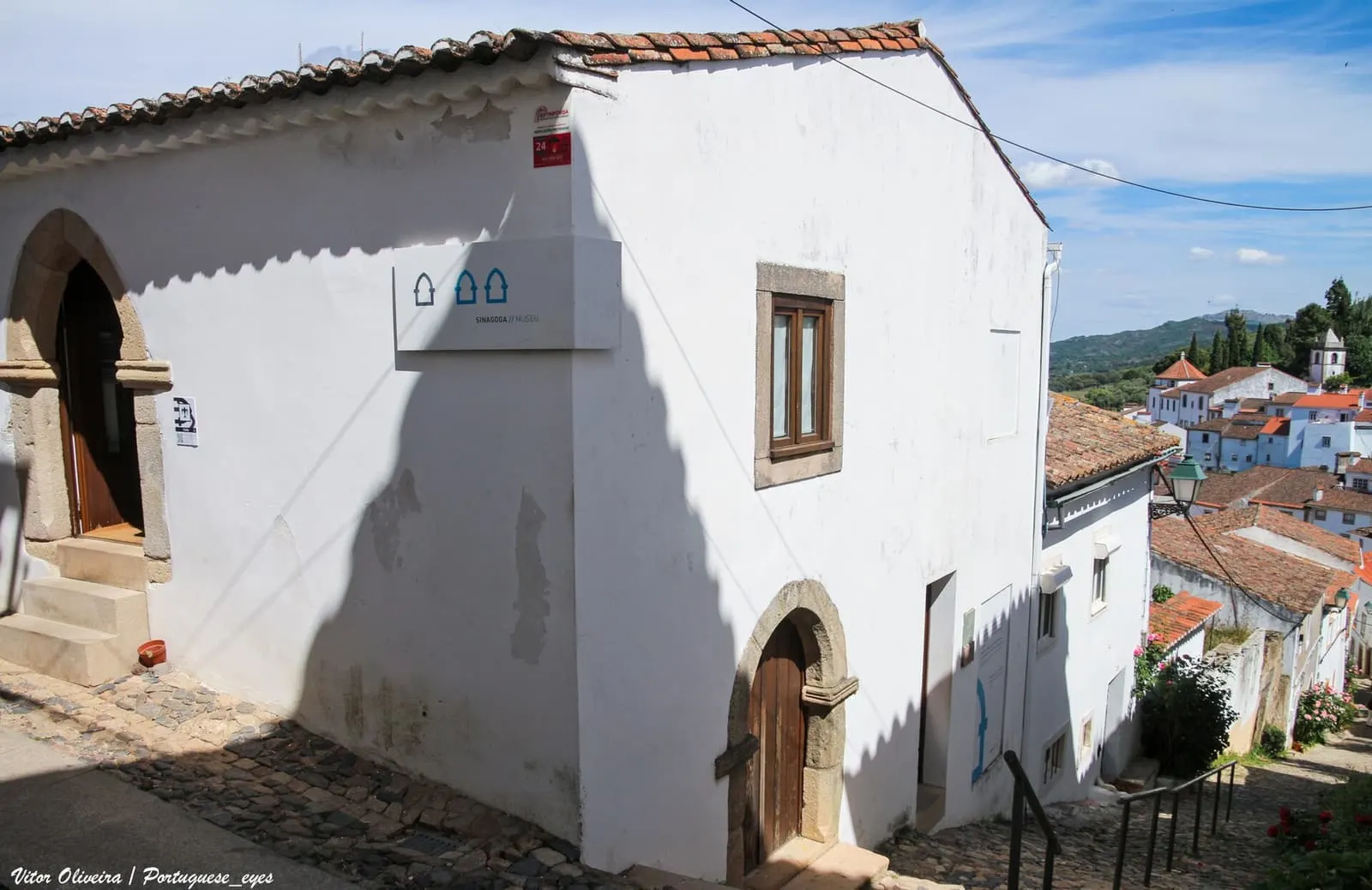
The judiarias were the quarters where Jews were required, by royal decree, to live in the medieval Portuguese cities and towns. More than a mere planning imposition, they constituted organised communities — the comunas — endowed with a synagogue, ritual slaughterhouse, oven and sometimes their own wall, with gates that closed at nightfall. Between the thirteenth and fifteenth centuries, Jewish settlements flourished in Lisbon, Coimbra, Santarém, Évora, Porto, Guarda, Trancoso and in dozens of other localities, contributing to medicine, trade, finance and, above all, to the nautical science that underpinned the maritime expansion.
From coexistence to expulsion
The legislation confining Jews to their own quarters took hold from the reign of King Pedro I, although its enforcement varied greatly from place to place: in the smaller towns, the royal orders were frequently ignored and cohabitation with the Christian population continued. The breaking point came in 1496, when King Manuel I signed the Edict of Expulsion of the Jews and Moors from the kingdom, under pressure from the terms of his marriage to the Castilian infanta. The following year, rather than letting a cultured and productive community depart, the king opted for forced conversion and collective baptism, giving rise to the so-called New Christians. The judiarias thus ceased to exist as an institution, the name surviving only as a place name for streets and neighbourhoods.
The persecution that followed, prolonged by the Inquisition established in 1536, turned faith into a secret practice: entire generations of New Christians kept, in domestic silence, prayers and rites passed from mothers to daughters.
Synagogues and built remains
The synagogues of Tomar and Castelo de Vide are two places through which to explore Portuguese Jewish heritage. The Synagogue of Tomar, built approximately 1430–1460, preserves a prayer hall with four columns and twelve wall corbels; the municipality associates them with Israel’s matriarchs and tribes. Samuel Schwarz bought the building in 1923 and donated it to the state in 1939; conversion to the Abraão Zacuto Luso-Hebrew Museum took place in 1942–1943. At Castelo de Vide, the former synagogue forms part of the Jewish quarter’s memory. Its dating is uncertain and is associated with the establishment of the quarter in the fourteenth century.
Beyond these two monuments, the Jewish legacy is read above all in the urban layout and in discreet details: crosses incised on doorjambs (a sign of New Christians wishing to affirm their conversion), niches for the mezuzah, door lintels and inscriptions. These remains are spread across many of the old fortified medieval towns of the interior, such as Trancoso, Marvão, Belmonte or Guarda.
Belmonte and the rediscovery of Sefarad
Belmonte occupies a singular place in this history. It was here that, in 1917, Samuel Schwarz found a community of crypto-Jews who, over four centuries, had kept their traditions secret, believing themselves to be the last in the world. The public recognition of the community led, in December 1996, to the inauguration of the Bet Eliahu synagogue, the first Jewish temple opened in the town since the Middle Ages. The story of Belmonte has become an emblem of a memory returning to the light.
This appreciation is articulated today within the Network of Jewish Quarters of Portugal, created in 2011 and integrated into the European cultural itinerary Routes of Sefarad, which brings together dozens of municipalities committed to rehabilitating, studying and promoting this heritage. The judiarias and synagogues thus constitute not merely an architectural typology, but the material testimony of one of the oldest and most silenced cultural presences in Portuguese territory.
Frequently asked questions
- Which historic synagogues can you explore?
- Tomar preserves a fifteenth-century prayer hall, now part of a museum space. Castelo de Vide offers its former synagogue and the memory of its Jewish quarter. These examples are not a complete inventory of Portuguese Jewish heritage.
- What was a judiaria?
- It was the quarter where Jews were required, by royal decree, to live in the medieval Portuguese cities and towns, with houses, a synagogue, a butcher's shop and sometimes a wall and gates that were closed at night.
- When did the Jewish quarters disappear in Portugal?
- The Edict of Expulsion issued by King Manuel I in 1496, and the forced conversions of 1497, put an end to the legal Jewish communities; the term judiaria survived only as a place name.