Monuments
Cloister of D. João III (Tomar)
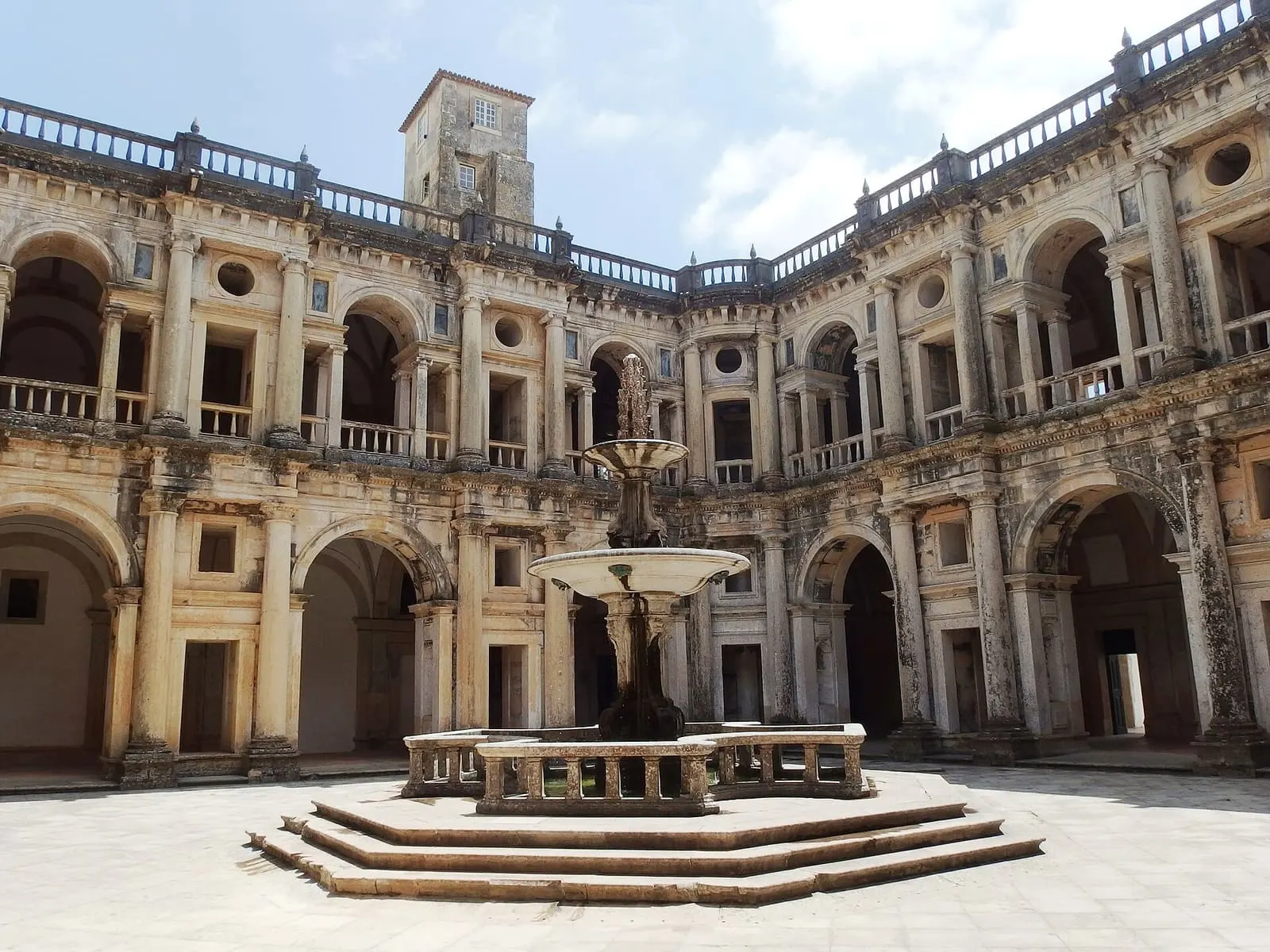
The Cloister of D. João III, at the Convento de Cristo in Tomar, a masterpiece of European Mannerism designed by Diogo de Torralva and completed by Filipe Terzi.
- Location
- Tomar, Santarém
- Built
- 1554–1591
- Style
- Maneirismo
At the heart of the Convento de Cristo, in Tomar (district of Santarém), the Cloister of D. João III is one of the loftiest achievements of sixteenth-century Portuguese architecture. Set against the south façade of the church’s Manueline nave, it stands apart from the decorative exuberance surrounding it through a classical serenity, sober and rigorously calculated. It is frequently cited as the culmination of Mannerism in Portugal and a landmark in the history of European architecture itself.
From Castilho’s demolition to Torralva’s design
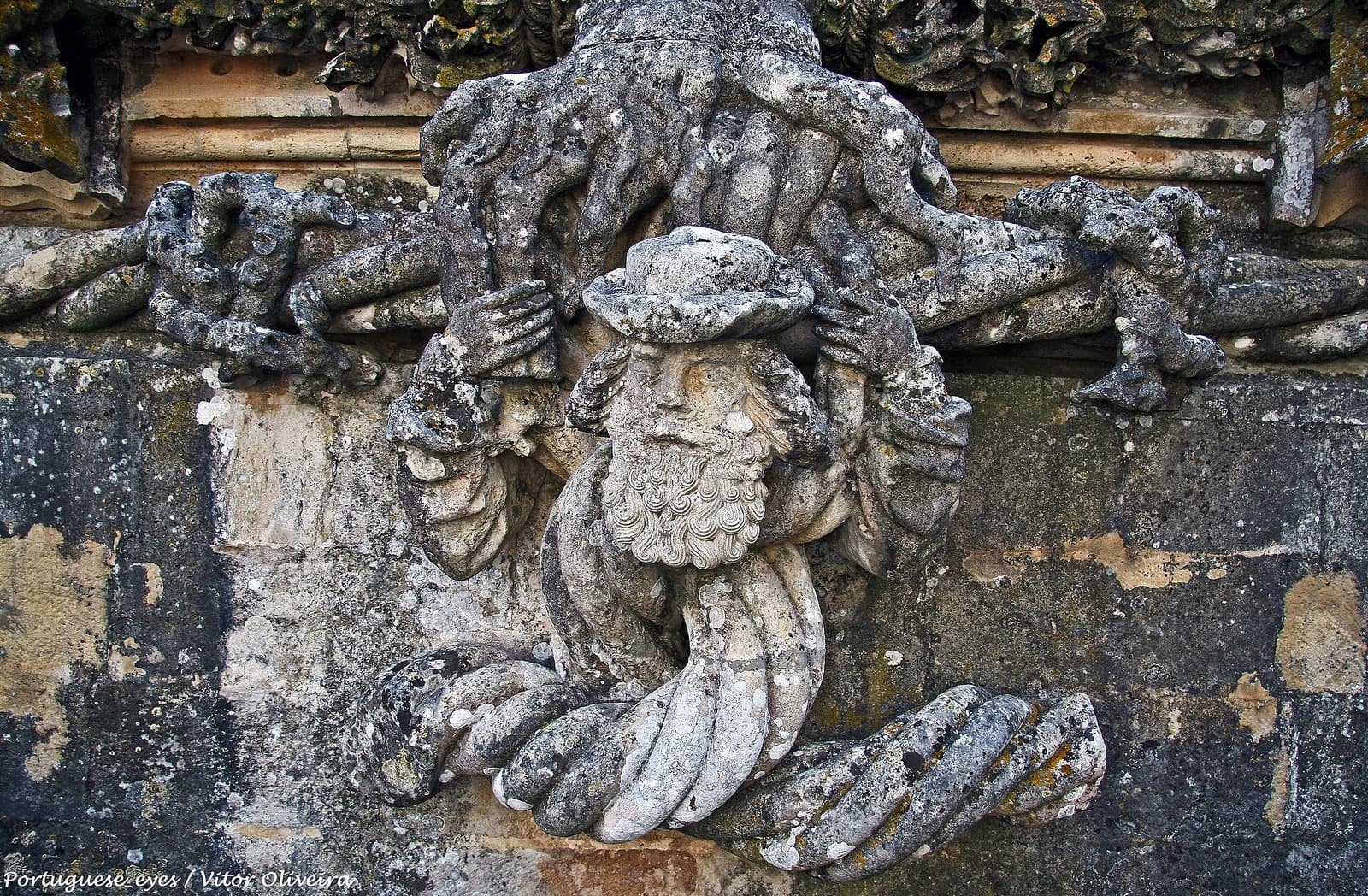
The history of the cloister is also the history of a change in taste. Under the reigns of D. Manuel I and D. João III, the convent had witnessed the flourishing of the Manueline, of which the famous Chapter Window is the supreme icon. It was in that spirit that João de Castilho began, from 1533, a first main cloister. For reasons the sources link to constructional problems, D. João III ordered its demolition in May 1554.
The task of rebuilding it fell to Diogo de Torralva, appointed master of the works that same year. Torralva conceived an entirely new work, Renaissance and Mannerist in character, breaking with the earlier Manueline grammar. The campaign stretched over decades: the north range was closed in 1562, work slowed in the mid-1560s, and the crowning — cornice and balustrade — was only completed around 1591, already under Philippine rule, by the hand of the architect Filipe Terzi.
A lesson in classicism
The cloister rises over two superimposed storeys, on a square plan with cut corners, where discreet spiral staircases linking the levels are housed. The composition rests on the erudite superimposition of the classical orders — Doric on the lower storey, Ionic on the upper — articulated by Serlian windows, with their central arched opening flanked by two architraved openings. This motif, disseminated by the treatises of Sebastiano Serlio, gives the galleries an alternating rhythm of solids and voids.
The warm-toned limestone contrasts with recessed planes in dark marble, an interplay that reinforces the plastic reading of the façades and their luminous transparency. At the centre of the enclosure, a fountain by Pedro Fernandes de Torres completes the ensemble. The result is an architecture of measure and proportion, abandoning profuse ornament in favour of structural clarity.
Place within the monumental complex
The Cloister of D. João III forms part of the Convento de Cristo, classified as a National Monument since 1910 and inscribed on UNESCO’s World Heritage list in 1983. Within a site that brings together almost five centuries of history — from the Romanesque Charola of the Templars to Manueline exuberance — the Mannerist cloister represents the moment when Portuguese architecture fully absorbed the principles of the Italian Renaissance, adapting them to a programme of national roots. To visit it is to understand how, in Tomar, medieval memory and classical erudition coexisted in harmonious tension.
Frequently asked questions
- Who designed the Cloister of D. João III?
- The Mannerist design seen today is owed to Diogo de Torralva, appointed master of the works in 1554. He replaced an earlier cloister begun by João de Castilho, which was ordered demolished. The work was completed by Filipe Terzi, already during the reign of Philip I.
- Why is it also called the Main Cloister or Cloister of the Philips?
- It is known as the Main Cloister because it is the largest in the convent and organised the regular life of the community. It is sometimes called the Cloister of the Philips because its crowning — with the cornice and the balustrade — was carried out under the Philippine dynasty, at the end of the sixteenth century.
- What architectural style does the cloister represent?
- It is considered one of the masterpieces of Mannerism in Portugal and in Europe. It reveals an erudite command of the classical language, with superimposed Doric and Ionic orders and Serlian windows inspired by the treatises of Sebastiano Serlio.
Sources
Keep exploring
Heritage nearby
More places to discover from here. Approximate straight-line distances, within 50 km.