Monuments
Évora Cathedral
Évora Cathedral, a Gothic cathedral in Alentejo, with a fortress-like facade, medieval lantern tower, and granite cloister, located in the UNESCO-listed…
- Location
- Évora, Évora
- Built
- 1186–1334
- Style
- Românico-gótico
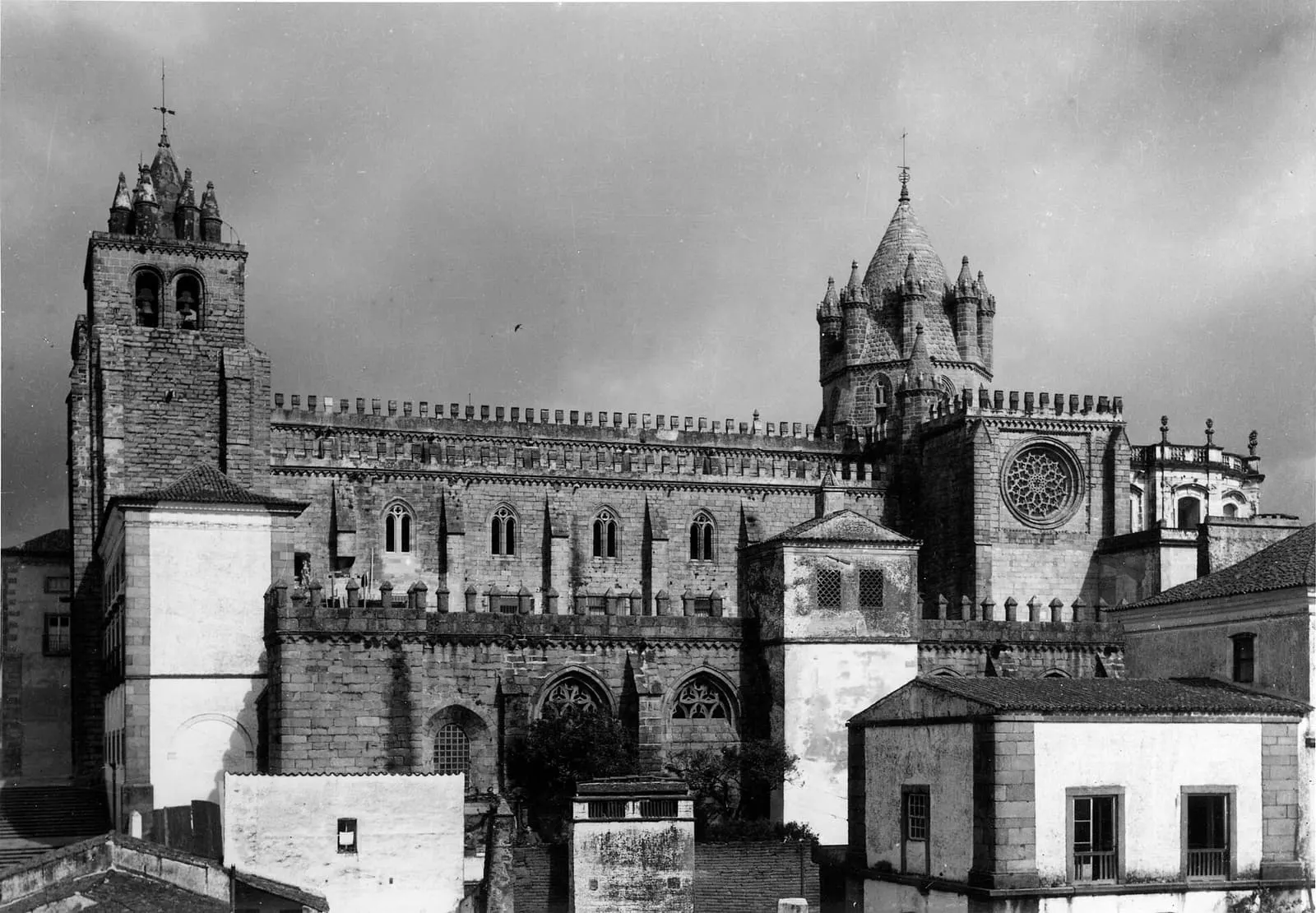
Évora Cathedral, or the Cathedral of Santa Maria, stands at the highest point of the Alentejo city, dominating the whitewashed houses with its granite fortress-temple silhouette. It is the largest of Portugal’s medieval cathedrals and one of the most remarkable examples of Gothic architecture south of the Tagus River, marking the transition between late Romanesque and the new ogival style arriving from northern Europe.
Foundation and construction
The cathedral was founded around 1186, during the Christian reconquest of Évora (1165), and consecrated to Santa Maria in 1204. Little remains of the original structure: the building we see today was mainly erected during the 13th century and the early decades of the 14th century, under master builders such as Domingos Pires and Martim Domingues, completing around 1334.
Built in granite, the floor plan consists of three naves spanning about eighty meters in length. The austere, fortified main facade is flanked by two asymmetrical towers, with the southern one serving as the bell tower. The deep pointed-arch portal is guarded by the statues of the Apostles, a Gothic marble sculptural ensemble that ranks among the finest in Portuguese medieval statuary.
More than a place of worship, Évora Cathedral was conceived as a statement of power: its massive stone structure and crenellated towers announce, from afar, the presence of the Church on the kingdom’s new frontier.
The lantern tower and the cloister
The most distinctive feature of the cathedral is the lantern tower, the octagonal conical tower rising above the transept crossing. Inspired by French designs, this lantern illuminates the interior and shapes the building’s unmistakable profile on the city’s skyline. It is considered one of the most unique examples of its kind in the Iberian Peninsula.
The cloister, built entirely in granite during the first half of the 14th century, is one of the masterpieces of Portuguese Gothic. In its corners rest the statues of the four Evangelists, and the galleries open into arcades and refined rose windows. The ensemble also includes the Main Chapel, rebuilt in marble in the 18th century by João Frederico Ludovice, and a valuable Museum of Sacred Art, featuring the Flamboyant Gothic reliquary known as the Relic of the True Cross.
Significance and heritage
The cathedral is part of the historic center of Évora, designated a UNESCO World Heritage Site in 1986, and is itself classified as a National Monument. Tradition links it to episodes of maritime expansion, recalling that the banners of fleets such as Vasco da Gama’s were blessed here.
As the most imposing episcopal seat in southern Portugal, Évora Cathedral holds a central place among Portugal’s cathedrals, rivaling in scale and ambition with Lisbon Cathedral and Guarda Cathedral. Just steps away, the Church of São Francisco and its famous Chapel of Bones complete one of the richest heritage routes in Alentejo.
Frequently asked questions
- When was Évora Cathedral built?
- The cathedral was founded around 1186 and consecrated in 1204, but its current configuration was mainly built during the 13th and early 14th centuries, completing around 1334.
- Is Évora Cathedral a National Monument?
- Yes. It has been classified as a National Monument since the early 20th century and is part of the Historic Center of Évora, a UNESCO World Heritage Site since 1986.
- Can you visit the cloister and tower of Évora Cathedral?
- Yes. The visit includes the Gothic cloister, the terrace with access to the roof and towers, and the Museum of Sacred Art housed in the cathedral.
Sources
Keep exploring
Heritage nearby
More places to discover from here. Approximate straight-line distances, within 50 km.