Typologies
Sees and Cathedrals of Portugal
The sees and cathedrals of Portugal, mother churches of dioceses, from the Romanesque of Coimbra to the Gothic of Évora and the contemporary architecture of…
- Built
- Séc. XI–XXI
- Style
- Românico, gótico, manuelino, barroco e contemporâneo
A Sé is the mother church of a diocese—the temple housing the cathedra, the bishop’s throne from which he presides over his local Church. The name comes from the Latin sedes, “seat,” expressing these buildings’ primary function: to be the administrative, liturgical, and symbolic center of an ecclesiastical territory. For this reason, Portugal’s sees rank among the most ambitious monuments of their eras, concentrating resources, master craftsmen, and artistic programs that few other commissions could match.
As a typology, the cathedral does not correspond to a single style or fixed form. It is defined by function, not appearance: over nearly a millennium, Portugal’s sees were built, expanded, and remodeled according to each century’s dominant architectural languages, from Romanesque to contemporary. Tracing their history is, in large part, tracing the history of Portuguese religious architecture.
From the Fortress-Cathedrals of the Reconquista
The kingdom’s first sees emerged from the Christian Reconquista and reflect it in stone. The Sé of Braga, consecrated in 1089, was Portugal’s first cathedral and became the seat of the archbishopric whose holder still bears the honorary title of Primate of the Spains. In the 12th century, robust, defensive buildings followed, where religious function coexisted with the need for protection on a still-unstable frontier.
The Old Cathedral of Coimbra, begun around 1162 under Bishop D. Miguel Salomão, is the most expressive example: crowned with battlements and resembling a military fortress, it is the only Romanesque cathedral from the Reconquista era to survive relatively intact. The Sé of Lisbon, built from 1147 atop an old mosque shortly after the city’s conquest, and the Sé of Porto share this same grammar of walls and crenellated towers—testimonies to a time when the cathedral was also a bulwark.
In a medieval Portuguese cathedral, the tower was not just a bell tower: it was a watchtower. The fortress-like silhouettes of the Old Cathedral of Coimbra or the Sé of Lisbon translate, in stone, the frontier condition of a kingdom still asserting itself.
From Gothic to Continuous Reinvention
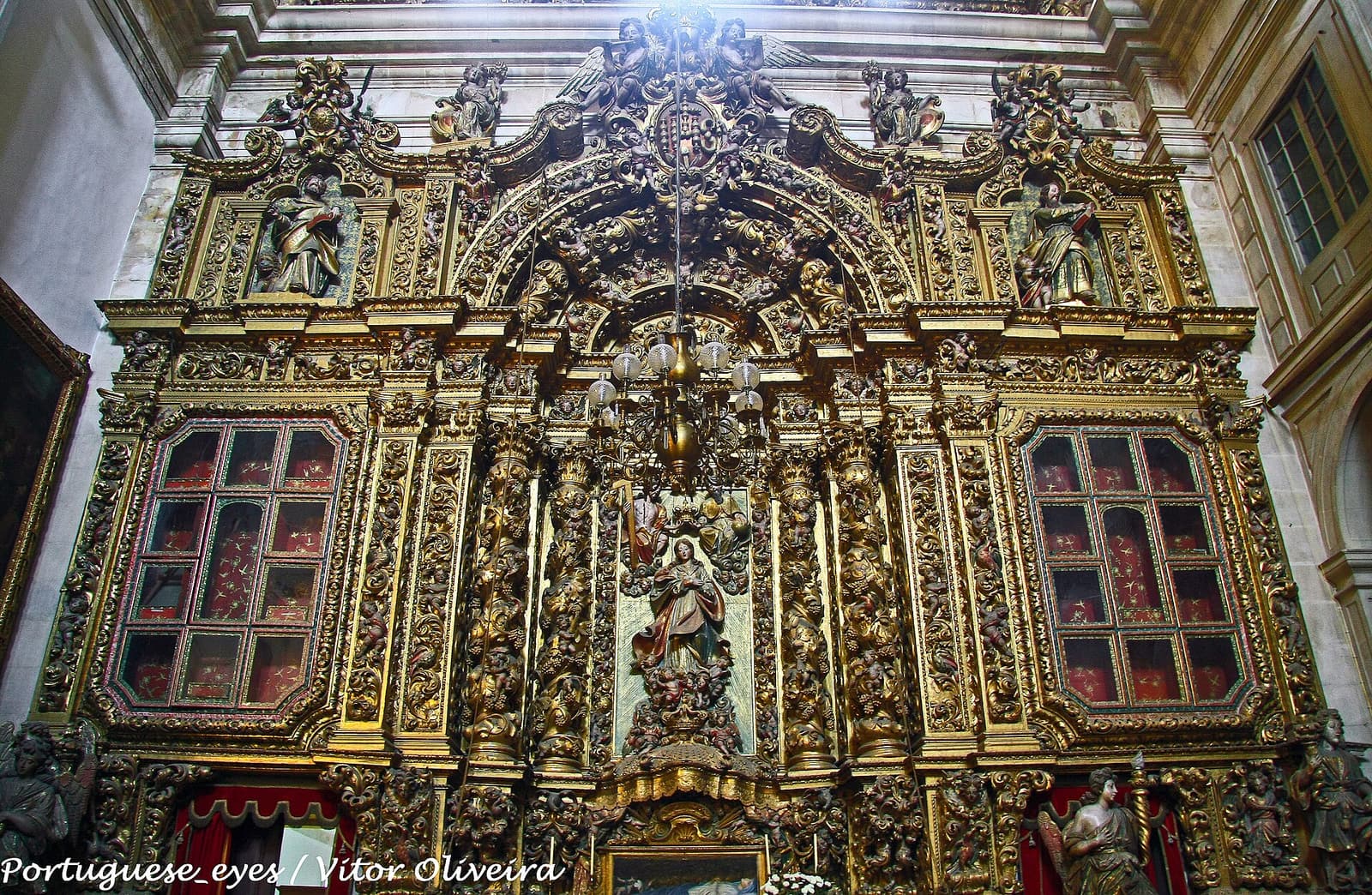
With the territory stabilized, cathedrals gained height, light, and refinement. The Sé of Évora, built mainly between 1280 and 1340, marks the full transition to Gothic in the south, with a marble-sculpted portal ranking among Portugal’s most notable medieval doorways. The cathedrals of Viseu and Guarda later received Manueline vaults and elements, while the Baroque renovations of the 17th and 18th centuries adorned many interiors with gilded woodwork and azulejos.
No cathedral has reached us untransformed. The great 1755 earthquake necessitated reconstruction campaigns in Lisbon; the restoration ideals of the 19th and 20th centuries sometimes sought to return them to a Romanesque purity they had never fully possessed. The creation of new dioceses extended the typology into modernity: the Cathedral of Bragança, inaugurated in 2001, was the first Portuguese see built from scratch in the 21st century, with deliberately modern architectural language.
A Network Structuring the Territory
Sees do not exist in isolation. They are organized into an ecclesiastical hierarchy headed by three metropolitan archdioceses—Braga, Lisbon, and Évora—each with its suffragan dioceses. This network, partly inherited from Roman and Visigothic administrative geography, spans the country and helped shape the fabric of Portugal’s historic cities. Thus, exploring cathedrals offers a privileged gateway to religious heritage and understanding the cities that grew in their shadow.
Frequently asked questions
- What is the difference between a 'Sé' and a cathedral?
- The terms are equivalent. 'Sé' derives from the Latin sedes, the bishop's seat, and designates the church housing the episcopal cathedra; 'cathedral' shares the same etymological origin in the word cathedra. In Portugal, the term 'Sé' is predominantly used.
- How many cathedrals are there in Portugal?
- Portugal has approximately 26 cathedrals within its territory, including current diocesan seats, co-cathedrals, and several former sees that lost their status over the centuries.
- What is the oldest cathedral in Portugal?
- The Sé of Braga was the first to be built, consecrated in 1089, even before the kingdom's foundation. However, the Old Cathedral of Coimbra is the best-preserved Romanesque cathedral from the Reconquista period.