Monuments
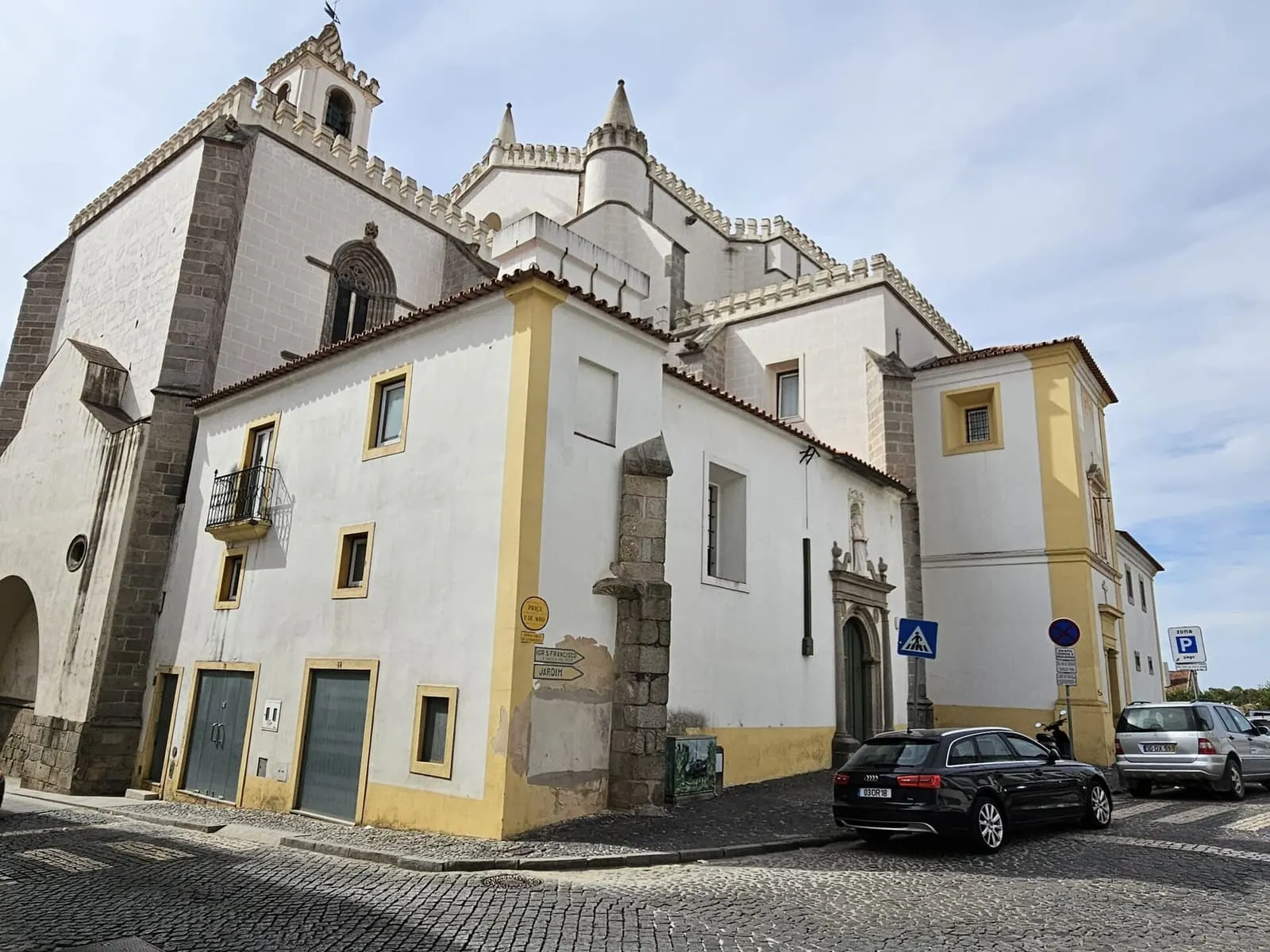
Church of São Francisco and the Chapel of Bones (Évora)
A Gothic-Manueline church in Évora, with its single, striking vaulted nave and the famous Chapel of Bones, lined with the remains of some 5,000 people.
- Location
- Évora, Évora
- Built
- 1480–1510
- Style
- Gótico-manuelino
The Church of São Francisco, in the heart of Évora, is one of the most expressive examples of Gothic-Manueline architecture in southern Portugal. Built between around 1480 and 1510 over an earlier Franciscan house, it displays on its porch and interior the emblems of the kings who patronised the work — King João II and King Manuel I — at a time when the city was a regular residence of the court. Together with the Cathedral of Évora, it is the monument that best conveys the importance of the Alentejo capital during the age of maritime expansion.
A single, monumental nave
The great remodelling of the late fifteenth century replaced the original three-nave plan with a single broad nave, in the form of a Latin cross, covered by a daring ribbed vault that rises to a height of around 24 metres. It was the work of the master masons Martim Lourenço and Pero de Trilho, and its decorative programme drew on royal painters such as Francisco Henriques, Jorge Afonso and Garcia Fernandes. The porch of the façade, with arches of varied profiles, illustrates the dialogue between Gothic and the Mudéjar grammar so characteristic of this region.
On the vault and the supports, the symbols of royal power and faith multiply: the Cross of the Order of Christ, the Manueline armillary sphere and the arms of the founding monarchs. This vocabulary brings the church close to other landmarks of royal Manueline art, such as the Convent of Christ in Tomar, and reveals a commission of clearly national ambition.
«We bones that are here await yours» — the inscription that greets the visitor at the entrance to the Chapel of Bones sums up, in a few words, an entire theology of human finitude.
The Chapel of Bones
The fame of the complex is owed above all to the Chapel of Bones, ordered to be built in the seventeenth century on the initiative of three Franciscan friars. The aim was pedagogical and spiritual: to confront the believer with the brevity of life and the inevitability of death. The walls and part of the vaults are lined with the bones and skulls of some 5,000 people, gathered from dozens of monastic cemeteries that occupied precious land within the walled city.
Organised in three bays, the chapel turns the macabre into meditation, in a Baroque exercise in memento mori that continues to impress those who visit it. More than morbid curiosity, it is a document on the relationship of Évora’s religious communities with death and salvation.
Visiting and context
The complex today forms a museum centre bringing together the church, the chapel and a collection of nativity scenes, and stands a few steps from the historic centre of Évora, classified by UNESCO. Set within the rich heritage of the Alentejo, the Church of São Francisco has been classified as a National Monument since 1910.
It is worth comparing the luminous sobriety of this Manueline nave with the exuberant Baroque interior of Franciscan churches in the North, such as the Church of São Francisco in Porto: two Franciscan readings, distant in time and in taste, but equally extraordinary.
Frequently asked questions
- How many bones are in the Chapel of Bones in Évora?
- The chapel is lined with the bones of some 5,000 people, exhumed from dozens of monastic cemeteries in the city and fixed to the walls and pillars as a meditation on death.
- What is the inscription at the entrance to the Chapel of Bones?
- Above the entrance arch one reads «We bones that are here await yours», a Franciscan warning about the transience of life.
- Is the Church of São Francisco a National Monument?
- Yes. The complex has been classified as a National Monument since 1910 and forms part of the historic centre of Évora, inscribed on the UNESCO World Heritage List.
Sources
Keep exploring
Heritage nearby
More places to discover from here. Approximate straight-line distances, within 50 km.