Monuments
Porto Cathedral
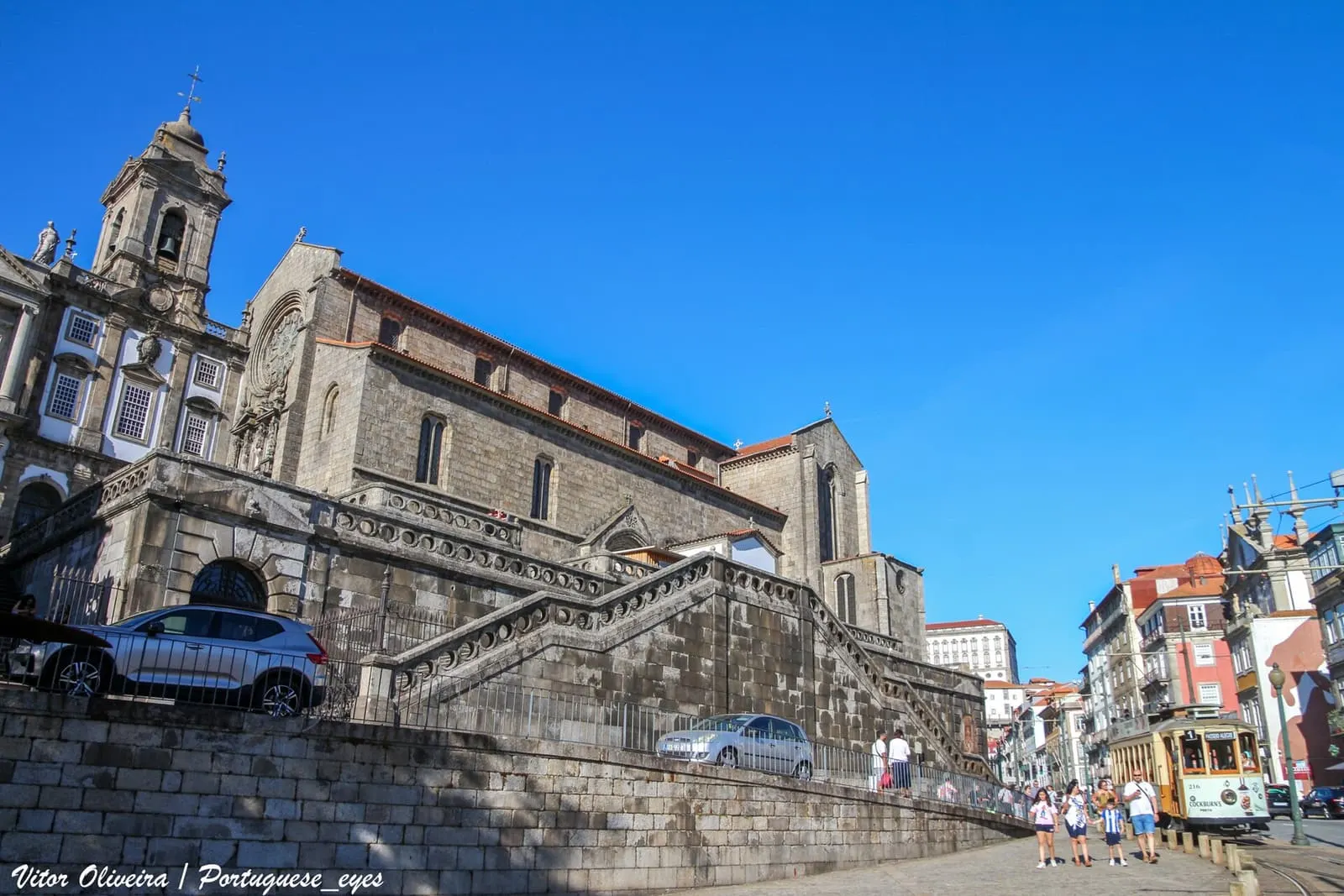
Porto Cathedral, a Romanesque fortress-cathedral on Pena Ventosa hill, with Nicolau Nasoni's Baroque galilee and Gothic cloister, in Porto.
- Location
- Porto, Porto
- Built
- século XII–XIII
- Style
- Românico, com acrescentos góticos e barrocos
Porto Cathedral stands at the city’s highest point, Pena Ventosa hill, overlooking the houses descending towards the Douro River. The cathedral of the Porto diocese and one of the country’s oldest monuments, it combines nearly nine centuries of history in a single structure: a military-looking Romanesque core, Gothic extensions and a profusion of Baroque work that transformed its interior and surroundings.
A Romanesque fortress-cathedral
Construction of the cathedral began in the first half of the 12th century and continued into the 13th century. The main facade, flanked by two sturdy towers topped with domes, and the narrow Romanesque rose window piercing it reveal its dual purpose: house of prayer and defensive stronghold. The thick walls, small openings and crenellated wall walk give it the character of a fortress-church so typical of Romanesque architecture in northern Portugal, shared with the nearby Braga Cathedral, seat of the former archdiocese to which the Porto diocese belonged.
Inside, the barrel-vaulted central nave and sturdy pillars retain their original austerity, though successive interventions have softened the original gloom.
Few monuments express so clearly the fusion of Porto’s eras: the severity of Romanesque stone meets the brilliance of Baroque, without one cancelling the other.
From Gothic cloister to Baroque splendour
During the 14th century, the Gothic cloister was added, later covered with 18th-century azulejos depicting scenes from Ovid’s Metamorphoses and the Song of Songs. From the 17th century and especially the 18th, the cathedral was profoundly renovated in Baroque style. The silver altar in the Chapel of the Blessed Sacrament, crafted in chased silverwork, is one of its most celebrated treasures.
The Italian presence of Nicolau Nasoni, the same architect of the Clérigos Church and Tower, was decisive: arriving in Porto in 1725, he painted frescoes and around 1736 designed the elegant Baroque galilee that enlivens the side facade, opening the church onto the square opposite.
Memory and meaning
The cathedral was the setting for pivotal events in national history. In 1387, the marriage of John I to Philippa of Lancaster was celebrated here, an alliance that sealed the historic Luso-British friendship. The monument was classified as a National Monument in 1910 and today forms part of the UNESCO-inscribed area of Porto’s Historic Centre, Luiz I Bridge and Monastery of Serra do Pilar.
A few steps away, the Church of São Francisco and the riverside monumental complex complete one of Portugal’s most heritage-dense urban centres. Visiting the cathedral thus means simultaneously exploring the city’s point of origin and a living compendium of Portuguese religious architecture’s evolution. See also other cathedrals in the country.
Frequently asked questions
- How much does it cost to visit Porto Cathedral?
- Entry to the cathedral is free; access to the Gothic cloister, Chapter House and treasury requires a ticket. Prices and opening hours may vary, so it is advisable to check with the institution.
- Who built the Baroque galilee of Porto Cathedral?
- The Baroque galilee on the side facade was designed by Italian architect and painter Nicolau Nasoni around 1736, during his long career serving the city of Porto.
- Is Porto Cathedral part of the World Heritage?
- Yes. The cathedral is part of the classified area of Porto's Historic Centre, Luiz I Bridge and Monastery of Serra do Pilar, inscribed by UNESCO on the World Heritage List in 1996.
Sources
Keep exploring
Heritage nearby
More places to discover from here. Approximate straight-line distances, within 50 km.