Monuments
Amoreira Aqueduct (Elvas)
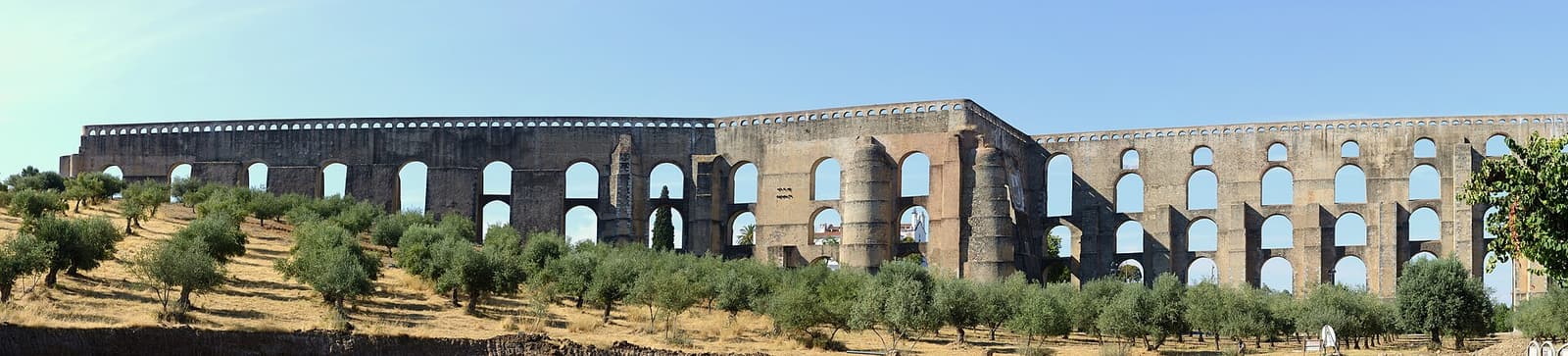
The Amoreira Aqueduct in Elvas: a monumental sixteenth-century arcade that supplied the Alentejo fortress town, part of the World Heritage site.
- Location
- Elvas, Portalegre
- Built
- 1537–1622
- Style
- Renascentista
The Amoreira Aqueduct rises to the west of Elvas, cutting across the rolling landscape of the Upper Alentejo with its endless succession of ashlar arches. Conceived to resolve the fortress town’s chronic shortage of water, it is one of the most ambitious public works of sixteenth-century Portugal and, even today, one of the largest aqueducts on the Iberian Peninsula.
A work of almost a century
The water shortage that afflicted Elvas led King João III to order, in 1537, the construction of a conduit to bring the city the water from the Amoreira spring, several kilometres to the west. The design was entrusted to Francisco de Arruda, master of works for the Alentejo, who shortly before had conceived the Água de Prata aqueduct in Évora. On his death, the undertaking passed into other hands — among them those of Afonso Álvares — and dragged on for generations, constrained by costs and by the scale of the project.
Only in 1622 was the work considered complete, with the inauguration of the Fonte da Misericórdia, within the city. Almost a century thus separates the laying of the first stone from the moment when water finally gushed in the fountains of Elvas.
Engineering and scale
The aqueduct runs for some 8.5 kilometres, combining underground sections with the celebrated arcade above ground. At the lowest points of the terrain, the structure stacks several tiers of arches, reaching nearly 31 metres in height, supported on sturdy quadrangular piers reinforced by semicircular buttresses. It boasts an impressive number of arches — several hundred —, part belonging to the original construction and part the result of later reinforcements and extensions.
The monumentality of the whole is not gratuitous: securing the water supply was an essential condition for a border fortress to be able to withstand a prolonged siege.
The architectural language is sober and Renaissance, without superfluous ornamentation, reflecting the utilitarian purpose of the work. It is precisely that restraint, combined with the scale, that gives the aqueduct its sculptural power.
Part of a frontier system
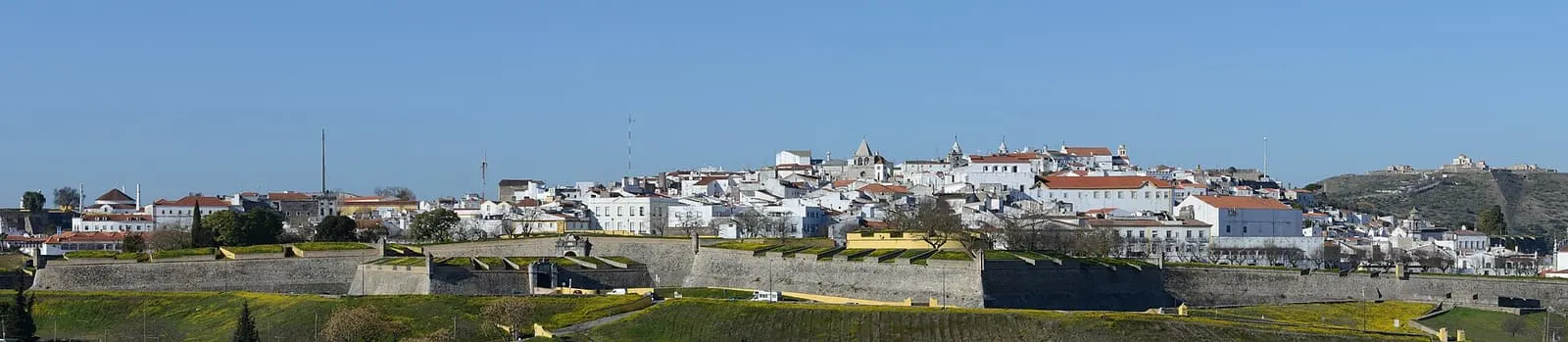
The Amoreira Aqueduct cannot be understood in isolation. It is part of the apparatus that made Elvas the most formidable fortress town on the Luso-Castilian border, alongside the medieval castle, the bastioned walls, and the forts crowning the surrounding hills. Without it, the garrison town and its fortifications could hardly have endured the long sieges of the Restoration Wars and the conflicts that followed.
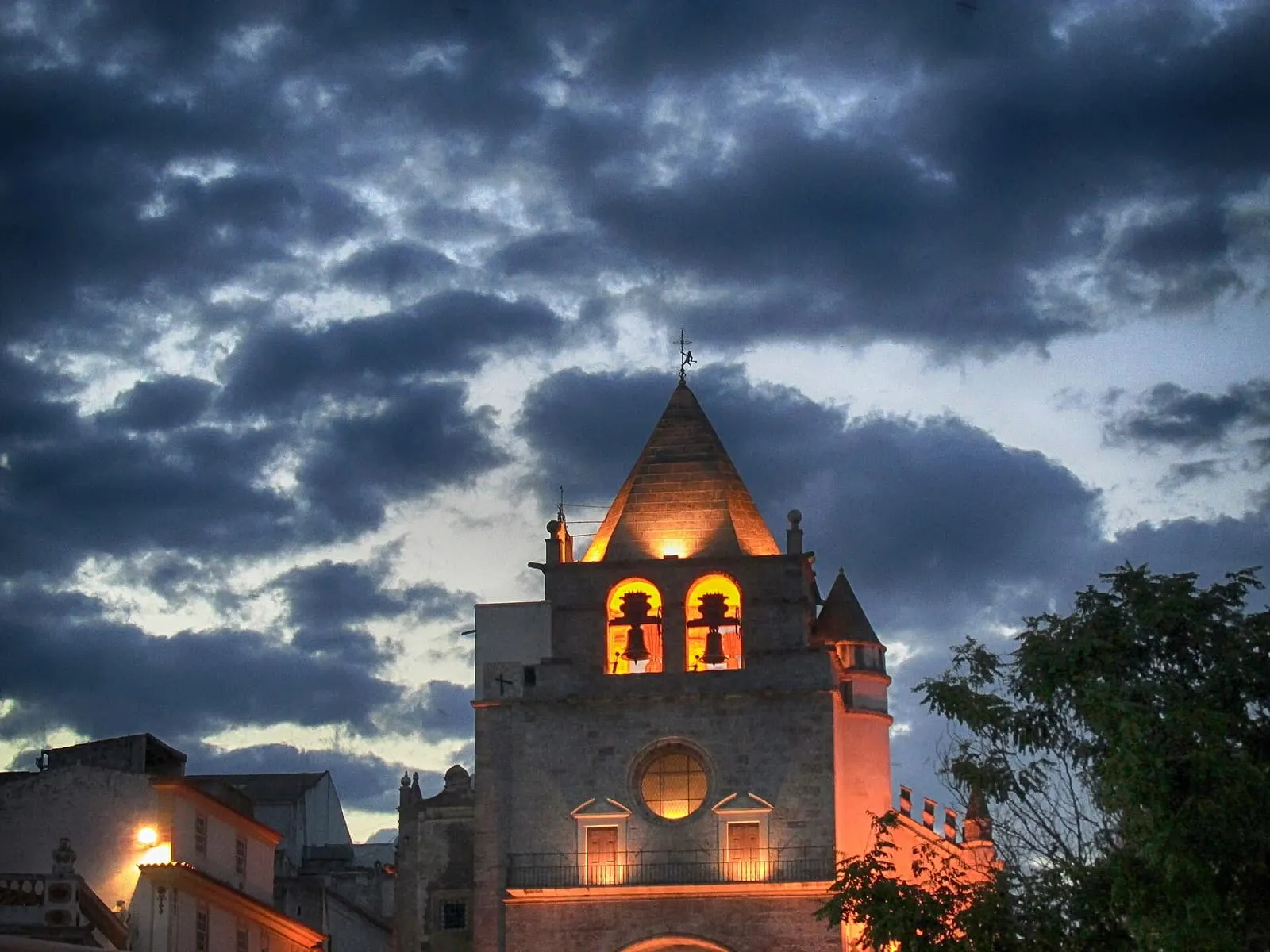
For this reason, the aqueduct is included as one of the seven components of the site that UNESCO inscribed, in 2012, on the World Heritage List, recognising Elvas as the largest dry-ditch bastioned fortification complex in the world. A few steps away rises also the Cathedral of Elvas, the parish church built by Francisco de Arruda, the same architect as the aqueduct.
Classified as a National Monument since 1910, the Amoreira Aqueduct remains one of the most recognisable symbols of Elvas and an eloquent testimony to Portuguese hydraulic engineering of the modern era. It belongs, naturally, to the long tradition of the great aqueducts built in Portugal to overcome the distance between water and the cities.
Frequently asked questions
- When was the Amoreira Aqueduct built?
- Work began in 1537, by order of King João III, and lasted almost a century, reaching completion in 1622 with the inauguration of the Fonte da Misericórdia, within Elvas.
- Who was the architect of the Amoreira Aqueduct?
- The design fell to Francisco de Arruda, master of works for the Alentejo and author of the Água de Prata Aqueduct in Évora. The undertaking was later carried on by masters such as Afonso Álvares.
- Is the Amoreira Aqueduct a World Heritage Site?
- Yes. It is one of the seven components of the Garrison Border Town of Elvas and its Fortifications site, inscribed on the UNESCO World Heritage List in 2012 (ref. 1367).
Sources
Keep exploring
Heritage nearby
More places to discover from here. Approximate straight-line distances, within 50 km.