Monuments
Basilica da Estrela (Lisbon)
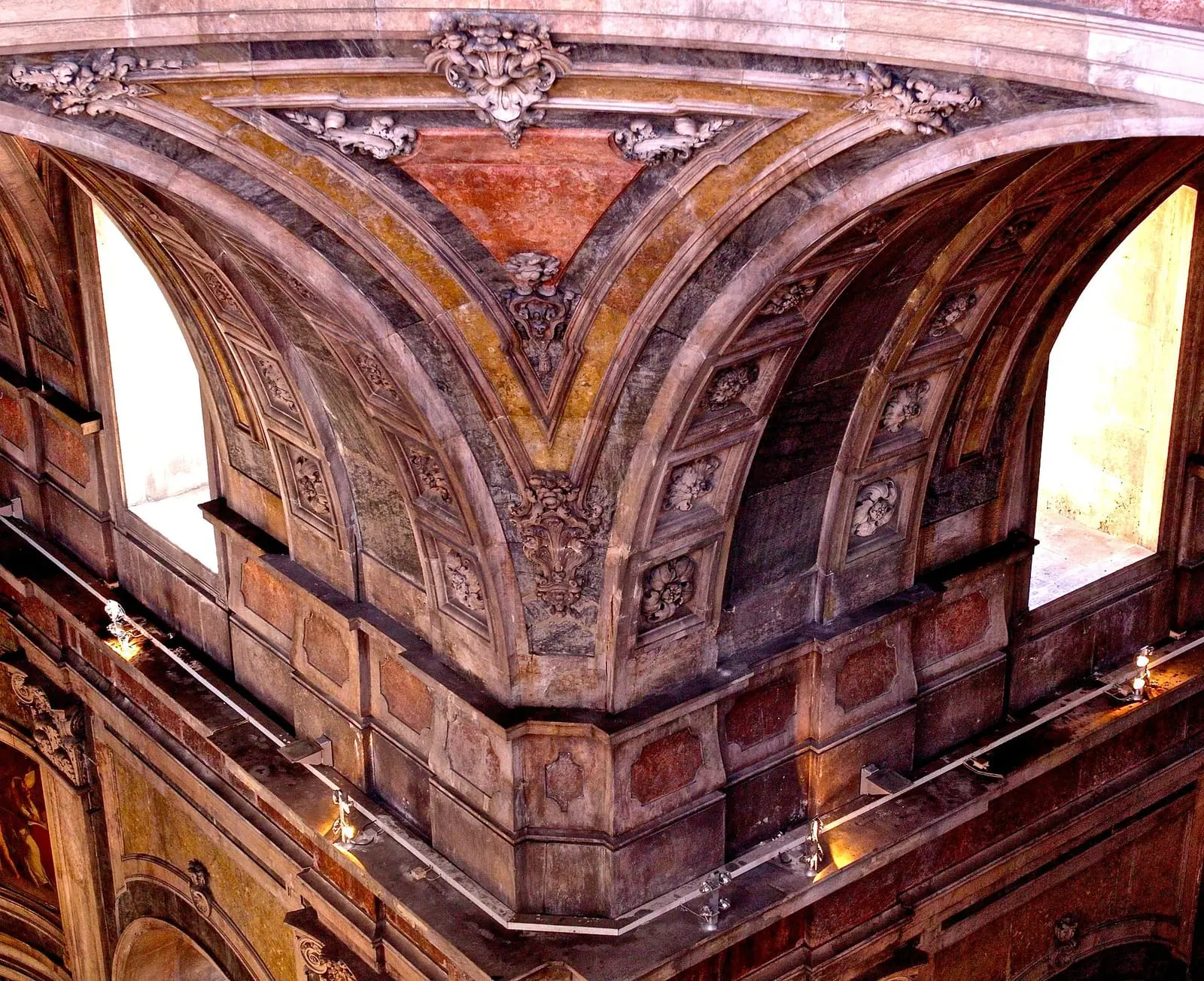
Basilica da Estrela in Lisbon: a late Baroque and Neoclassical church built by vow of Queen Maria I, featuring a monumental dome and the queen's tomb.
- Location
- Lisboa, Lisboa
- Built
- 1779–1790
- Style
- Barroco tardio e neoclássico
The Basilica da Estrela, officially the Royal Basilica and Monastery of the Most Sacred Heart of Jesus, stands atop Estrela hill in Lisbon, dominating the city with its white lioz stone dome. Built between 1779 and 1790, it is one of the most significant religious monuments of the second half of the 18th century in Portugal and the first church in the world dedicated to the worship of the Sacred Heart of Jesus.
A temple born from a vow
The origin of the basilica is tied to a royal promise. Queen Maria I, eldest daughter of King José I, vowed to build a temple to the Sacred Heart of Jesus if God granted her a male heir to secure the succession. With the birth of Prince José, heir to the throne, the queen kept her word: the cornerstone was laid in 1779 on land near the former Convent of the Discalced Carmelites, which the royal family itself protected.
Fate, however, was unkind. Prince José died of smallpox in 1788, before the completion of the works, and the queen herself would later lose her sanity. The basilica, conceived as a monument of thanksgiving, ultimately became a place of dynastic memory. In 1816, Queen Maria I died in exile in Rio de Janeiro, where the court had fled from the French invasions; her remains were transferred to Estrela in 1821, where they rest in a sumptuous marble tomb in the transept.
Between Baroque and Neoclassical
The building’s design is attributed to Mateus Vicente de Oliveira, an architect trained in the grand works of the Palácio Nacional de Mafra, from whose school he inherited a taste for monumentality and the restrained use of stone. After his death in the mid-1780s, the project was taken over by Reinaldo Manuel dos Santos, also linked to Mafra, who significantly altered the upper part of the design—the façade, bell towers, and especially the dome, to which he added a lantern.
The Basilica da Estrela is, in stone, the transitional moment when Portuguese Rocaille taste gives way to classical restraint—the last great temple of late Baroque and the first to breathe the air of Neoclassicism.
The two-story façade is organized into seven bays rhythmically punctuated by Doric columns and pilasters, pediments, and allegorical statues. The interior, generously clad in gray, pink, and yellow marbles arranged in geometric patterns, conveys a cold and ordered richness, distant from the gilded exuberance of the Joanine Baroque that marked the preceding decades. The great dome over the crossing is the element that gives the ensemble its unmistakable silhouette in Lisbon’s skyline.
A landmark in the capital’s religious heritage
In its ambitious scale and the quality of its stonework, the Basilica da Estrela belongs to the lineage of great royal undertakings of the Ancien Régime, alongside monuments like the Panteão Nacional, in the former Church of Santa Engrácia, with which it shares the aspiration to vaulted monumentality. It was classified as a National Monument in 1907, recognizing its architectural value and its unique place in the history of Portuguese art.
For those traversing the hills on the right bank of the Tagus, the basilica also offers one of the most expansive panoramic views of the city—from the forecourt and, especially, from the dome’s terrace, accessible to visitors. Within Lisbon’s ecclesiastical heritage, it stands midway between the Romanesque austerity of the Sé de Lisboa and the eclecticism of the following centuries, closing the cycle of the great temples of Marian absolutism.
Frequently asked questions
- Why was the Basilica da Estrela built?
- The basilica originated from a vow by Queen Maria I, who promised to erect a temple to the Sacred Heart of Jesus if she bore a male heir. With the birth of Prince José, heir to the throne, in 1761, the queen fulfilled her promise: the cornerstone was laid in 1779.
- Who is buried in the Basilica da Estrela?
- Queen Maria I herself is buried in the basilica, in a marble tomb in the transept. The queen died in exile in Rio de Janeiro in 1816, and her remains were transferred to Estrela in 1821.
- Who were the architects of the Basilica da Estrela?
- The initial design was by Mateus Vicente de Oliveira, trained in the works of Mafra. After his death in the mid-1780s, the project was completed by Reinaldo Manuel dos Santos, who modified the façade, towers, and dome.
Sources
Keep exploring
Heritage nearby
More places to discover from here. Approximate straight-line distances, within 50 km.