Monuments
Castle of Arraiolos
The Castle of Arraiolos, a rare Gothic castle with a circular enclosure in the district of Évora, built by order of King Dinis in 1306, an Alentejo sentinel…
- Location
- Arraiolos, Évora
- Built
- a partir de 1306 (reinado de D. Dinis)
- Style
- Gótico
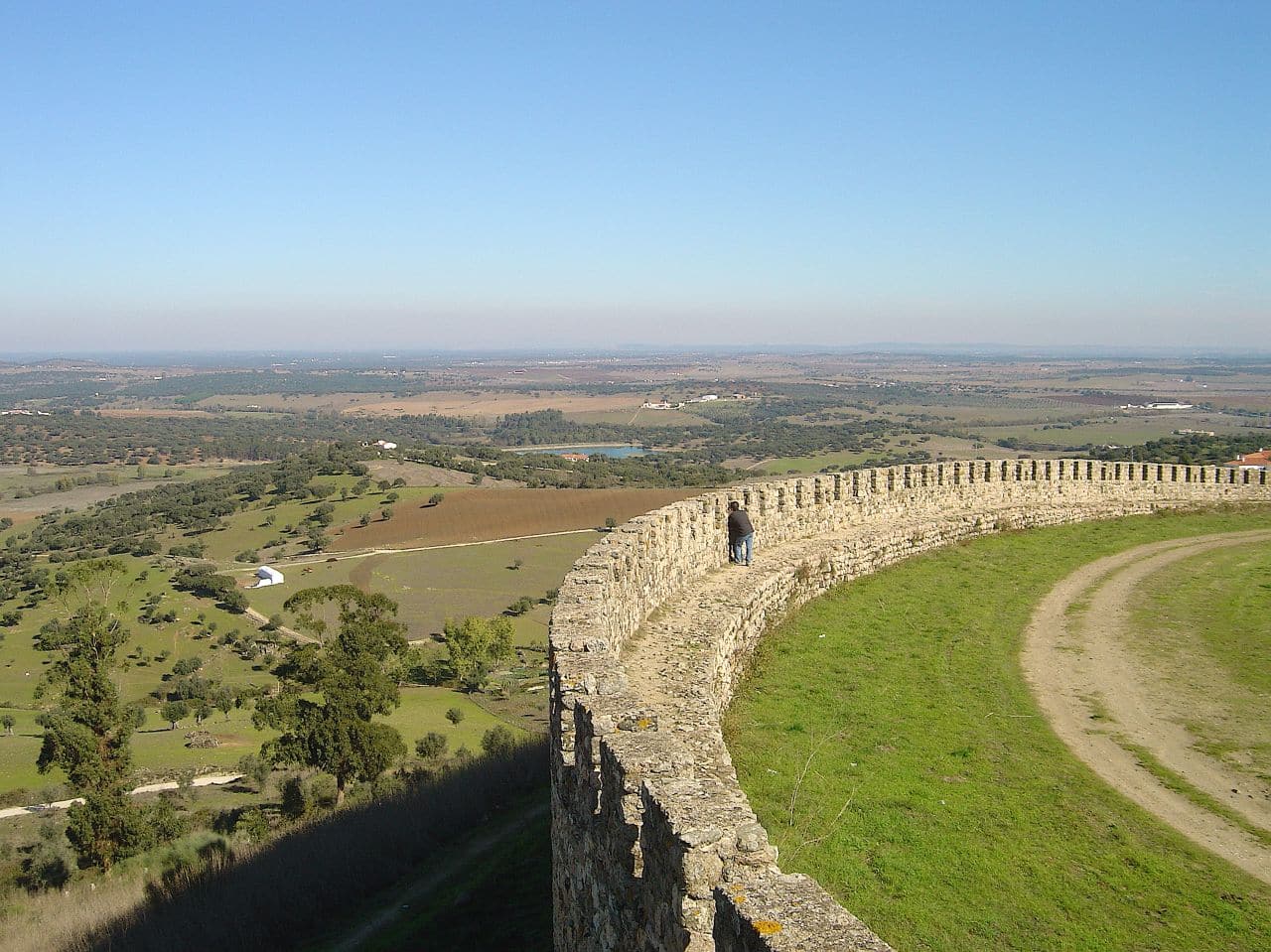
High on the Monte de São Pedro, north of the town, the Castle of Arraiolos traces against the Alentejo plain a silhouette that sets it apart from almost all its peers: a circuit of walls that describes an almost perfect ring. Its circular plan, with a perimeter of about 250 metres adapting to the contour of the rocky hilltop, makes this fortress one of the rare examples of its kind in military architecture, which is why it is so often referred to as the “round castle” of the Alentejo.
From ancient occupation to the Dinis-era foundation
The hilltop was inhabited long before the medieval fortress: archaeological surveys in the citadel recovered quartz hammerstones and a prehistoric copper axe, signs of an early occupation of the site. The history of the castle proper, however, begins with King Dinis. A contract signed in 1305 between the monarch, the alcaide, the judges and the council of Arraiolos stipulated the obligation to raise walls, and work began in 1306, financed with a royal sum of 2,000 pounds and following a design attributed to João Simão. Within a few years the enclosure was completed “in stone and lime and in good defence”, forming part of the policy of fortifying the frontier and the Alentejo interior that marked the reign, as happened with other castles in the region.
Dominating the northern sector of the enclosure stands the Paço dos Alcaides, the residential and command nucleus of the complex. After the dynastic crisis of 1383–1385, the town and its castle were granted to the Constable Nuno Álvares Pereira, who received the title of Count of Arraiolos, an episode that links the monument to one of the great figures in the assertion of Portuguese independence.
The circular enclosure and its architecture
The originality of Arraiolos lies in its geometry. While most medieval Portuguese fortifications combine a keep with angular stretches of wall, here the solid crenellated wall, broad and of regular height, closes in an elliptical layout that wraps around the top of the hill. Two main gates open into it — the Porta da Vila, to the south, and the Porta de Santarém, to the northwest, the latter Gothic in character — and local tradition still preserves the memory of an underground passage that is said to have linked the castle to the town’s convent.
Over the centuries the enclosure underwent gradual abandonment from the late Middle Ages onward, regaining importance only as a heritage landmark. Between 1959 and 1963 the castle and walls were partly restored by the Directorate-General for National Buildings and Monuments, an intervention that consolidated the wall-walk and restored legibility to the complex.
A landmark in the heart of Arraiolos
Classified as a National Monument since 1910, the castle is today a privileged viewpoint over the white houses and the surrounding countryside of the Alentejo. A visit combines the climb to the wall-walk with the chapel and the old urban space that grew under the protection of the walls. Inseparable from the town that hosts it — famous throughout the country for the tradition of the Arraiolos carpets — the monument offers one of the most singular images of Portuguese military heritage: that of a fortress which, instead of imposing itself through the height of its towers, asserts itself through the purity of its circle of stone.
Frequently asked questions
- Where is the Castle of Arraiolos?
- It rises on the Monte de São Pedro, north of the town of Arraiolos, in the district of Évora, in Central Alentejo.
- Why is the Castle of Arraiolos unusual?
- It has an enclosure on a circular plan, a rare layout in military architecture, with a perimeter of about 250 metres that follows the contour of the hilltop.
- When was the Castle of Arraiolos built?
- Work on the walls began in 1306, following a contract of 1305 between King Dinis and the council, with the design attributed to João Simão.
- Is the Castle of Arraiolos a National Monument?
- Yes. It was classified as a National Monument by decree of 23 June 1910.
Sources
Keep exploring
Heritage nearby
More places to discover from here. Approximate straight-line distances, within 50 km.