Typologies
Fountains and Public Fountains
Fountains, public fountains and village fountains of Portugal: the typology of hydraulic heritage that for centuries supplied drinking water to villages, towns…
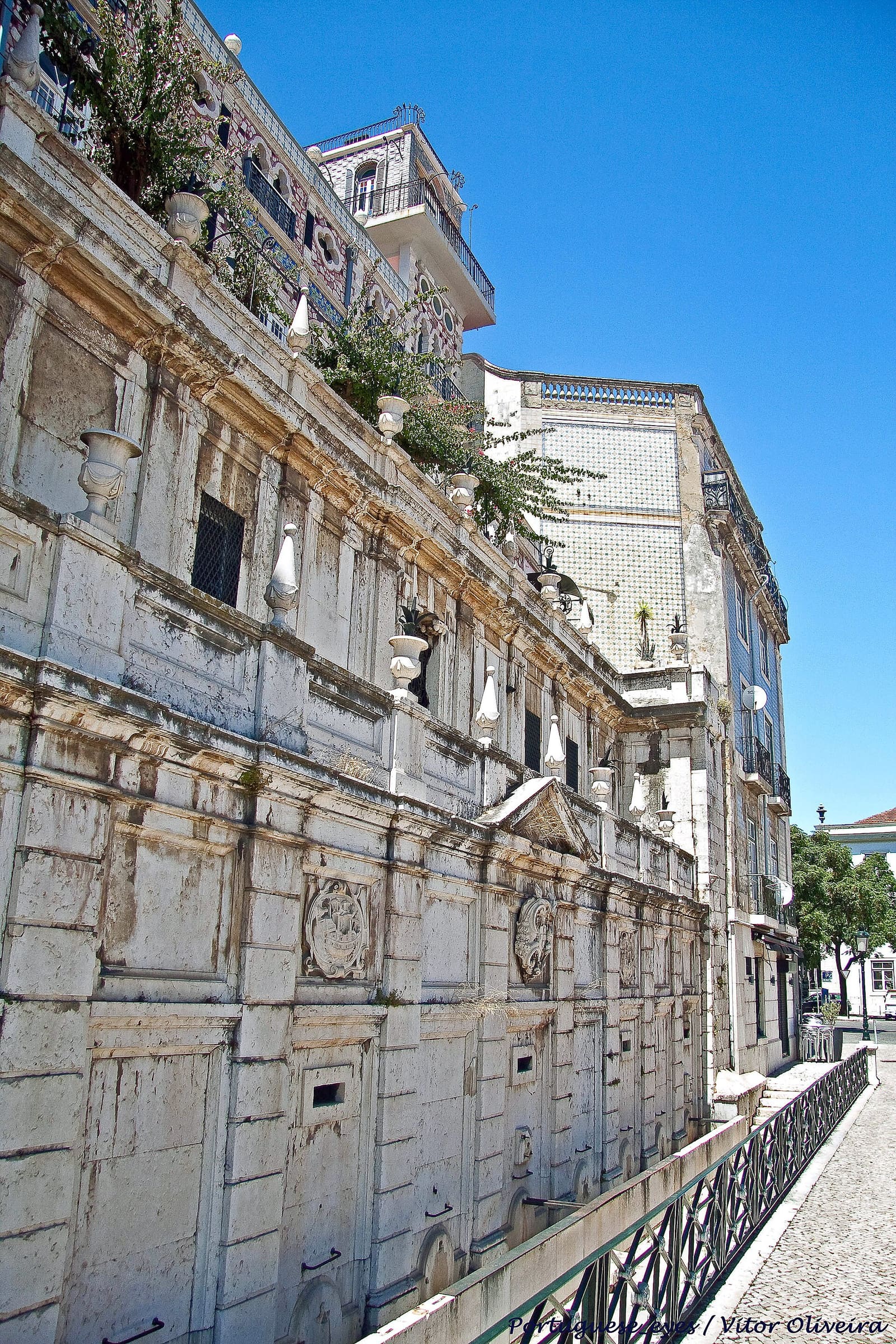
- Style
- Arquitetura hidráulica civil (gótica, manuelina, maneirista e barroca)
For centuries, fetching water was an everyday gesture that organised life in Portuguese settlements. Before household plumbing, drinking water reached the population at a fixed, public point — the fonte, the chafariz or the fontanário — around which people queued, exchanged news and kept to their routines. More than infrastructure, these structures were for a long time the true social centre of the streets and squares.
The very word chafariz preserves that antiquity. It derives from vulgar Arabic çahrij, which reached Portuguese through Hispanic Arabic sahríǧ, meaning cistern or reservoir. Only with time did the term slide from the water tank to the ornamental fountain that distributed it — a sign of how deeply the Islamic heritage shaped the culture of water on the Peninsula.
Fonte, chafariz and fontanário
Although they are often used as synonyms, the three terms correspond to distinct realities. The fonte is the broadest concept: it may designate the simple captured spring or a modest structure. The chafariz is the most monumental form — the terminal point of a supply conduit, normally fitted with several spouts and tiered basins that separated the water meant for people from that used to water the animals and wash the laundry. The fontanário, in turn, generally refers to the functional, plain version that proliferated in villages and, later, in the urban neighbourhoods of the nineteenth and early twentieth centuries.
The chafariz was the visible face of an invisible engineering: behind its spouts there often ran kilometres of conduits and galleries that brought the water by gravity from distant springs.
An engineering tied to the aqueducts
Great urban fountains rarely existed in isolation. They formed the public culmination of complete hydraulic systems which, in Antiquity and the Early Modern period, relied on the aqueducts to carry water by gravity over great distances. In Lisbon, the construction of the Águas Livres Aqueduct in the eighteenth century multiplied the city’s public fountains, which came to be supplied from the central reservoir of the Mãe d’Água. The fountain was thus the point where a work of engineering on a territorial scale finally became accessible to the gesture of whoever filled the pitcher.
Lisbon’s most celebrated example is the Chafariz d’El-Rei, in Alfama, regarded as the oldest in the city. Its waters were already being used in the thirteenth century, in the reigns of Afonso III and Dinis, and during the age of the Discoveries it was there that the ships bound for India took on drinking water before departing.
From carved stone to the memory of the villages
The evolution of fountains followed the history of Portuguese architecture. From the Gothic to the Manueline, from Mannerism to the Baroque, the public fountains were progressively covered with royal arms, armillary spheres, mascarons and spouts in the shape of animal heads. In the North, workshops of master stonemasons — such as that of João Lopes, the Elder, active in Ponte de Lima and Porto from the 1540s onwards — spread Renaissance taste through these works, making the fountain a privileged support for decorative sculpture in stone.
From the end of the nineteenth century, with the arrival of household water networks and, later, of the automobile, many of these structures became unnecessary and were dismantled or relocated. Those that survived, often classified and protected, continue to mark squares and church forecourts across the country. Like the watermills or the pillories, fountains and public fountains belong to a typology of civil heritage that, without ostentation, tells the history of communities — that of a need as elementary as water, resolved with ingenuity, stone and art.
Frequently asked questions
- What is the difference between a fonte, a chafariz and a fontanário?
- All three terms refer to structures for the public supply of water, but with nuances. The fonte is the broadest concept and may be no more than a captured spring. The chafariz is a monumental structure, the terminal point of a conduit, generally with several spouts and basins set at different levels in order to separate the water for people from that for animals. The fontanário is, as a rule, a more modest and functional version, common in villages and neighbourhoods.
- Where does the word chafariz come from?
- It comes from vulgar Arabic çahrij (by way of Hispanic Arabic sahríǧ), which meant cistern or reservoir. The term entered Portuguese during the Islamic presence on the Peninsula and only later came to designate the ornamental fountains that distributed water in settlements.
- What is the oldest fountain in Lisbon?
- The Chafariz d'El-Rei, in Alfama, is considered the oldest in the city. Its waters, captured on the slopes of Alfama, were already being used in the thirteenth century, during the reigns of Afonso III and Dinis, and for centuries supplied the ships that set sail for India.